ABB shifts industrial robot control to commercial tablets
The handheld E-Device interface supplies physical emergency stop controls across all OmniCore controllers, enabling plant operators to bypass proprietary teach pendants.
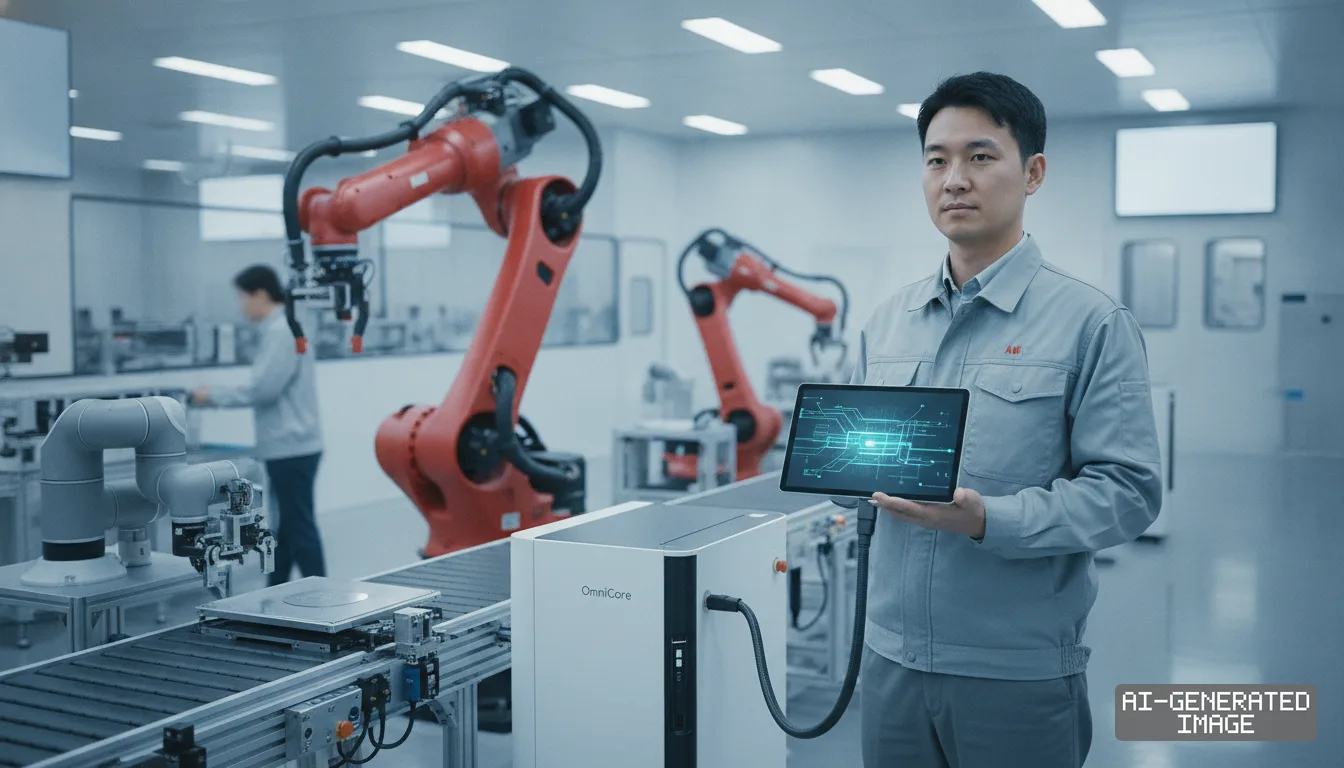
ABB Robotics released technical specifications on Sept. 29 for its E-Device safety interface, allowing commercial tablets and personal computers to operate industrial arms under ISO 10218:2025 rules.
The interface deploys across all five OmniCore controller models, bridging consumer hardware with industrial machines across 100% of the manufacturer's current robot and collaborative robot lineup.
ABB has not published retail pricing or quantitative cost-reduction figures, but replacing specialized handheld units with commercial screens targets significant capital savings across high-density automated plants.
Factory floors have traditionally relied on proprietary teach pendants — ruggedized handheld terminals equipped with hardwired safety switches — to program motion paths and configure joint coordinates.
The E-Device replaces the bulk of that dedicated hardware by functioning as a handheld physical safety interface that connects to an ordinary Windows tablet via USB-C.
The physical unit plugs directly into the FlexPendant receptacle on the front panel of the robot controller, preserving the hardwired emergency circuitry required by industrial codes.
Regulatory standards prohibit running primary safety functions purely through consumer touchscreens. The interface therefore houses a mechanical emergency-stop button, a normal stop button and a three-position enabling switch.
The three-position enabling switch — a spring-loaded deadman switch that halts machine motion if squeezed too hard or released — protects technicians during manual teaching inside cell perimeters.
Non-safety operational tasks, including trajectory programming, manual axis jogging and program verification, execute on the commercial tablet screen through the OmniCore User Interface software.
The combined hardware and software architecture complies with ISO 10218:2025, the updated international safety standard that governs industrial robot design, functional safety validation and collaborative operation.
ABB also completed compliance evaluations to secure CE conformity marking in the European Union and UL functional safety certification for industrial installations across North America.
The hardware interface links to compact controllers such as the OmniCore E10 and C30, as well as high-payload cabinet units including the C90XT, V250XT and V400XT.
Engineers using commercial tablets can access RobotStudio, ABB's offline simulation software, to model automated work cells and calculate cycle times before taking devices to the plant floor.
Technicians can also customize operator panels using AppStudio, a no-code software tool that builds application-specific interfaces for gluing, welding, machine tending and mobile phone display assembly.
Because configuration profiles remain stored inside the controller or on the mobile device, maintenance teams can disconnect a single tablet and service multiple robot work cells consecutively.
ABB Robotics framed the hardware introduction as a central step in expanding its Autonomous and Versatile Robotics initiative across global manufacturing networks.
Customers want solutions they can customize and scale without spending time learning new interfaces, Marc Segura, President of ABB Robotics, said in release documents.
A consistent user interface across diverse robot models reduces training requirements, simplifies field commissioning and accelerates production ramp-up, Segura said.
Operating the safety interface on existing OmniCore controllers requires upgrading system software from RobotWare 7 to RobotWare 8, according to technical compliance notices issued by the company.
Upgraded systems must retain their original European Union Machinery Directive declarations of incorporation and matching serial numbers to maintain verified functional safety compliance under the 2025 standard.
Tier-1 automotive parts suppliers and electronics contract manufacturers carry high exposure to the interface shift because both sectors retool modular assembly lines frequently to accommodate product redesigns.
In high-density facilities housing dozens of articulated arms, purchasing dedicated teach pendants for every station adds substantial capital expenditure to equipment budgets.
Proprietary pendants also present operational vulnerabilities on active shop floors, where dropped screens or frayed industrial cables cause unpredicted cell downtime and require costly specialized replacements.
Standardizing terminal hardware on commercial Windows devices allows plant IT teams to integrate robot control endpoints into corporate cybersecurity policies, automated backup systems and remote device management.
Technicians can keep electrical wiring schematics, standard operating procedures and inventory dashboards active on the same commercial tablet used to supervise robot routines.
However, plant operators must still maintain the physical USB-C tether between the tablet and the E-Device during manual motion teaching to keep the hardwired safety loop active.
The release documentation does not state unit purchase pricing, warranty periods or volume discount schedules for the E-Device hardware module.
Independent third-party conformity certificates covering manipulator safety compliance under ISO 10218-1:2025 are scheduled for publication following the formal rollout of RobotWare 8.0 in late 2026.
Impact map
How this development propagates across the region and out to global buyers.
| Event | Korea | China | Japan | Global impact |
|---|---|---|---|---|
| E-Device industrial robot control rollout | battery and display lines assess tablet controls to cut retooling capex | electronics assembly contractors test commercial PCs for multi-cell lines | robot makers evaluate tablet interfaces as pendant component costs rise | factory operators face lower training overhead across OmniCore fleets |
In this story
- Companies
- ABB
- Tickers
- ABBN.SW
- Policy
- Economic Security
- Impact
- CapexCost StructureCompliance
Track every Economic Security development →
Related briefings
- FANUC America links factory robots to Palladyne AI platform Also on ABB, Compliance, Cost Structure
- China Antimonopoly Review Imposes Harsher Operational Remedies on Automation Mergers Also on ABB, Compliance, Cost Structure
- IndexBox projects delta robot market will double by 2035 Also on ABB, Cost Structure
- ABB targets end-of-line palletizing with heavy-payload PoWa cobots Also on ABB, Cost Structure
Sources
Reporting
Confidence: medium — how we grade this
The documents behind this briefing are linked above. East Asia Brief produces its English text with AI assistance under human editorial review, and does not translate or republish other outlets' articles. See our methodology and AI policy. Spotted an error? Tell us.
The Morning Brief
What changed in Korean, Chinese and Japanese industry overnight — and what it means for your supply chain. One email, weekday mornings, US time. Free.
The Morning Brief is in preparation. Leave your address and we will write to you once — when the first issue is ready. Nothing before that.