ABB targets end-of-line palletizing with heavy-payload PoWa cobots
Industrial packaging lines adopt higher-payload collaborative arms as the global collaborative palletizing market expands toward $11.2 billion by 2036.
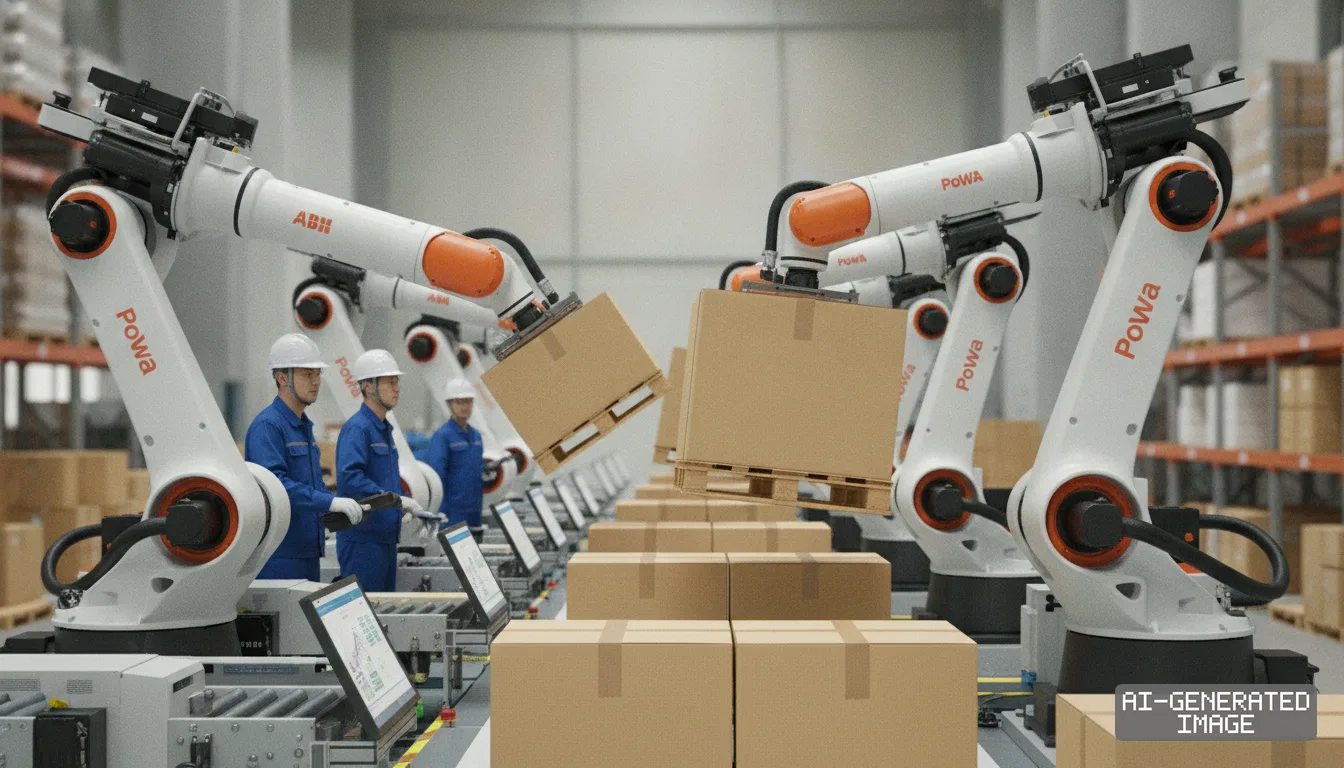
ABB positioned its high-payload PoWa collaborative robot lineup for end-of-line warehouse packaging on Sept. 15, targeting secondary logistics lines where chronic factory floor labor shortages have accelerated automation demand.
The Swiss automation group originally introduced the PoWa family on April 22 with six distinct payload classifications spanning 7 kg to 30 kg. That deployment envelope allows plants to handle heavy cartons without installing guarded perimeter cages.
The shift directly targets palletizing, a sector that research group Fact.MR valued at $2.4 billion in 2026. The broader collaborative palletizing segment is projected to expand to $11.2 billion by 2036, representing a 16.7% compound annual growth rate.
Cartons weighing between 10 kg and 20 kg represent 31.0% of the collaborative palletizing market in 2026. That segment has historically challenged traditional cobots because repeated lifting at high cycle speeds strains smaller joint gearboxes.
The PoWa series operates at rated payload speeds reaching 5.8 meters per second, the company said. Motion control runs through the company's OmniCore platform, which coordinates trajectory planning to prevent cargo slippage during high-speed swings.
ABB integrated Power and Force Limiting alongside Speed and Separation Monitoring safety systems. Those software controls permit the robot arm to work beside warehouse operators without physical metal fences.
Packaging facilities can complete initial unboxing, mounting and line commissioning in under 60 minutes, ABB said. The setup relies on Wizard Easy Programming, a visual software package that replaces proprietary code scripts with block commands.
The system architecture also connects directly with RobotStudio simulation tools. Engineering teams can test carton stacking geometry virtually before reconfiguring physical packing stations on the plant floor.
Logistics engineers have turned toward heavy cobots because manual lifting creates severe operational friction. Fact.MR estimates that manual stacking strain and warehouse turnover add 1.8 percentage points to annual market expansion.
Secondary packaging in food and beverage facilities contributes another 1.5 percentage points to category growth. These plants require compact equipment that fits existing layouts without consuming valuable floor square footage.
The competitive landscape for palletizing cobots has intensified across East Asia and Europe. Japanese robot builders have moved aggressively to secure high-payload end-of-line contracts.
FANUC widened its CRX collaborative series by qualifying the CRX-30iA arm for loads up to 40 kg in palletizing operations. The Japanese supplier bundles the machine with proprietary PalletTool and PalletPRO software suites.
Yaskawa Electric introduced its MOTOMAN-HC35 collaborative robot with a 35 kg payload and a 2,030 mm reach. The Japanese manufacturer designed the arm specifically for heavy packaging handling and automotive parts kitting.
Denmark-based Universal Robots fields its UR15 cobot with a 15 kg baseline rating that extends to 17.5 kg. Germany's KUKA competes in identical packaging channels with its LBR iisy robot family and FlexPal control software.
Plant managers select cobots over conventional industrial models because standard multi-axis arms demand dedicated security enclosures. Those mechanical fences expand facility footprints and prevent personnel from clearing occasional conveyor jams safely.
The PoWa platform utilizes built-in torque sensors and compact harmonic drive reducers to absorb contact forces instantly. The arm decelerates within milliseconds when human proximity sensors register workers inside the shared buffer zone.
Global robotic installations exceeded 542,000 units in 2024, topping the 500,000 mark for a fourth consecutive year, according to the International Federation of Robotics. End-of-line packaging lines represent a rising share of those installations.
ABB projects that total collaborative robot industry shipments will grow by 20% annually through 2028. That expansion outpaces growth in conventional caged machinery across automotive and heavy metal fabrication sectors.
Factory equipment buyers plan capital expenditures around specific commissioning calendars. Multi-site food and consumer goods processors face fourth-quarter deployment deadlines before peak shipping volumes commence in December.
The published documentation does not confirm whether ABB released a separate food-dedicated variant on Sept. 15, as that day's formal record was confined to an external market evaluation of the April rollout.
Initial production units of the CRB 1910 and CRB 1920 configurations began customer factory trials during the third quarter of 2026.
Impact map
How this development propagates across the region and out to global buyers.
| Event | Korea | China | Japan | Global impact |
|---|---|---|---|---|
| Heavy-payload cobot adoption | CJ Logistics and food processors test 20-30 kg cobots to offset aging distribution depot workforces | Domestic suppliers deploy hollow-shaft reducers to compete with ABB 30 kg payload capacity | FANUC and Yaskawa leverage domestic reducer suppliers to protect 35-40 kg palletizing market share | Secondary packaging lines reduce cell footprint by 40% by eliminating perimeter safety fencing |
| Heavy-payload cobot adoption | CJ Logistics and food processors test 20-30 kg cobots to offset aging distribution depot workforces | Domestic suppliers deploy hollow-shaft reducers to compete with ABB 30 kg payload capacity | FANUC and Yaskawa leverage domestic reducer suppliers to protect 35-40 kg palletizing market share | Secondary packaging lines reduce cell footprint by 40% by eliminating perimeter safety fencing |
In this story
- Companies
- ABB
- Tickers
- ABBN.SW
- Exposed
- FANUCYaskawa ElectricTeradyneKUKA
- Policy
- Economic Security
- Impact
- CapexSupply ChainCost Structure
Track every Economic Security development →
Related briefings
- Fanuc and Google launch AI welding robot to read blueprints Also on KUKA, ABB, Fanuc
- Estun Automation completes buyout of robotics unit Codroid Also on KUKA, ABB, Fanuc
- FANUC America links factory robots to Palladyne AI platform Also on KUKA, ABB, Yaskawa Electric
- FANUC UK restructures sales leadership to target aerospace and defense Also on KUKA, ABB
Sources
Reporting
Confidence: medium — how we grade this
The documents behind this briefing are linked above. East Asia Brief produces its English text with AI assistance under human editorial review, and does not translate or republish other outlets' articles. See our methodology and AI policy. Spotted an error? Tell us.
The Morning Brief
What changed in Korean, Chinese and Japanese industry overnight — and what it means for your supply chain. One email, weekday mornings, US time. Free.
The first issue goes out shortly. Sign up now and you will not miss it.