Samsung SDI clears UL fire safety test for utility LFP battery systems
The containerized SBB 2.0 system demonstrated zero fire propagation in testing, advancing plans to produce cells at its Indiana joint venture in the fourth quarter of 2026.
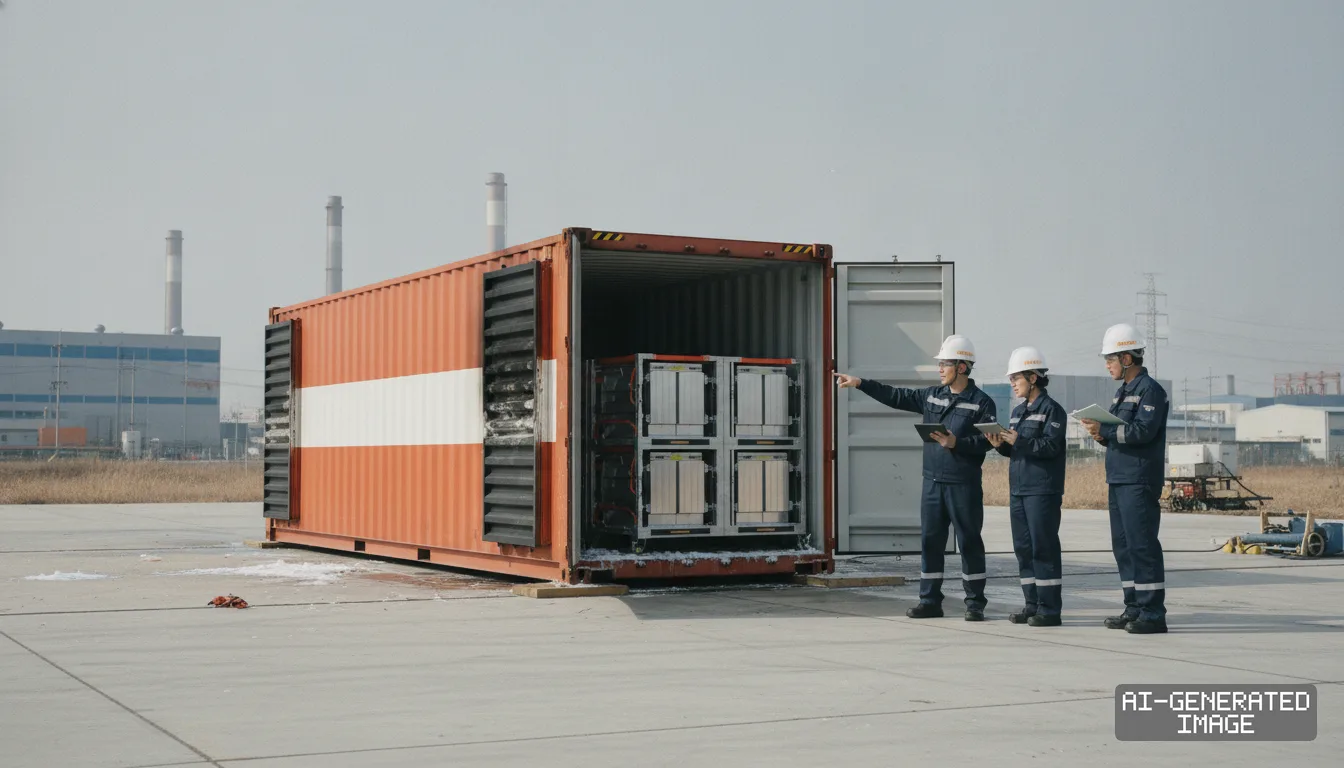
Samsung SDI said Sept. 28, 2026, that its containerized energy storage system, Samsung Battery Box 2.0, cleared the Large-Scale Fire Test conducted by UL Solutions.
The unit houses prismatic lithium iron phosphate cells inside a standard 20-foot shipping container. It represents the manufacturer's first commercial storage architecture built around the lower-cost iron-based chemistry.
Samsung SDI holds more than 3.5 trillion won ($2.6 billion) in North American energy storage contracts signed since December 2025, equal to roughly a quarter of its non-automotive order pipeline.
Safety certification firm UL Solutions evaluated whether an intentional internal thermal event could spread beyond the initial module. Engineers deliberately ignited a fire inside an operational container to observe containment behavior.
The thermal runaway remained entirely confined within the designated testing enclosure. Flames did not propagate to adjacent containers or adjacent battery racks during the trial.
The testing revealed no explosive gas releases, cabinet ruptures or combustible venting from the enclosure. The internal fire self-extinguished without requiring activation of external water sprinkler systems.
The outcome verified two proprietary hardware containment mechanisms developed by the South Korean manufacturer. Both systems aim to mitigate hazards associated with utility-scale energy storage deployments.
The first design, labeled No Thermal Propagation, relies on structural thermal insulation sheets between individual cells. The barrier stops heat transfer from triggering cascading thermal runaway in adjacent prismatic units.
The second system, termed Enhanced Direct Injection, dispenses extinguishing agents directly into affected battery modules. Automated sensors detect elevated cell temperatures and release suppressants before flames breach the structural casing.
Prismatic battery cells use rigid aluminum outer casings that resist physical deformation under high internal pressure. The metal enclosure incorporates integrated venting caps and mechanical fuses that vent pressure before structural walls fail.
Samsung SDI plans to assemble the certified storage systems at StarPlus Energy, its manufacturing joint venture with automaker Stellantis in Kokomo, Indiana.
Stellantis owns a 50% equity stake in the StarPlus Energy venture, which was originally developed to assemble traction batteries for electric passenger vehicles.
Weakening passenger electric vehicle demand prompted the partners to reassign factory floor space. Samsung SDI is converting three assembly lines at the Indiana facility toward stationary grid storage production.
One converted production line currently builds nickel-cobalt-aluminum storage batteries at an operational capacity of about 7 gigawatt-hours. The two remaining lines are undergoing retooling for prismatic lithium iron phosphate production.
Cathode producer L&F will provide cathode active materials for the Indiana storage lines under a 1.6 trillion won ($1.2 billion) contract signed in March 2026.
The three-year procurement agreement with L&F accounts for roughly 40% of the supplier's planned iron-phosphate cathode output. The arrangement provides Samsung SDI with an established upstream materials channel outside mainland China.
Chinese battery manufacturers Contemporary Amperex Technology and BYD control more than 75% of global lithium iron phosphate cell manufacturing. Chinese suppliers have long maintained an estimated 20% to 30% pricing advantage over South Korean competitors.
South Korean battery producers have struggled to match Chinese pricing on bare cell procurement costs. Samsung SDI is responding by marketing certified fire containment as an operational cost hedge for utility developers.
North American power utilities and municipal authorities enforce rigorous site permitting standards, including NFPA 855 installation rules. Passing large-scale propagation testing allows project developers to reduce inter-container spacing buffers on commercial project sites.
Denser site layouts lower balance-of-system civil construction spending for grid operators. The certification also reduces commercial property underwriting premiums and emergency response compliance burdens for utility sponsors.
The result marks Samsung SDI's second major fire containment validation this quarter. The company cleared an indoor large-scale fire evaluation for lithium manganese oxide uninterruptible power systems on July 14, 2026.
Samsung SDI first secured UL 9540A rack-level safety certification for its high-nickel nickel-manganese-cobalt storage chemistries in November 2019. It unveiled the physical container design for the SBB 2.0 system at the RE+ clean energy exhibition on Sept. 9, 2025.
Commercial commitments for the platform have expanded across the United States. Samsung SDI signed an initial supply agreement exceeding 2 trillion won ($1.5 billion) with an American grid developer in December 2025.
The company followed that transaction on March 16, 2026, with a 1.5 trillion won ($1.1 billion) contract through its Michigan subsidiary to deliver batteries through 2029.
Independent grid integrators that historically procured storage cells from Chinese vendors are evaluating alternative suppliers to diversify hardware sources. Rising United States tariff schedules on imported Chinese cells have compressed the price differential against domestic production.
The corporate announcement does not publish the specific UL Solutions certificate tracking number or listing reference code, and the testing record is not yet indexed on the public UL directory.
Samsung SDI said commercial mass production of the prismatic lithium iron phosphate cells will begin at the Indiana joint venture plant in the fourth quarter of 2026.
Impact map
How this development propagates across the region and out to global buyers.
| Event | Korea | China | Japan | Global impact |
|---|---|---|---|---|
| Utility LFP ESS Fire Test Clearance | Samsung SDI validates prismatic LFP safety, supporting $2.6 billion in US grid battery contracts | CATL and BYD face tighter fire-safety hurdles and tariff scrutiny in North American grid bids | Panasonic and component suppliers face rising competition for US utility-scale grid contracts | Grid operators reduce container separation buffers, lowering balance-of-system civil installation costs |
In this story
- Companies
- Samsung SDIStellantis
- Tickers
- 006400.KSSTLAM.PA
- Exposed
- Contemporary Amperex TechnologyBYD
- Policy
- Economic SecuritySubsidies
- Impact
- Supply ChainCapexOrder Book
Track every Economic Security development → Track every Subsidies development →
Related briefings
- BYD plans three European car plants to counter EU tariffs Also on Stellantis, BYD
- Samsung SDI restarts Synergy Cells investment for 2028 ramp Also on Stellantis, Samsung SDI, Order Book
- Innometry sweeps Samsung SDI US ESS battery inspection orders Also on Stellantis, Samsung SDI, Order Book
- CATL and Kuehne+Nagel agree on electric freight logistics Also on Stellantis, Contemporary Amperex Technology
Sources
Reporting
Confidence: medium — how we grade this
The documents behind this briefing are linked above. East Asia Brief produces its English text with AI assistance under human editorial review, and does not translate or republish other outlets' articles. See our methodology and AI policy. Spotted an error? Tell us.
The Morning Brief
What changed in Korean, Chinese and Japanese industry overnight — and what it means for your supply chain. One email, weekday mornings, US time. Free.
The Morning Brief is in preparation. Leave your address and we will write to you once — when the first issue is ready. Nothing before that.