POSCO Future M draws $336 million in orders for domestic bond issue
Institutional orders reached 4.5 times the target size on Nov. 4 as the South Korean battery materials maker moved to refinance short-term bank borrowings.
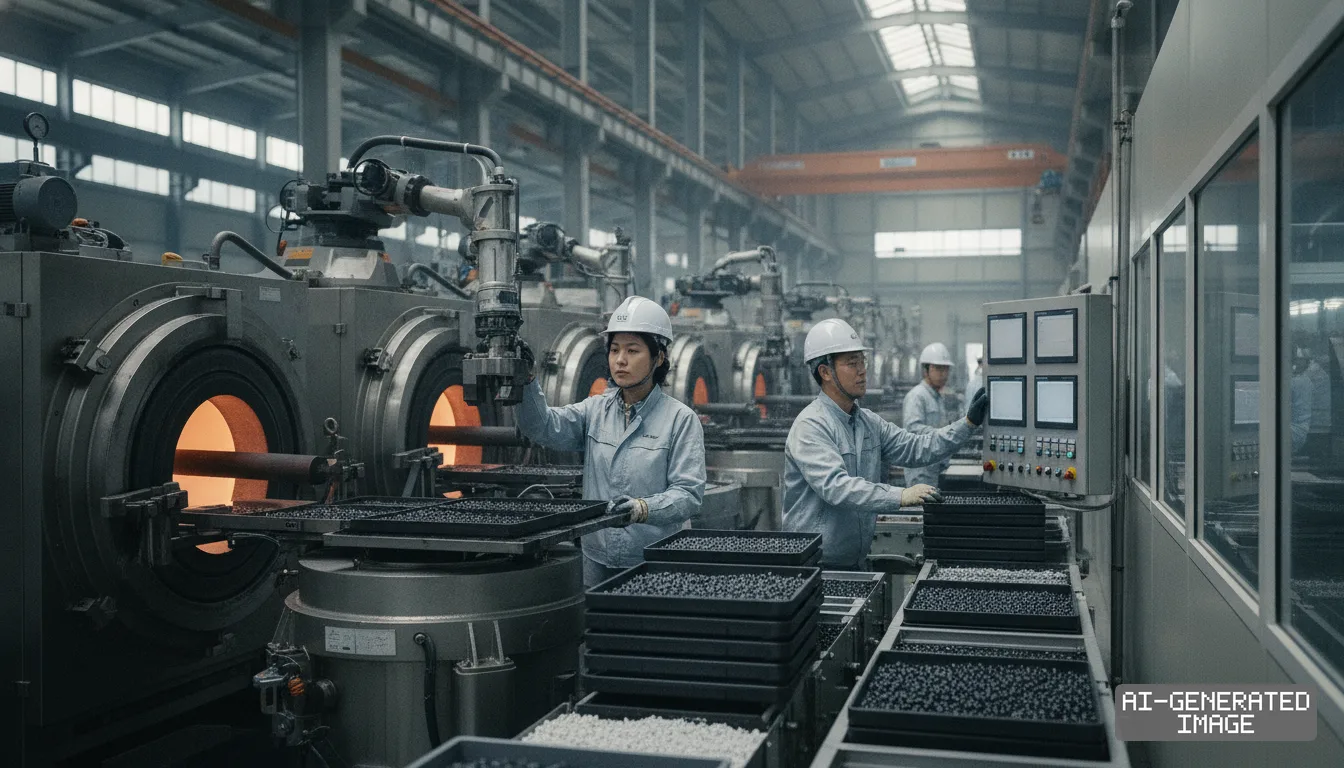
POSCO Future M secured 450 billion won ($336 million) in institutional bids on Nov. 4, 2026, oversubscribing its public corporate bond offering 4.5 times to refinance short-term bank borrowings.
The South Korean battery material producer initially offered 100 billion won ($74.7 million) across two tranches. The transaction represents the company's second tap of the domestic debt market this year.
Institutional investors placed 240 billion won ($179 million) in orders for the two-year tranche against an initial target of 40 billion won ($29.9 million). That tranche was six times oversubscribed.
Bids for the three-year tranche reached 210 billion won ($157 million) against a target of 60 billion won ($44.8 million). Demand for that tenor exceeded the targeted issuance volume by 3.5 times.
Both tranches cleared inside reference rates. The two-year paper priced at 10 basis points below the company's individual market reference yield, according to its regulatory filing.
The three-year notes cleared at four basis points below the benchmark yield. The pricing reversed the spread widening POSCO Future M encountered during its previous bond sale early in the year.
The company raised 250 billion won ($187 million) in January. That transaction closed with clearing yields 18 basis points and 24 basis points above reference rates on three-year and five-year tranches.
All proceeds from the latest debt sale will repay maturing bank credit lines. POSCO Future M has 100 billion won in bank loans coming due between Nov. 23 and Dec. 31, 2026.
Those bank credit facilities carry interest rates between 3.41% and 3.99% per annum. Replacing the credit lines with fixed-rate corporate paper locks in funding costs and lengthens debt maturities.
The transaction consists entirely of senior unsecured debt rather than hybrid capital securities. The company issued standard non-guaranteed corporate bonds through a public institutional bookbuilding process.
POSCO Future M submitted its initial securities registration statement for the offering to the Financial Supervisory Service on Nov. 2, 2026. The filing set an initial issuance cap of 100 billion won.
The company filed an amended registration statement on Nov. 6, 2026. That document finalized the subscription results and established the cleared credit spreads following the institutional demand forecast.
The registration filing includes a provision permitting the company to expand the total bond issuance to 200 billion won ($149 million). The expansion depends on institutional appetite and final funding decisions.
Five domestic brokerages managed the bond transaction as joint lead underwriters. The syndicate includes NH Investment & Securities, KB Securities, Korea Investment & Securities, Kiwoom Securities and Samsung Securities.
Korea Ratings affirmed POSCO Future M's credit rating at AA- with a stable outlook on Oct. 28, 2026. The agency cited the company's market position in cathode materials and operational backing.
Parent company POSCO Holdings owns 59.7% of POSCO Future M. The industrial group provides access to raw material inputs, including refined lithium and nickel feedstocks for cathode production.
Battery material manufacturers face tighter cash generation across South Korea as global electric vehicle adoption slows. The cyclical pause has led material suppliers to preserve cash and curtail discretionary spending.
POSCO Future M operates major cathode and anode plants in Gwangyang and Pohang. The facilities supply nickel-rich cathode active materials to cell makers including LG Energy Solution and Samsung SDI.
Capital expenditure commitments for precursor synthesis and active material lines have increased POSCO Future M's net borrowings over the past eight quarters, according to company financial disclosures.
Total borrowings rose as the manufacturer expanded production capacity to meet multi-year cell supply agreements. Managing debt maturities has become a primary operational priority for financial planners across the group.
The company selected shorter maturities for the November offering to match bank repayment schedules. Two-year and three-year corporate paper drew stronger buy-side participation than longer tenors among asset managers.
Korean institutional demand has concentrated in high-grade corporate credits rated AA- and above. Portfolio managers have deployed cash into benchmark industrial names while avoiding lower-rated mezzanine instruments.
The debt issuance closes and settles on Nov. 12, 2026. Proceeds will transfer to designated repayment accounts ahead of the first bank loan maturity date on Nov. 23, 2026.
The regulatory filing does not state whether POSCO Future M will exercise its option to upsize the issuance to 200 billion won, or if it will keep the offering at 100 billion won.
Impact map
How this development propagates across the region and out to global buyers.
| Event | Korea | China | Japan | Global impact |
|---|---|---|---|---|
| POSCO Future M corporate bond refinancing | POSCO Future M secures 450 billion won in bids to replace bank credit lines due late 2026 | No exposure, cathode competitors CXMT and BTR operate separate domestic funding lines | No direct debt market exposure, Japanese cathode suppliers Sumitomo Metal Mining rely on commercial paper | Electric vehicle battery cell manufacturers maintain contracted material flow without supplier credit disruption |
In this story
- Companies
- POSCO Future M
- Tickers
- 003670.KS
- Exposed
- LG Energy SolutionSamsung SDIPOSCO Holdings
- Impact
- Cost StructureCompliance
Related briefings
- Posco Holdings starts direct lithium extraction test runs for Korean cathode lines Also on Posco Holdings, Posco Future M, Samsung SDI
- POSCO Future M signs $776M LFP cathode supply deal with SK On Also on POSCO Holdings, POSCO Future M, Samsung SDI
- POSCO Future M profit rebounds 23% as cathode shipments rise Also on POSCO Holdings, POSCO Future M, Samsung SDI
- POSCO Future M Pursues 1.2M Tons of Orders for 2028 Recovery Also on POSCO Holdings, POSCO Future M, Samsung SDI
Sources
Primary documents
Reporting
Confidence: high — how we grade this
The documents behind this briefing are linked above. East Asia Brief produces its English text with AI assistance under human editorial review, and does not translate or republish other outlets' articles. See our methodology and AI policy. Spotted an error? Tell us.
The Morning Brief
What changed in Korean, Chinese and Japanese industry overnight — and what it means for your supply chain. One email, weekday mornings, US time. Free.
The Morning Brief is in preparation. Leave your address and we will write to you once — when the first issue is ready. Nothing before that.