EU weighs black mass export curbs as 60% of battery scrap exits
More than 60% of European battery scrap currently ships to Asian refiners, prompting regulators to safeguard feedstocks before regional hydrometallurgy expands.
The European Commission began reviewing broader export restrictions on battery scrap and black mass on Nov. 27, 2026, targeting trade flows to China.
The policy review seeks to prevent critical mineral leakages before European hydrometallurgical refining capacity expands. More than 60% of European black mass currently departs the internal market for commercial processing facilities across Asia.
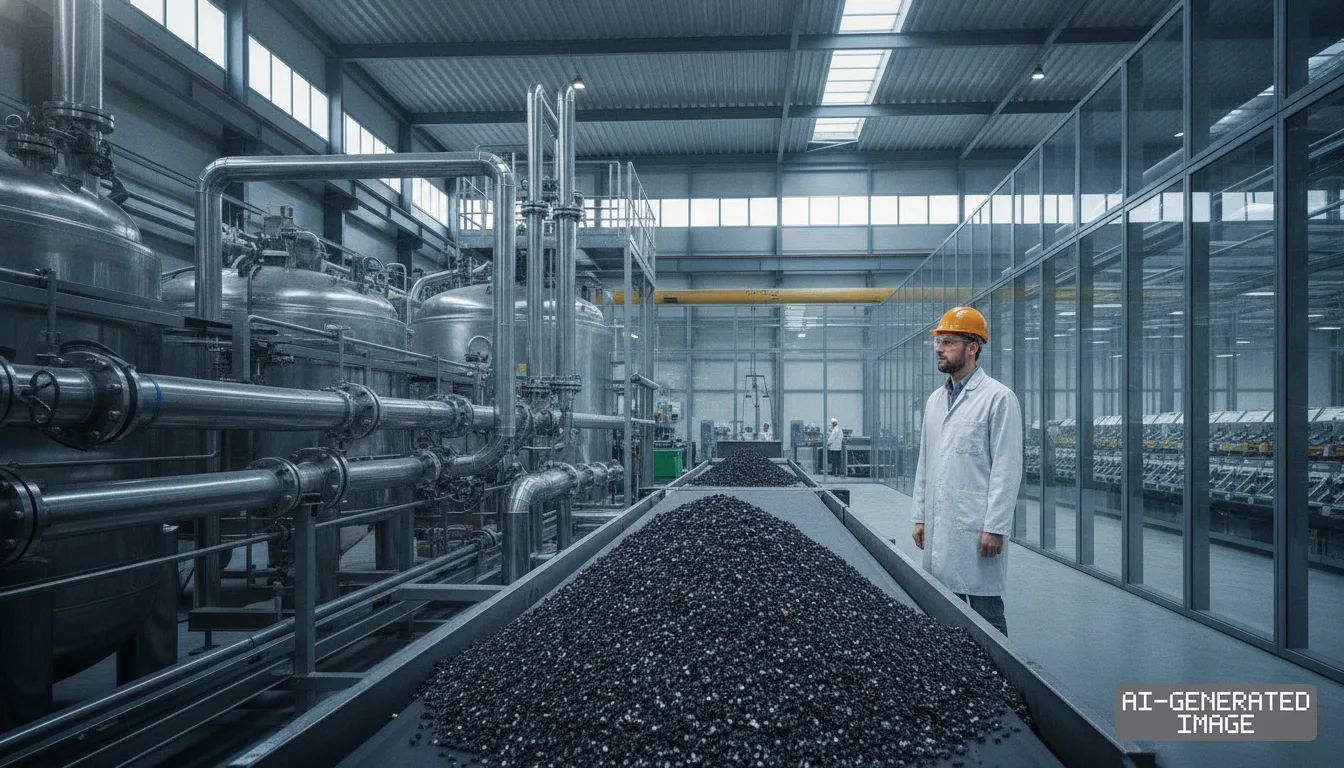
Black mass is the dark powdered substance produced after discharging, shredding and sieving end-of-life battery cells and production scrap. One tonne of spent lithium-ion battery packs yields roughly 400 kilograms of this metal-bearing material.
The powdered mixture contains high concentrations of valuable critical raw materials, including lithium, nickel, cobalt, manganese and graphite. Securing this secondary material is vital for European battery makers seeking to meet mandatory recycled content rules.
Internal research conducted by the European Commission's Joint Research Centre indicates that recycling 50% to 65% of domestic black mass within the European Union could supply cathode metals for 1 million electric vehicles annually.
European officials are assessing whether to incorporate strict scrap retention instruments into the upcoming Circular Economy Act. The forthcoming legislative package intends to establish enforceable regulatory safeguards to keep secondary resources inside the single market.
The regulatory reassessment builds on an established trade curb scheduled to take effect across the bloc on Dec. 9, 2026. That measure will prohibit exports of hazardous battery scrap to non-OECD jurisdictions.
Brussels formalized that classification through Commission Delegated Decision (EU) 2025/934, adopted on March 5, 2025. The decision updated Decision 2000/532/EC, which establishes the official European List of Waste.
The delegated decision introduced seven distinct hazardous waste codes for black mass, designated as 19 14 01* through 19 14 07*, organized by chemical composition. It additionally assigned code 16 06 07* to spent lithium-based batteries.
Those hazardous listings trigger the export bans set forth in Regulation (EU) 2024/1157, the Waste Shipment Regulation. Article 39 of that statute forbids the shipment of hazardous waste for recovery operations in non-OECD countries.
Because China is not an OECD member, the Dec. 9 mandate legally halts direct scrap exports to Chinese recycling installations. However, European authorities are concerned that traders will bypass the restriction through OECD member nations.
Waste shipments to OECD partners remain permitted under prior written notification and consent procedures. Industry trade flows indicate that substantial scrap consignments shipped to OECD hubs like South Korea can undergo secondary processing before reaching China.
China altered its import landscape on Aug. 1, 2025, by enacting national standard GB/T 45203-2024. That regulatory revision reclassified black mass with combined nickel and cobalt concentrations of 25% or higher as raw material products.
By lifting solid waste import barriers for qualifying materials, Beijing opened direct channels for Chinese refiners. China accounts for most global hydrometallurgical processing capacity, enabling its domestic plants to operate with lower costs and higher recovery efficiencies.
Those operational cost advantages allow Chinese buyers to pay higher procurement prices for European battery scrap. European recycling operators argue that scrap price competition threatens to leave regional facilities without sufficient feedstock to maintain commercial operations.
European industrial groups have urged Brussels to introduce defensive trade policies to support domestic circularity. French waste management group Veolia inaugurated a specialized battery recycling facility in Amnéville, France, on Nov. 12, 2026, demanding stronger market safeguards.
Veolia Chief Executive Estelle Brachlianoff said European preference rules and tighter export curbs are necessary to protect investments. European Commission Executive Vice-President Stéphane Séjourné confirmed the implementation of the Dec. 9 ban during the Amnéville event.
The European Commission signaled its intention to monitor export leakage in its RESourceEU action plan, released in December 2025. In document COM(2025) 945 final, the Commission pledged to propose additional trade restrictions if leakages continued.
Under Regulation (EU) 2023/1542, the European Union Battery Regulation, electric vehicle battery manufacturers must satisfy mandatory recycled content quotas by 2031. Those quotas require specific minimum levels of recovered cobalt, lithium and nickel in newly manufactured batteries.
Automakers manufacturing vehicles within the European Union depend on localized refining to obtain compliant secondary materials. Losing black mass volumes to Asian competitors risks making European cell producers dependent on imported battery-grade salts that originated from European scrap.
Environmental authorities in several member states have voiced concern over stockpiling risks if export barriers outpace regional hydrometallurgical refining capacity. European refining plants currently lack the scale required to process all locally generated scrap immediately.
The European Commission has not published the draft text of the Circular Economy Act or specified whether the proposal will restrict shipments to OECD trading partners.
The European Commission is scheduled to publish its formal legislative proposal for the Circular Economy Act on Dec. 15, 2026, opening review proceedings with the European Parliament and the Council of the European Union.
Impact map
How this development propagates across the region and out to global buyers.
| Event | Korea | China | Japan | Global impact |
|---|---|---|---|---|
| EU battery scrap export controls | OECD scrap imports face tighter documentation under PIC, monitoring bridgehead trade | Non-OECD ban cuts direct black mass imports on Dec. 9, 2026, forcing reliance on domestic scrap | OECD trade status preserves scrap flows subject to prior notification rules | EV battery material supply chains split as EU retains feedstock for domestic hydrometallurgy |
In this story
- Companies
- Veolia
- Tickers
- VIE.PA
- Policy
- Export ControlsStandards
- Impact
- Supply ChainCompliance
Track every Export Controls development → Track every Standards development →
Related briefings
- US signs multilateral AI supply chain pact with eight allies Also on Standards, Export Controls, Compliance
- China Rare Earth Group tightens southern clay mining with MCC pact Also on Standards, Export Controls, Compliance
- China brings rare earth industry body under direct Communist Party rule Also on Standards, Export Controls, Compliance
- Factory robot benchmark pivots hardware evaluation to setup speed Also on Standards, Compliance
Sources
Primary documents
Reporting
Confidence: high — how we grade this
The documents behind this briefing are linked above. East Asia Brief produces its English text with AI assistance under human editorial review, and does not translate or republish other outlets' articles. See our methodology and AI policy. Spotted an error? Tell us.
The Morning Brief
What changed in Korean, Chinese and Japanese industry overnight — and what it means for your supply chain. One email, weekday mornings, US time. Free.
The Morning Brief is in preparation. Leave your address and we will write to you once — when the first issue is ready. Nothing before that.