BYD buffers 1.5 MW charging stations with 370 kWh battery packs
The 370-kilowatt-hour lithium iron phosphate battery buffers cap utility peak demand at 560 kilowatts, delivering 1,500 kilowatts without direct substation overhauls.
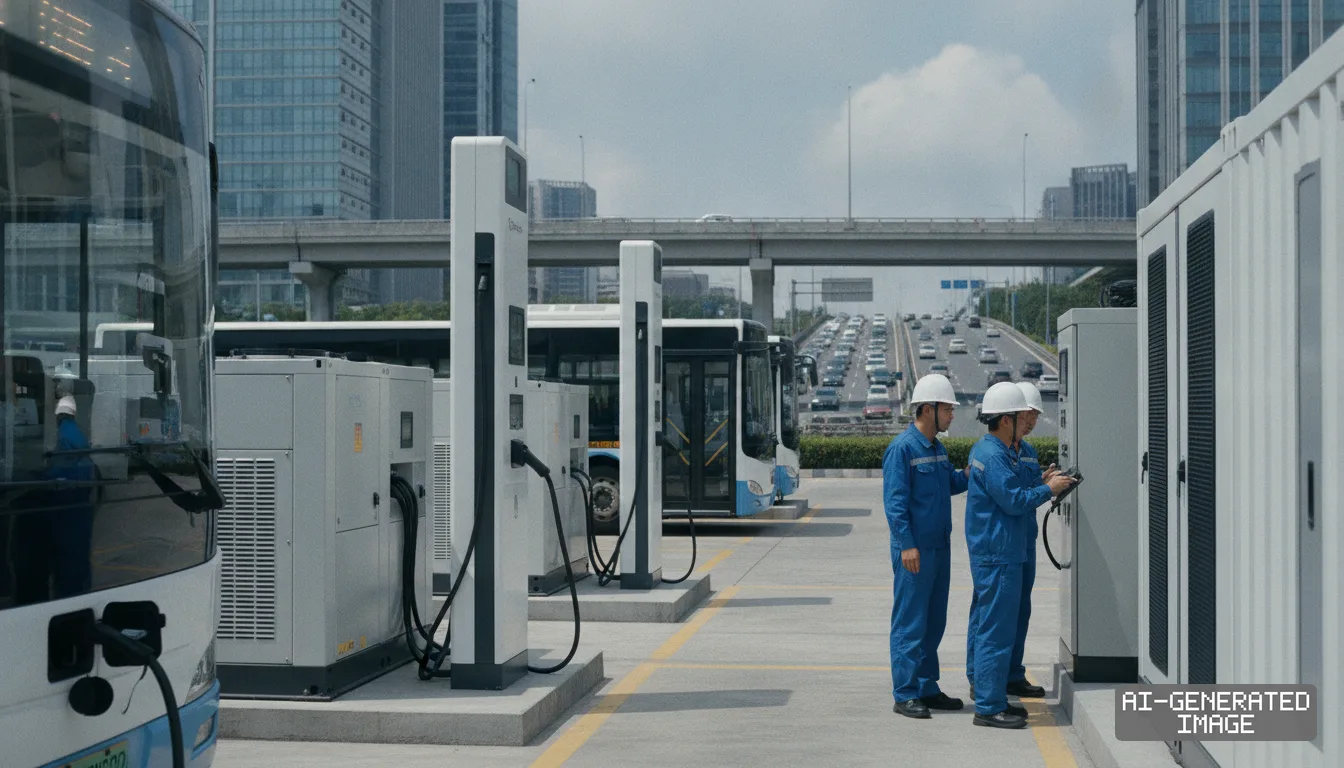
BYD advanced commercial deployment of its megawatt-scale Flash Charging network with integrated stationary storage systems on Nov. 27, 2026, targeting transmission bottlenecks across high-traffic transit corridors.
The Shenzhen-based automaker, the world's largest producer of new energy vehicles, is combining ultra-fast vehicle dispensers with stationary batteries to bypass costly electrical substation upgrades.
Each terminal delivers up to 1,500 kilowatts at 1,000 volts, backed by an on-site 370-kilowatt-hour lithium iron phosphate storage buffer. Drawing 100 to 560 kilowatts from the grid, the buffer caps peak utility demand at 37% of terminal output.
Traditional direct-current fast chargers pull peak load straight from utility lines during vehicle hookup. In contrast, BYD trickle-charges stationary batteries during idle intervals and discharges bursts of high-amperage current when compatible vehicles arrive.
Compatible passenger cars built on BYD's 1,000-volt platform accept charging currents of up to 1,000 amperes. The high flow replenishes battery capacity from 10% to 70% in five minutes, or 97% in nine minutes, under standard testing conditions.
The hardware relies entirely on in-house manufacturing, spanning battery cells, power electronics and control software. BYD documented full internal sourcing of the energy storage stack in its 2026 interim financial report filed on Aug. 28.
The stationary unit incorporates BYD's large-capacity 2,710-ampere-hour Blade Battery cells, engineered specifically for stationary utility duties. The cells utilize lithium iron phosphate chemistry to deliver extended cycle life and thermal stability during repeated deep discharges.
Power conversion relies on the company's proprietary GC Flux power conversion system, which synchronizes alternating-current grid intake with direct-current vehicle output. Operational software runs on BYD's GC Master energy management system to balance real-time grid draw against vehicle demand.
This full vertical integration insulates BYD from third-party component bottlenecks. It also lowers equipment procurement costs compared to competing charging operators that assemble subsystems from disparate power electronics suppliers.
Grid stress has emerged as the primary constraint on high-power charging corridors across East Asia. Installing multi-dispenser megawatt plazas typically requires local utilities to lay dedicated medium-voltage feeders and add heavy step-down transformers.
BYD avoids feeder expansion by sizing standard grid connections to commercial baseload levels. The 370-kilowatt-hour storage buffer acts as an electrical shock absorber, ensuring that substation demand remains steady even during simultaneous vehicle charging events.
Domestic deployment has expanded rapidly through land-sharing partnerships with state petroleum distributors. BYD reached 10,000 operational Flash Charging stations across China in September 2026 through joint infrastructure pacts with Sinopec and PetroChina.
Sinopec operates more than 30,000 retail filling stations across China, offering existing forecourt land that BYD utilizes for turnkey charger installations. The partnership aims to double the network to 20,000 operational stations before the end of 2026.
Overseas deployment has begun in Southeast Asia through utility partnerships. In Malaysia, clean energy operator Gentari, a subsidiary of state oil company Petronas, activated three Flash Charging sites at Denza showrooms on Nov. 19, 2026.
Gentari operates an existing public footprint of more than 600 charging points in Malaysia. The company plans to deploy 12 BYD Flash Charging stations by the end of 2026 before expanding the network to 130 highway locations by 2027.
European expansion will follow a similar land-partner model. BYD executives outlined plans at the Paris Auto Show to commission 100 flash chargers in Europe by late 2026, scaling to 3,000 storage-backed units by the end of 2027.
Government filings do not show a newly approved standalone pilot project on Nov. 27, 2026. The technical validation underway reflects operational testing at commercial stations deployed under existing municipal permits.
Network rollout schedules remain tied to published calendar targets. BYD plans to reach 20,000 operational flash stations in China by Dec. 31, 2026, while Gentari begins site surveys for Malaysian highway plazas in the first quarter of 2027.
Terminal access remains open to non-BYD vehicles, though charging speeds drop according to each vehicle's onboard voltage ceiling. The company is outfitting all new Denza Z9GT and Denza D9 models with compatible liquid-cooled battery packs.
Impact map
How this development propagates across the region and out to global buyers.
| Event | Korea | China | Japan | Global impact |
|---|---|---|---|---|
| BESS-buffered megawatt charging rollout | Hyundai and SK Signet face higher export bar on ultra-fast hardware integration | BYD scales 20,000-station network with Sinopec, bypassing transformer queues | Toyota and e-Mobility Power maintain 150 kW grid-tied units, lagging 10C rates | Charging operators face capex shift toward stationary storage to offset grid connection delays |
In this story
- Companies
- BYDSinopecGentari
- Tickers
- 002594.SZ1211.HK600028.SS
- Exposed
- PetroChina
- Policy
- StandardsProcurement Rules
- Impact
- Supply ChainCapexCost Structure
Track every Standards development → Track every Procurement Rules development →
Related briefings
- US House advances 100% tariff bill on Russian crude buyers Also on PetroChina, Sinopec, Cost Structure
- China Gas buys US LNG from Venture Global under 20-year pact Also on PetroChina, Sinopec
- BYD and Gentari Detail 1.5MW EV Flash Charging Push Across Malaysia Also on Gentari, BYD, Standards
- Trump signs sanctions act authorizing 100% tariffs on oil buyers Also on Sinopec, Cost Structure
Sources
Primary documents
Reporting
Confidence: high — how we grade this
The documents behind this briefing are linked above. East Asia Brief produces its English text with AI assistance under human editorial review, and does not translate or republish other outlets' articles. See our methodology and AI policy. Spotted an error? Tell us.
The Morning Brief
What changed in Korean, Chinese and Japanese industry overnight — and what it means for your supply chain. One email, weekday mornings, US time. Free.
The Morning Brief is in preparation. Leave your address and we will write to you once — when the first issue is ready. Nothing before that.