BYD targets UK coach market to sidestep European car tariffs
The Chinese automaker prepares British deliveries of a bespoke battery coach while commercial vehicles remain exempt from the European Union's 35.3% passenger EV duties.
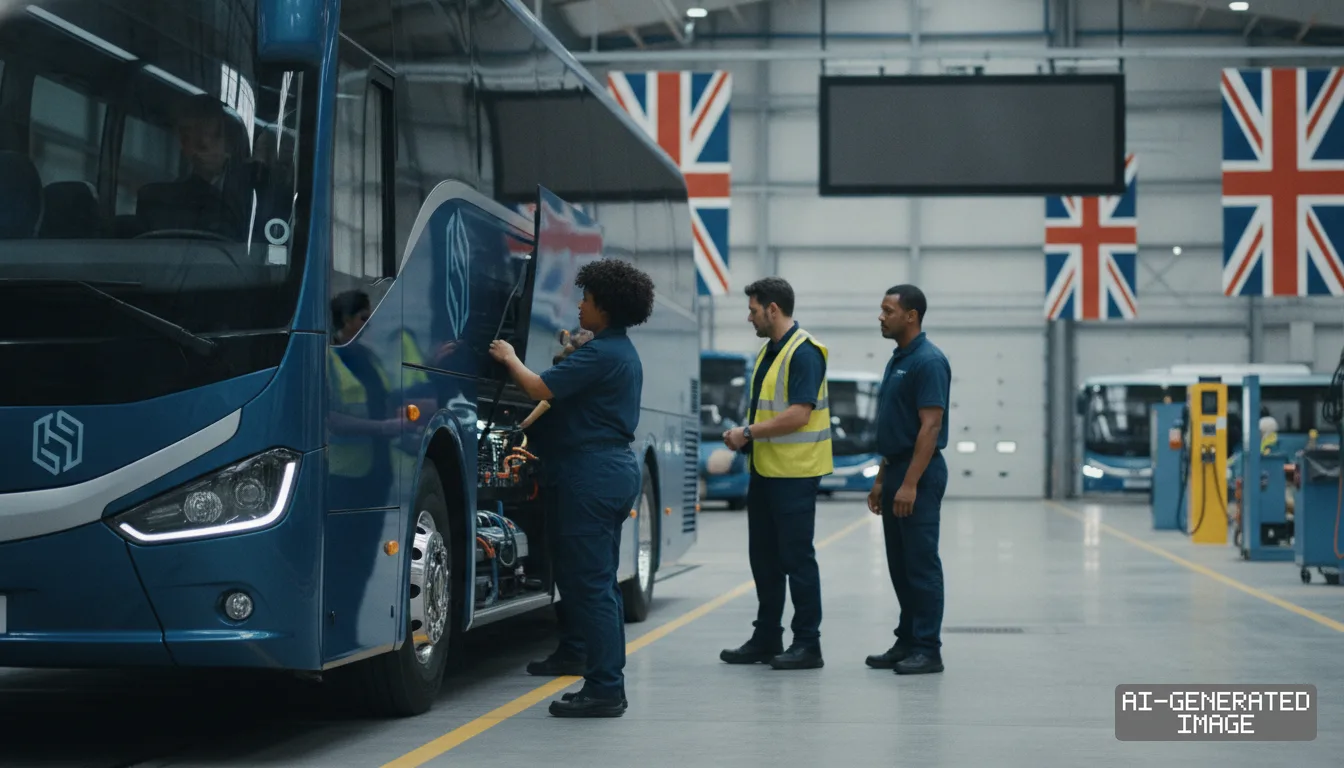
BYD advanced its commercial vehicle expansion into the British market on Oct. 30, 2026, preparing to introduce a dedicated battery-electric coach while sidestepping European tariffs on passenger electric vehicles.
The move extends the presence of the Shenzhen-based automaker beyond municipal transit contracts into private travel operations across the United Kingdom. Private tour fleets represent an unpenetrated segment for imported zero-emission commercial platforms.
The commercial bus segment allows Chinese manufacturers to avoid European countervailing duties of up to 35.3% on passenger cars. BYD is focusing instead on fleet procurement, where it already accounts for more than 1,500 electric transit buses operating in Britain.
European Union trade regulators finalized countervailing duties on Chinese passenger electric vehicles earlier this month. The measures left heavy commercial vehicles, including long-distance coaches and urban transit buses, entirely exempt from supplemental tariff penalties.
British bus procurement relies on competitive tenders organized by regional transport authorities and private fleet conglomerates. These commercial buyers prioritize total cost of ownership and delivery speed over vehicle assembly origin.
Domestic vehicle manufacturers face direct pressure from the expansion. Alexander Dennis Limited, a subsidiary of Canada's NFI Group, placed up to 160 assembly jobs at risk at its Falkirk plant following rising procurement of Chinese bus chassis.
Alexander Dennis assembled more than 1,500 electric buses in a decade-long partnership with BYD. The British builder supplied the bodywork while BYD provided lithium-iron-phosphate battery packs and chassis drivelines.
BYD ended its chassis-only reliance by designing complete vehicles for British operators. The manufacturer launched the BD11 double-decker bus earlier this year, using proprietary chassis construction with integrated Blade battery systems.
The planned coach represents an extension of this direct vehicle strategy. BYD Commercial Vehicle UK Managing Director Frank Thorpe said the new vehicle was engineered specifically for British road regulations rather than modified from overseas variants.
British coach specifications require narrow vehicle envelopes and distinct seating configurations compared to continental models. BYD plans to use the existing electric bus powertrain to speed regulatory approval and simplify fleet spare parts logistics.
British labor unions and domestic bus builders have urged the government to enforce local content rules. Transport Secretary Louise Haigh convened an industry panel to assess strategies for safeguarding domestic manufacturing after domestic suppliers lost market share to imported platforms.
The commercial coach sector operates with different financing mechanics than urban bus routes. Municipal transit authorities subsidize city buses directly, whereas coach operators purchase equipment using commercial bank leasing and private fleet reserves.
Chinese battery technology gives BYD a production cost advantage over European chassis assemblers. BYD manufactures its own battery cells, silicon carbide power modules and traction motors, cutting supply chain overhead across its commercial division.
The company differentiates its heavy platforms through proprietary structural battery integration. Its commercial chassis incorporates lithium-iron-phosphate Blade batteries directly into the frame, increasing torsional stiffness while lowering vehicle center of gravity by 40%.
The company pairs its structural battery packs with six-in-one integrated power controllers using silicon carbide semiconductors. These power modules achieve 99.5% operating efficiency, extending driving range without requiring oversized battery packs that reduce passenger payload capacity.
Commercial operators adopted BYD platforms early in the United Kingdom. Go-Ahead London converted its Waterloo depot to full electric operation in 2016 using 51 BYD electric single-deckers, establishing the first fully electrified bus garage in Europe.
Fleet operator Go-Ahead London holds contracts for more than 500 electric buses supplied through BYD platforms. Repeat fleet orders from major private operators have established long-term maintenance relationships and service software installations across depot networks.
Transit operators across the region are accelerating zero-emission fleet acquisitions to meet statutory carbon reduction deadlines. London plans to make its entire public bus network zero-emission by 2037, driving sustained orders for high-capacity battery vehicles.
Continental expansion is planned to follow the British rollout. Horst Woitschig, head of sales for BYD Europe in German-speaking markets, said the company plans to introduce a 12-meter electric coach to mainland Europe in 2027.
The continental vehicle targets an operating range of at least 600 kilometers on a single charge. BYD is evaluating an extended 15-meter three-axle version for high-density intercity routes across Germany, Austria and Switzerland.
Assembly for continental European units is slated for BYD's existing plant in Komarom, Hungary. Localizing heavy vehicle assembly within the European Union protects the manufacturer against prospective commercial tariffs and lowers cross-border logistics costs.
European competitors have begun responding with dedicated battery-electric coach platforms. Daimler Buses and Swedish builder Scania are testing long-distance electric prototypes to preserve market share in municipal express and private charter transport.
Charging infrastructure remains the principal operational constraint for electric coaches. Urban transit buses charge overnight at centralized municipal depots, while long-distance tour operators require high-power megawatt charging along highway corridors and interchange hubs.
The exemption of commercial buses from recent trade measures provides Chinese commercial vehicle makers an unimpeded channel into Europe. While automotive tariffs restrict consumer car sales, institutional bus fleets continue purchasing zero-emission vehicles on capital cost and delivery schedules.
The manufacturer has not published technical specifications, pricing or formal delivery contracts for the British coach model, and official registration documents for the vehicle remain unreleased.
Transit buyers will review the manufacturer's near-term fleet pipeline at the Euro Bus Expo in Birmingham from Nov. 3 to Nov. 5, where BYD will display its commercial city buses ahead of next year's coach deployment.
Impact map
How this development propagates across the region and out to global buyers.
| Event | Korea | China | Japan | Global impact |
|---|---|---|---|---|
| BYD electric coach expansion | battery suppliers face expanding Chinese LFP commercial competition | BYD secures tariff-free heavy vehicle sales channel across Europe | commercial chassis builders face increased fleet bidding pressure | European transit operators gain lower-cost zero-emission coach alternatives |
In this story
- Companies
- BYD
- Tickers
- 002594.SZ
- Exposed
- Alexander DennisNFI Group
- Policy
- TariffsSubsidies
- Impact
- Supply ChainOrder Book
Track every Tariffs development → Track every Subsidies development →
Related briefings
- China battery exports jump 36% as makers build plants abroad Also on BYD, Tariffs, Subsidies
- CATL Surpasses Korean Battery Trio in Markets Outside China Also on BYD, Tariffs, Subsidies
- Chinese EVs capture 35% Korea market share under 8% tariff Also on BYD, Tariffs, Subsidies
- BYD opens orders for second-gen Seal 07 with rooftop LiDAR Also on BYD, Tariffs, Subsidies
Sources
Reporting
Confidence: medium — how we grade this
The documents behind this briefing are linked above. East Asia Brief produces its English text with AI assistance under human editorial review, and does not translate or republish other outlets' articles. See our methodology and AI policy. Spotted an error? Tell us.
The Morning Brief
What changed in Korean, Chinese and Japanese industry overnight — and what it means for your supply chain. One email, weekday mornings, US time. Free.
The Morning Brief is in preparation. Leave your address and we will write to you once — when the first issue is ready. Nothing before that.