CATL Surpasses Korean Battery Trio in Markets Outside China
The Chinese cell giant captured 33.7% of non-China electric vehicle battery usage through August 2026 as South Korean competitors dropped to 26.8% on a 46.5% North American collapse.
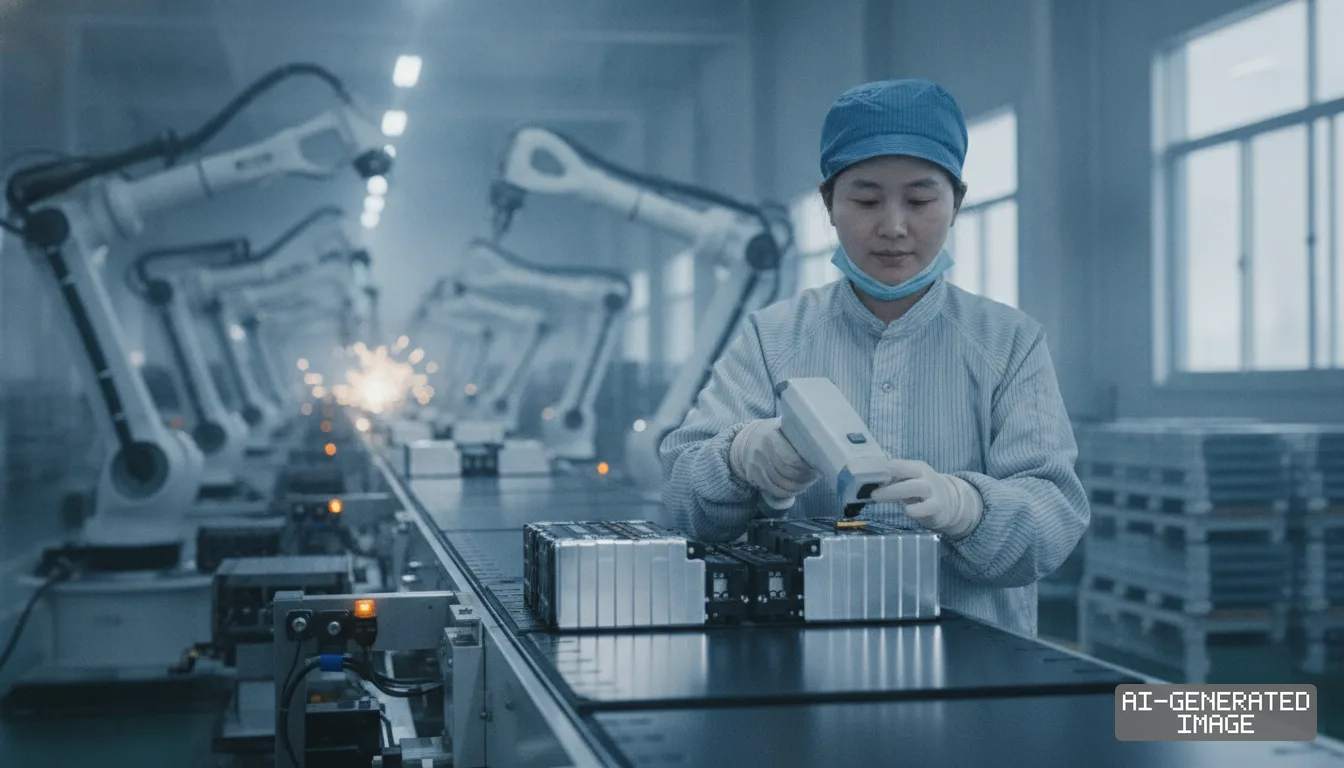
SNE Research reported Oct. 7, 2026, that Contemporary Amperex Technology captured 33.7% of the global electric vehicle battery market outside China, surpassing all three South Korean manufacturers combined.
The Seoul research firm tracks power pack installations across electric, plug-in hybrid and hybrid passenger vehicles in more than 80 countries. It found non-China battery consumption climbed 23.7% to 360.5 gigawatt-hours during the first eight months of 2026.
Contemporary Amperex Technology, known as CATL, deployed 121.3 gigawatt-hours outside its home market. That represented a 43.3% increase over the previous year, lifting its individual share from 29.0% to 33.7%.
South Korea's three cell makers delivered a combined 96.5 gigawatt-hours during the same eight-month period. Their collective volume contracted 12.8%, pulling their shared market stake down 11.1 percentage points from 37.9% to 26.8%.
The shift marks the first multi-quarter period where a single Chinese supplier held more non-China battery volume than the entire South Korean cohort.
Weakness centered on North America, where United States policy shifts curtailed retail electric vehicle purchases. Combined North American shipments from the South Korean producers plunged 46.5% to 25.3 gigawatt-hours from 47.4 gigawatt-hours a year earlier.
Modest growth elsewhere failed to compensate for that regional loss. The South Korean producers expanded European shipments 5.2% to 52.5 gigawatt-hours, while deliveries across Asian markets outside China gained 33.0% to 14.8 gigawatt-hours.
LG Energy Solution retained the second ranking overall with 58.1 gigawatt-hours deployed, down 5.8%. The company saw its non-China market share drop 5.1 percentage points to 16.1% from 21.2%.
Its North American volume fell 42.3% to 14.6 gigawatt-hours. Gains in Europe, where deliveries rose 9.8% to 31.3 gigawatt-hours, and in Asia, where volume rose 44.4% to 9.2 gigawatt-hours, could not offset the deficit, SNE Research said.
SK On experienced a 14.4% drop in non-China deliveries to 24.8 gigawatt-hours. The downturn reduced its international market share from 9.9% to 6.9%, pushing the company down to fifth place.
The battery supplier suffered a 41.8% drop in North American vehicle installations. European installations slipped 1.5% as core customers Ford Motor and Volkswagen adjusted regional production runs.
Samsung SDI recorded the sharpest reversal among the top 10 global producers. Its non-China installations slumped 32.0% to 13.6 gigawatt-hours, shrinking its market share from 6.8% to 3.8%.
Declining output by Rivian Automotive and softer European deliveries for legacy electric sport utility vehicles from BMW and Audi drove that reduction, SNE Research said.
Chinese battery producers expanded their footprint across Europe, Southeast Asia and South America over the same timeframe. BYD ranked third in non-China deliveries with an 11.0% market share.
Together, CATL and BYD captured 44.7% of electric vehicle battery demand outside China, up from 37.2% a year earlier.
The broader group of the six largest Chinese battery manufacturers accounted for 56.2% of non-China market installations. That cohort includes Gotion High-tech, SVOLT Energy Technology, CALB and Eve Energy.
Cost differences between battery chemistries accelerated the structural shift toward Chinese suppliers. Chinese manufacturers rely heavily on lithium iron phosphate chemistry, which uses cheaper iron and phosphorus rather than costlier nickel, cobalt and manganese.
Automakers outside China increasingly adopt lithium iron phosphate packs to lower electric vehicle sticker prices. Chinese cell makers hold dominant control over upstream cathode refining and commercial manufacturing capacity for that chemistry.
Western automakers such as Tesla, Stellantis, Renault and Mercedes-Benz expanded contracts with Chinese suppliers for European and international assemblies. Those procurement decisions directly bypassed South Korean nickel-based product lines.
South Korean cell producers reacted by altering factory plans across their North American manufacturing hubs. LG Energy Solution initiated line conversions to produce grid-scale energy storage systems at sites in the United States.
SK On entered a 1.1 trillion won ($810 million) lithium iron phosphate cathode supply agreement with Posco Future M to develop low-cost cell lines. That technical transition will require several quarters before reaching commercial automotive scale.
Global automotive battery usage across all regions totaled 844.2 gigawatt-hours during the eight months, up 19.7%. Non-China expansion outpaced global growth early in the year, but monthly non-China growth slowed to 9.0% in August.
SNE Research noted that regulatory friction and supply chain disclosure rules will test battery vendors over the coming year. The European Union requires digital battery passports verifying carbon footprints and supply origins starting in February 2027.
The published dataset does not state operating margins or average selling prices for cells delivered into individual non-China export corridors.
SNE Research will release complete third-quarter performance tallies for global electric vehicle battery installations on Nov. 6, 2026.
Impact map
How this development propagates across the region and out to global buyers.
| Event | Korea | China | Japan | Global impact |
|---|---|---|---|---|
| Chinese battery expansion outside China | Big three combined ex-China share fell 11.1 percentage points to 26.8% as North American volume dropped 46.5% | CATL and BYD took 44.7% of non-China market on strong LFP demand across Europe and emerging regions | Panasonic share compressed as Western OEMs diversified into low-cost Chinese cell contracts | Automaker shift toward LFP lowers pack BOM while raising compliance overhead under 2027 EU passport rules |
In this story
- Companies
- Contemporary Amperex TechnologyLG Energy SolutionSK OnSamsung SDIBYD
- Tickers
- 300750.SZ373220.KS006400.KS002594.SZ
- Exposed
- TeslaFord MotorVolkswagenBMWRivian AutomotivePOSCO Future M
- Policy
- SubsidiesTariffs
- Impact
- Supply ChainPricingCapexOrder Book
Track every Subsidies development → Track every Tariffs development →
Related briefings
- CATL widens global EV battery lead to 39.4% as Korean share slips Also on Rivian Automotive, Volkswagen, Ford Motor
- CATL and Kuehne+Nagel agree on electric freight logistics Also on Volkswagen, BMW, Contemporary Amperex Technology
- CATL develops tall pickup batteries to bypass US tariffs Also on Ford Motor, SK On, Contemporary Amperex Technology
- Tesla sweeps Canada EV import quota as Chinese makers wait Also on Ford Motor, Tesla, BYD
Sources
Reporting
Confidence: medium — how we grade this
The documents behind this briefing are linked above. East Asia Brief produces its English text with AI assistance under human editorial review, and does not translate or republish other outlets' articles. See our methodology and AI policy. Spotted an error? Tell us.
The Morning Brief
What changed in Korean, Chinese and Japanese industry overnight — and what it means for your supply chain. One email, weekday mornings, US time. Free.
The Morning Brief is in preparation. Leave your address and we will write to you once — when the first issue is ready. Nothing before that.