US soybean farmers press Trump to scrap 10% China trade levy
The grower group petitioned Scott Bessent and Jamieson Greer on Nov. 16 as Chinese crushers continue purchasing untaxed South American crops.
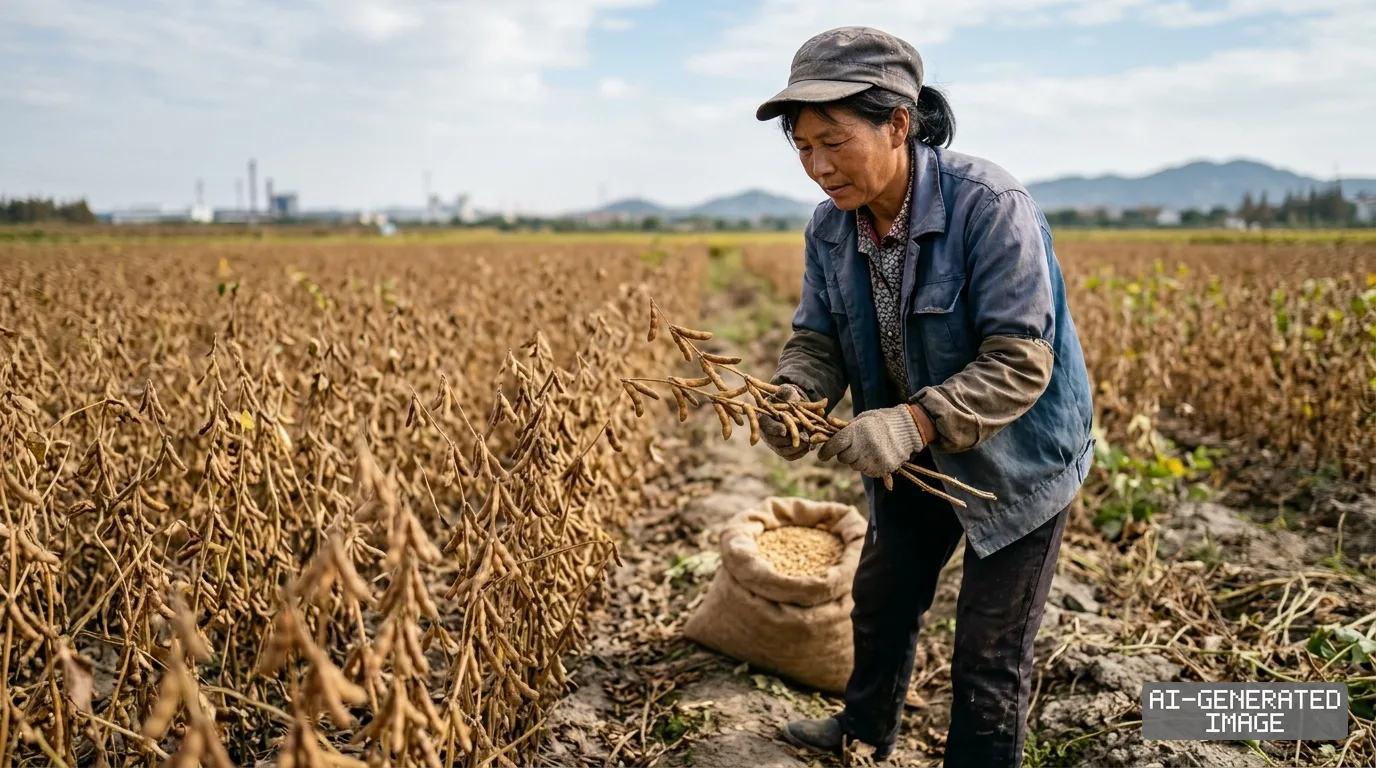
The American Soybean Association urged the Trump administration Nov. 16 to remove China's remaining 10% retaliatory tariff on whole soybeans ahead of bilateral presidential talks in Shenzhen.
The grower group petitioned Treasury Secretary Scott Bessent and United States Trade Representative Jamieson Greer. The trade association represents more than 500,000 farmers across 30 states.
China agreed in October 2025 to buy 25 million metric tons of American soybeans annually through 2028. That quota represents roughly 55% of total American soybean shipments to foreign buyers.
Unprocessed soybeans remain subject to China's 10% retaliatory import duty alongside a 3% most-favored-nation base rate. The combined 13% tax puts American beans at a direct cost disadvantage against Brazilian beans.
Brazilian soybeans enter Chinese ports subject only to the 3% base tariff. Brazil supplied 74% of China's 102 million metric tons of soybean imports in 2025.
The United States share of Chinese soybean intake fell to 21% in 2025, down from nearly 40% a decade earlier. That shift eroded export volumes through Gulf Coast and Pacific Northwest waterways.
A bilateral tariff agreement finalized Sept. 28 lowered duties on $60 billion of bilateral commerce. The package halved duties on $30 billion of American exports, including corn, wheat, beef and processed soybean meal.
The agreement excluded raw, unprocessed soybeans from tariff reductions. Whole beans generated $12.2 billion in American export sales to China in 2024, standing as the largest agricultural trade flow.
The omission leaves private Chinese processors unable to purchase American soybeans on commercial spot terms. Private crushers account for roughly 60% of total oilseed processing capacity across China.
State-owned reserve enterprises handle all current American soybean deliveries into China. State buyers receive government customs exemptions that offset the 10% punitive tariff.
Sinograin and COFCO Group control more than 40% of China's domestic soybean crushing and storage capacity. The two state enterprises purchased approximately 15.5 million metric tons of American soybeans through mid-November.
Those purchases cover about 62% of Beijing's 25-million-ton annual commitment under the 2025 Busan framework. Commercial feed manufacturers and independent crushing mills remain locked out by the border tax.
The American Soybean Association stated that state purchase pledges cannot replace access to private commercial crushers. Independent crushers process the majority of livestock feed in China's southern coastal provinces.
Multinational grain merchandisers Archer-Daniels-Midland Co. and Bunge Global SA face commercial headwinds from the tariff split. The two handlers move more than 45% of bulk grain shipped from Gulf Coast export elevators.
Archer-Daniels-Midland Co. relies on Chinese processing demand for roughly 20% of its ocean bulk export volume. Bunge Global SA maintains a similar 20% volume exposure across its North American grain originations.
Both trading houses report that ocean bulk transit remains constrained while the 10% duty blocks commercial sales. South American export terminals continue to capture open market bids from Chinese private buyers.
The grower petition reflects widening division among American industrial lobbies over trade negotiations with Beijing. Agricultural exporters seek lower border levies to preserve volume into their largest foreign market.
Advanced manufacturing and semiconductor sectors advocate stricter export controls and foreign investment limits. Washington tightened outbound licensing on high-bandwidth memory and wafer fabrication equipment throughout 2026.
Beijing uses agricultural purchase commitments to demand relief from American technology curbs and shipping fees. Chinese trade officials requested reciprocal tariff rollbacks on industrial goods during bilateral talks.
The existing bilateral tariff truce between Washington and Beijing is set to expire on Jan. 10, 2027. Both governments extended the negotiation window to resolve remaining tariff schedules and port fees.
President Donald Trump meets Chinese President Xi Jinping this week on the sidelines of the Asia-Pacific Economic Cooperation forum in Shenzhen. Agricultural groups are pushing the delegation to put soybean duties on the summit table.
The Office of the United States Trade Representative has not stated whether raw agricultural commodities will be added to the tariff reduction schedule before the January deadline.
Impact map
How this development propagates across the region and out to global buyers.
| Event | Korea | China | Japan | Global impact |
|---|---|---|---|---|
| China 10% soybean tariff | no direct tariff impact, grain feed import costs track Brazilian FOB spreads | Sinograin and COFCO take all US quota, private crushers pay 10% premium | commercial crushers source US origin without tariff penalty, trade routes unchanged | ADM and Bunge Gulf export pipelines constrained by bilateral tariff exclusion |
In this story
- Companies
- Archer-Daniels-MidlandBunge GlobalSinograinCOFCO Group
- Tickers
- ADMBG
- Policy
- Tariffs
- Impact
- Supply ChainOrder BookPricing
Track every Tariffs development →
Related briefings
- China ties US farm imports to reciprocal $60bn tariff cuts Also on COFCO Group, Sinograin, Archer-Daniels-Midland
- U.S.-China Board of Trade sets tariff cuts on corn and beef as raw soybeans stay excluded Also on Bunge Global, Archer-Daniels-Midland, Tariffs
- China MOFCOM Excludes Soybeans From $30B US Tariff Relief Also on Sinograin, Archer-Daniels-Midland, Tariffs
- USTR and MOFCOM set $60B tariff cuts on non-sensitive items Also on Archer-Daniels-Midland, Tariffs, Pricing
Sources
Reporting
Confidence: medium — how we grade this
The documents behind this briefing are linked above. East Asia Brief produces its English text with AI assistance under human editorial review, and does not translate or republish other outlets' articles. See our methodology and AI policy. Spotted an error? Tell us.
The Morning Brief
What changed in Korean, Chinese and Japanese industry overnight — and what it means for your supply chain. One email, weekday mornings, US time. Free.
The Morning Brief is in preparation. Leave your address and we will write to you once — when the first issue is ready. Nothing before that.