China MOFCOM Excludes Soybeans From $30B US Tariff Relief
The exemption lowers duties to baseline rates on over 90% of 1,619 American products, leaving raw oilseed imports under an extra 10% penalty to preserve trade leverage.
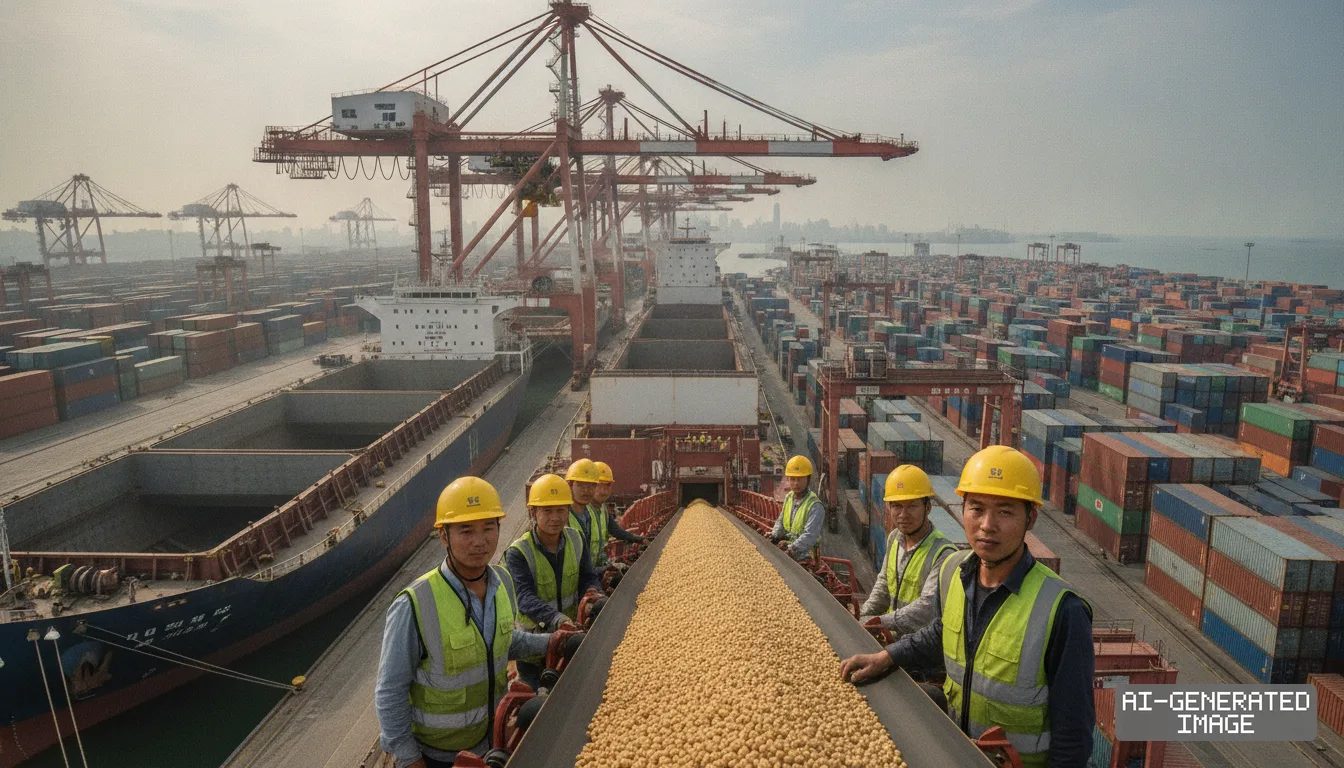
China's Ministry of Commerce excluded American soybeans Sept. 28, 2026 from a $30 billion reciprocal tariff rollback on United States farm imports, leaving raw oilseeds under an additional 10% retaliatory duty.
The exclusion keeps Beijing's heaviest trade lever firmly in place while offering duty relief to secondary agricultural goods. The agency published the exemptions following the eighth round of bilateral trade consultations in Washington and New York.
Under the framework agreed through the bilateral Board of Trade, each government selected roughly $30 billion in non-sensitive goods for reciprocal tariff relief. The joint arrangement spans $60 billion in two-way trade.
China's product roster covers 1,619 tariff lines. Over 90% of the covered items will see additional tariffs dropped, returning duties to Most-Favored-Nation rates, according to the ministry notice.
Beijing extended duty relief to American corn, wheat, sorghum, dairy products, beef and pork. The list also carves out processed soybean derivatives, including soymeal and soyoil, while bypassing whole raw soybeans entirely.
Whole soybeans represent the largest single American agricultural export to the Chinese market. Retaining the 10% duty ensures commercial crushers cannot purchase American cargoes without paying a significant regulatory penalty.
State-owned agricultural giants Sinograin and COFCO have purchased over 12 million metric tons of American soybeans under state-directed programs this year. Commercial crushers, however, remain shut out by the 10% tariff margin.
Private processors account for roughly 60% of national crushing capacity. Those private processors continue to direct spot purchases toward Brazil, where harvest volumes trade free of Chinese retaliatory penalties.
The policy architecture allows Beijing to manage its livestock feed costs selectively. By lowering tariffs on sorghum, corn and soymeal, feed mills gain alternative protein and starch inputs without opening the primary oilseed channel.
United States Trade Representative Jamieson Greer praised the broader $30 billion package Sept. 27, noting that the arrangement restores competitive access for scores of American producers.
The Office of the United States Trade Representative published reciprocal concessions lowering tariffs on Chinese consumer goods. American reductions cover more than 1,600 product categories, including home appliances, kitchenware, toys and seasonal decorative items.
The bilateral agreement also encompasses industrial energy commodities. China agreed to import 10 million metric tons of American coal annually across 2027 and 2028 under adjusted tariff schedules, the commerce ministry said.
Alongside the tariff schedules, both sides confirmed an extension of their overarching bilateral trade truce. The ceasefire, initially scheduled to expire Nov. 10, 2026, will now run through Jan. 10, 2027.
The two months of extra runway give trade negotiators room to build institutional mechanisms. The governments agreed to establish a dedicated Agricultural Working Group under the Board of Trade.
That working group will convene its inaugural formal session before the end of 2026, the ministry said. Bilateral teams will use the forum to debate phytosanitary rules, biotechnology approvals and seasonal purchasing quotas.
For American growers, the exclusion leaves the harvest export window heavily restricted. The peak shipping season for American soybeans runs from September through January, when Midwest river networks move grain to export elevators.
Retaining the tariff prevents United States exporters from capturing normal seasonal market share. Brazilian export terminals in Santos and Paranagua have extended operations, maintaining shipments through what is traditionally a dormant period for South American exporters.
Chinese port inventories remain elevated following heavy spring imports from South America. State strategic reserves held by Sinograin provide sufficient near-term buffer stock, reducing domestic urgency to lift the soybean tariff.
Trade data show agricultural goods included in Monday's reduction list accounted for approximately $17 billion in bilateral trade during 2024. Excluding soybeans caps the direct value of American farm relief well below pre-dispute baselines.
The commercial impact falls unevenly across American agribusiness. Grain merchants Archer-Daniels-Midland, Bunge and Cargill handle both American and Brazilian origination, allowing them to shift supply routes to meet Chinese port demand.
Pure domestic producers in the American farm belt lack that flexibility. Midwest farming operations face wider local basis discounts as uncommitted supplies accumulate in regional river elevators without active commercial Chinese bids.
The notice does not state the calendar date on which customs will implement the tariff rollbacks, and Chinese filings do not confirm White House claims of an annual 25 million metric ton purchase target through 2028.
Both governments stated that tariff reductions will take effect simultaneously after each country completes required domestic legal procedures. Further tariff modifications remain tied to the performance of the newly formed working groups.
Impact map
How this development propagates across the region and out to global buyers.
| Event | Korea | China | Japan | Global impact |
|---|---|---|---|---|
| China excludes whole soybeans from reciprocal tariff rollback | feed grain millers face higher transshipment spreads as Chinese buyers absorb non-soy commodities | Sinograin and COFCO monopolize subsidized U.S. soy imports while private crushers rely on Brazil | domestic feed compounders face no direct tariff changes but monitor regional corn and sorghum flows | Chicago Board of Trade soybean futures face continued export basis pressure against South American rivals |
In this story
- Companies
- SinograinCOFCOArcher-Daniels-MidlandBungeCargill
- Policy
- TariffsTrade Truce
- Impact
- Supply ChainCompliancePricing
Track every Tariffs development →
Related briefings
- CATL develops tall pickup batteries to bypass US tariffs Also on Tariffs, Compliance, Pricing
- Trump signs sanctions act authorizing 100% tariffs on oil buyers Also on Tariffs, Compliance, Pricing
- China Gas buys US LNG from Venture Global under 20-year pact Also on Tariffs, Compliance, Pricing
- China opens zero-tariff market access for Seychelles goods Also on Tariffs, Compliance, Pricing
Sources
Primary documents
Reporting
Confidence: high — how we grade this
The documents behind this briefing are linked above. East Asia Brief produces its English text with AI assistance under human editorial review, and does not translate or republish other outlets' articles. See our methodology and AI policy. Spotted an error? Tell us.
The Morning Brief
What changed in Korean, Chinese and Japanese industry overnight — and what it means for your supply chain. One email, weekday mornings, US time. Free.
The Morning Brief is in preparation. Leave your address and we will write to you once — when the first issue is ready. Nothing before that.