China offers rare earth export permits to Europe for dual-use relief
The Ministry of Commerce said it will process mineral shipments if Brussels resolves individual export approvals for Chinese buyers seeking controlled industrial goods.
China's Ministry of Commerce said Oct. 15, 2026, it will expedite European rare-earth export licenses if Brussels facilitates reciprocal approvals for Chinese purchases of controlled dual-use technologies.
Ministry spokesperson He Yadong presented the offer during a regular press briefing in Beijing. The position links mineral supply directly to European licensing decisions on sensitive civilian and military hardware.
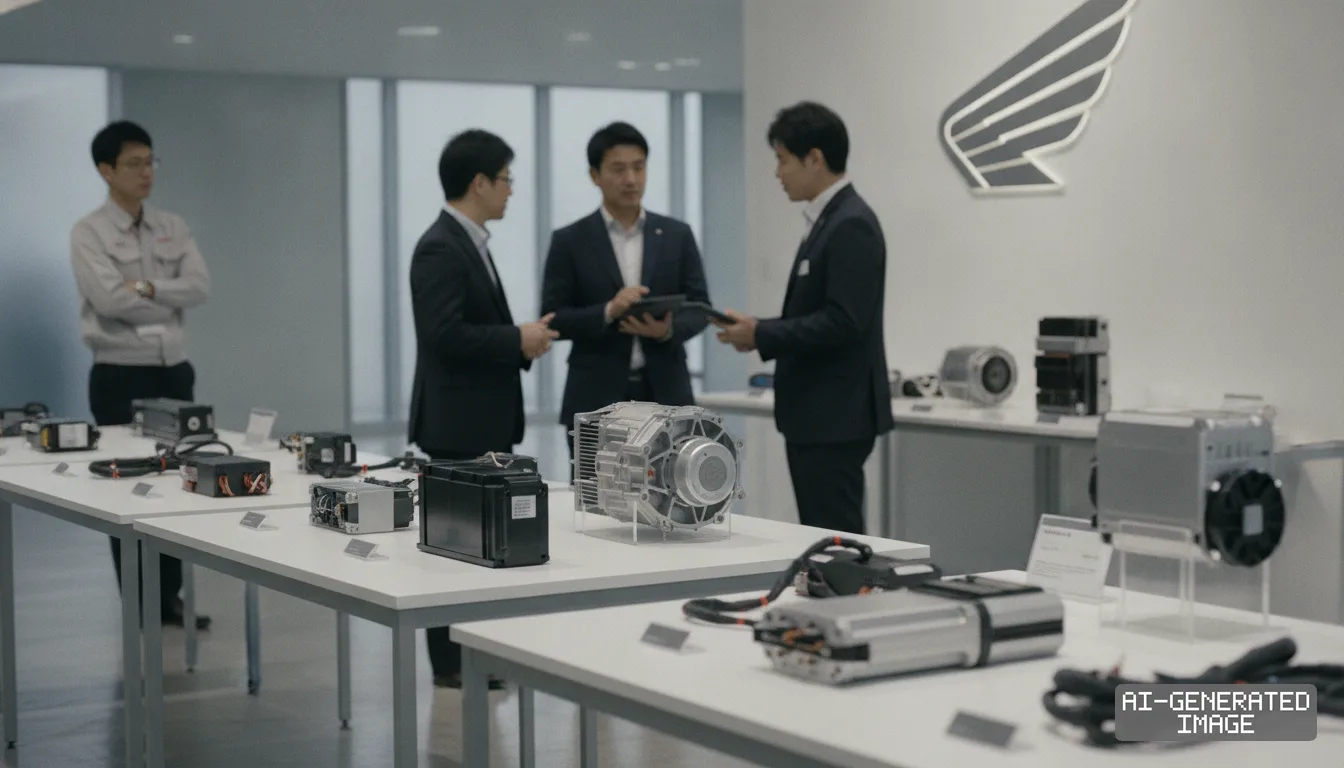
China controls roughly 90% of global refined rare-earth output and over 90% of permanent magnet capacity. That concentration leaves European automotive, aerospace and defense manufacturers dependent on Chinese processing lines for heavy rare earths such as dysprosium and terbium.
The ministry stated that Beijing stands ready to provide regulatory facilitation for European rare-earth and permanent magnet applications. In exchange, China expects European authorities to resolve pending licensing cases for Chinese entities purchasing European dual-use products.
The exchange formalizes a strategy that pairs resource leverage with market access for restricted European technologies. Beijing has sought to ease Western technology transfer limits since enacting strict mineral controls in 2025.
Under Announcement No. 61 and No. 62 issued on Oct. 9, 2025, the ministry imposed extraterritorial licensing rules on rare earths. Those rules require foreign companies to obtain Chinese permits for overseas products that contain 0.1% or more Chinese-origin heavy rare earths.
The rules also cover manufacturing lines using Chinese refining, extraction or magnet production patents. The sweeping extraterritorial reach forced European industrial groups to seek individual license approvals to prevent factory stoppages.
The commercial friction prompted bilateral negotiations earlier this year. Chinese Commerce Minister Wang Wentao met European Commission Executive Vice President Maros Sefcovic on June 29 and June 30, 2026, creating an export control working group under the EU-China Trade and Investment Consultations mechanism.
Senior trade negotiators met again in Beijing on Oct. 8 and Oct. 9, 2026, to negotiate supply terms for hybrid vehicles, critical minerals and industrial equipment. The Oct. 15 briefing marks the first formal public confirmation of the reciprocal licensing proposal.
Exposure across the trade corridor centers on advanced equipment and electric vehicle components. ASML Holding, the Dutch supplier of photolithography systems, draws roughly 40% of its system net sales from semiconductor manufacturers in China.
ASML relies on export licenses from the Dutch government to ship deep ultraviolet lithography tools to Chinese fabrication plants. Tightened European licensing reviews have delayed deliveries of optical systems and maintenance parts to Chinese customers.
On the materials side, Chinese suppliers hold critical leverage over European tier-one automotive integrators. JL MAG Rare-Earth, a major magnet supplier listed in Shenzhen, accounts for roughly 15% of high-performance sintered neodymium-iron-boron magnet output globally.
JL MAG Rare-Earth secured initial government export authorizations earlier in the regulatory transition, giving it clearance to ship to European powertrain plants. However, European automotive suppliers operating without general export licenses have experienced supply friction under case-by-case review rules.
The bilateral arrangement relies on the China-EU export control dialogue mechanism to manage the trade pipeline. Both sides plan to convene the working group in Brussels in November 2026 to review the first batch of prioritized dual-use licensing applications.
The notice does not state the volume quotas, statutory review deadlines or element schedules governing the fast-track process. The ministry has not published the list of European dual-use technologies it has asked Brussels to release in return.
Impact map
How this development propagates across the region and out to global buyers.
| Event | Korea | China | Japan | Global impact |
|---|---|---|---|---|
| rare earth reciprocity demand | domestic magnet producers monitor European demand shifts, feedstock protected by bilateral pacts | MOFCOM leverages 90% magnet processing share to negotiate dual-use tech approvals | Tokyo Electron and automotive tiers track de minimis 0.1% enforcement for re-exports | automotive and semiconductor supply chains face transactional review of strategic inputs |
In this story
- Companies
- ASML HoldingJL MAG Rare-Earth
- Tickers
- ASML.AS300748.SZ
- Policy
- Export ControlsTariffs
- Impact
- Supply ChainCompliancePricing
Track every Export Controls development → Track every Tariffs development →
Related briefings
- China ties rare earth permits to European trade concessions Also on JL MAG Rare-Earth, Tariffs, Export Controls
- China magnet export controls near end of one-year suspension Also on JL MAG Rare-Earth, Export Controls, Compliance
- China mandates digital tracking codes for heavy rare earth shipments to tighten export control Also on JL MAG Rare-Earth, Export Controls, Compliance
- China permanent magnet controls squeeze motor supply as alloy research stalls Also on JL MAG Rare-Earth, Export Controls, Compliance
Sources
Primary documents
Reporting
Confidence: high — how we grade this
The documents behind this briefing are linked above. East Asia Brief produces its English text with AI assistance under human editorial review, and does not translate or republish other outlets' articles. See our methodology and AI policy. Spotted an error? Tell us.
The Morning Brief
What changed in Korean, Chinese and Japanese industry overnight — and what it means for your supply chain. One email, weekday mornings, US time. Free.
The Morning Brief is in preparation. Leave your address and we will write to you once — when the first issue is ready. Nothing before that.