China magnet export controls near end of one-year suspension
Western automakers and robotics builders stepped up rare earth magnet purchases as Beijing prepared to let a pause on extraterritorial export licensing expire on Nov. 10.
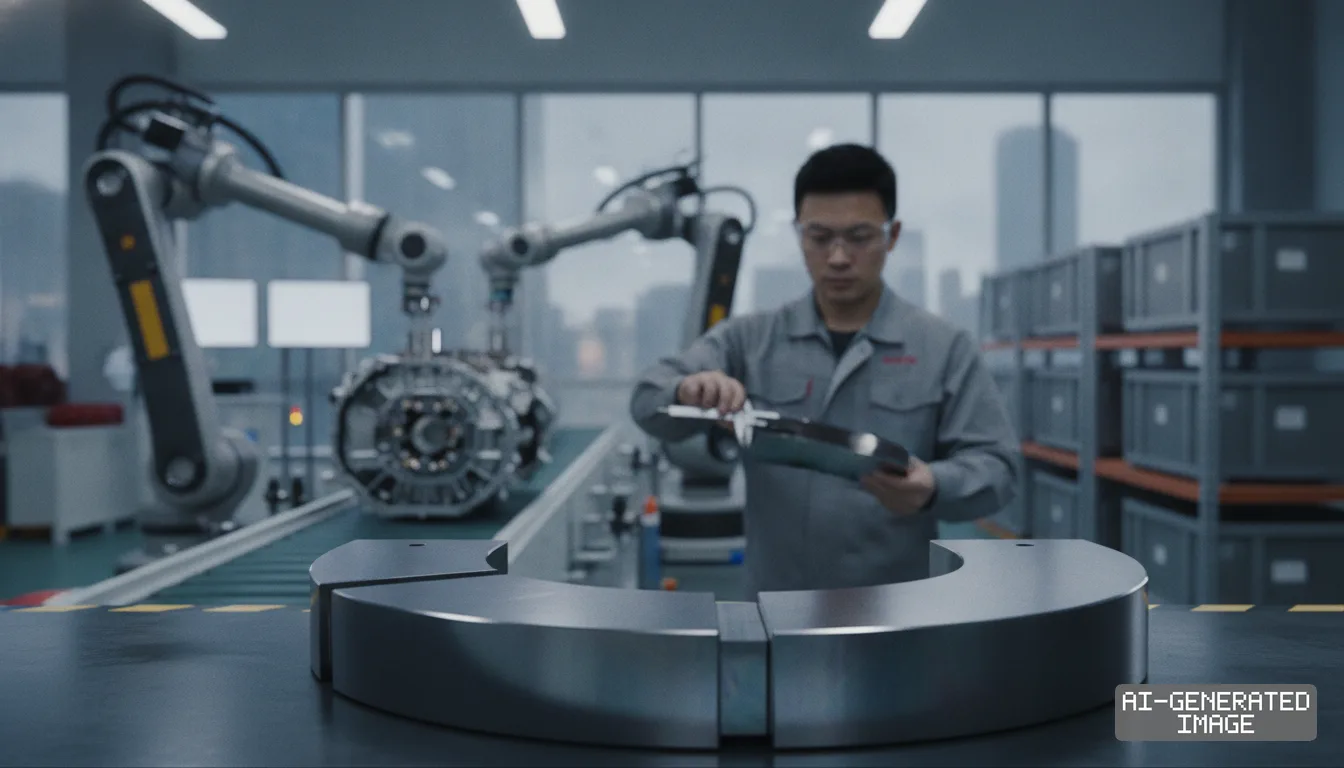
Western electric vehicle and robotics manufacturers accelerated permanent magnet stockpiling on Oct. 2 as China neared the Nov. 10 expiration of its export control suspension.
The looming deadline revives restrictions that place global supply chains under unilateral Chinese oversight. Sintered neodymium-iron-boron magnets form essential components in electric drive units, precision robotic actuators and wind turbines.
China controls roughly 90% of global permanent magnet production and 97% of heavy rare earth separation capacity. The International Energy Agency estimated that full enforcement of the rules threatens $6.5 trillion per year in downstream manufacturing outside China.
The Ministry of Commerce and the General Administration of Customs jointly established the pause on Nov. 7, 2025, under Announcement No. 70. That decree halted six export control notices for exactly 12 months following bilateral summit talks.
The frozen package included Announcement No. 56, which restricted exports of specialized manufacturing machinery. That order targeted vacuum sintering furnaces, jet mills and hydrogen decrepitation equipment used to fabricate high-grade magnets.
The most contested measure remains Announcement No. 61. It introduced an extraterritorial licensing regime requiring foreign companies to secure permits from the Chinese commerce ministry before transferring products to third countries.
Under Announcement No. 61, the licensing rule triggers if a foreign-made component contains 0.1% or more of designated Chinese rare earths by value. The threshold applies to critical additives such as dysprosium, terbium, samarium and yttrium.
The regulation also asserts jurisdiction over overseas items manufactured using Chinese processing intellectual property. Foreign suppliers must submit end-user documentation and register supply chain routes directly with Beijing authorities.
A separate baseline licensing rule introduced in April 2025 under Announcement No. 18 remained in effect throughout the suspension period. That framework already requires individual permits for seven medium and heavy rare earth categories.
Western buyers have endured shipment delays of 60 to 120 days under the existing baseline controls. The added documentation requirements have forced industrial consumers to hold up to four months of buffer inventory.
Major Chinese magnet producers operate under general export quotas that insulate select domestic volumes. JL MAG Rare-Earth, Beijing Zhong Ke San Huan High-Tech and Ningbo Yunsheng hold general export licenses for qualifying overseas shipments.
Foreign manufacturers face far tighter structural constraints. Japanese magnet producers Shin-Etsu Chemical and TDK Corporation remain exposed to feedstock disruptions because Japan sources most of its heavy rare earth inputs from Chinese refineries.
TDK Corporation draws more than 60% of its dysprosium and terbium feedstocks from Chinese processors to produce high-temperature magnets for automotive customers.
Shin-Etsu Chemical produces advanced NdFeB magnets for hybrid vehicles and industrial automation, where heavy rare earth additives prevent demagnetization under severe operating heat.
European industrial groups face compounding regulatory barriers. Beijing placed German defense contractor Rheinmetall on its export control list in July 2026, cutting the firm off from direct and indirect Chinese dual-use shipments.
The United States operates with severe domestic processing deficits. American separation plants process roughly 15,000 metric tons of rare earth oxides annually, covering one-third of the country's 45,000 metric tons in annual consumption.
The domestic processing shortfall leaves Western automotive and robotics firms unable to substitute Chinese inputs before the deadline. Motor makers require between 18 and 24 months to requalify alternative magnetic material formulations.
The expiration of Announcement No. 70 would subject overseas component makers to Chinese audit inspections. A component containing trace amounts of Chinese terbium assembled into a European robotic joint would require a Chinese export permit before shipment to North America.
The Ministry of Industry and Information Technology reinforced this mechanism by implementing a mandatory digital tracing system for rare earth supply chains. The portal monitors batch weights, refining sources and customer identities across transaction stages.
Compliance officers at multinational tier-one auto suppliers have warned that tracing sub-tier magnet alloys to specific smelting batches poses severe legal liabilities.
Automakers have absorbed sharp price differentials as a result of earlier restrictions. European dysprosium prices reached six times Chinese domestic rates during previous licensing bottlenecks, according to industry transaction data.
Procurement leads have expanded warehouse holdings of unmachined magnet blocks to protect production schedules into early 2027. Holding costs have risen as financing rates remain elevated across major Western economies.
The one-year suspension published under Announcement No. 70 expires on Nov. 10, 2026.
The ministry has not published whether it will renew the suspension or issue updated guidance on the 0.1% value calculation before Nov. 10.
Chinese customs authorities continue to process standard export applications under the April 2025 licensing baseline at major commercial ports.
Impact map
How this development propagates across the region and out to global buyers.
| Event | Korea | China | Japan | Global impact |
|---|---|---|---|---|
| China permanent magnet export suspension expiry | domestic EV motor builders expand NdFeB magnet reserves to cushion 60-day shipping lags | JL MAG and domestic peers retain export quotas while MOFCOM tightens overseas re-export rules | Shin-Etsu Chemical and TDK face tighter audits on heavy rare earth feedstock origin | downstream equipment manufacturing faces licensing scrutiny across $6.5 trillion in output |
In this story
- Companies
- JL MAG Rare-EarthShin-Etsu ChemicalTDK Corporation
- Tickers
- 300748.SZ4063.T6762.T
- Exposed
- Beijing Zhong Ke San Huan High-TechNingbo YunshengRheinmetall
- Policy
- Export Controls
- Impact
- Supply ChainPricingCompliance
Track every Export Controls development →
Related briefings
- China mandates digital tracking codes for heavy rare earth shipments to tighten export control Also on JL MAG Rare-Earth, Ningbo Yunsheng, Shin-Etsu Chemical
- China permanent magnet controls squeeze motor supply as alloy research stalls Also on JL MAG Rare-Earth, Ningbo Yunsheng, Export Controls
- Japan urges China to expedite rare earth export approvals Also on TDK Corporation, Shin-Etsu Chemical, Export Controls
- Pentagon ends Chinese mineral waivers before 2027 deadline Also on Shin-Etsu Chemical, Export Controls, Compliance
Sources
Primary documents
Reporting
Confidence: high — how we grade this
The documents behind this briefing are linked above. East Asia Brief produces its English text with AI assistance under human editorial review, and does not translate or republish other outlets' articles. See our methodology and AI policy. Spotted an error? Tell us.
The Morning Brief
What changed in Korean, Chinese and Japanese industry overnight — and what it means for your supply chain. One email, weekday mornings, US time. Free.
The Morning Brief is in preparation. Leave your address and we will write to you once — when the first issue is ready. Nothing before that.