Korea Urges USTR to Strictly Honor 15% Bilateral Tariff Cap
Trade Minister Park Jung-sung pressed Washington to prevent new trade measures from breaching the agreed duty limit as Korean automakers and steelmakers confront separate import curbs.
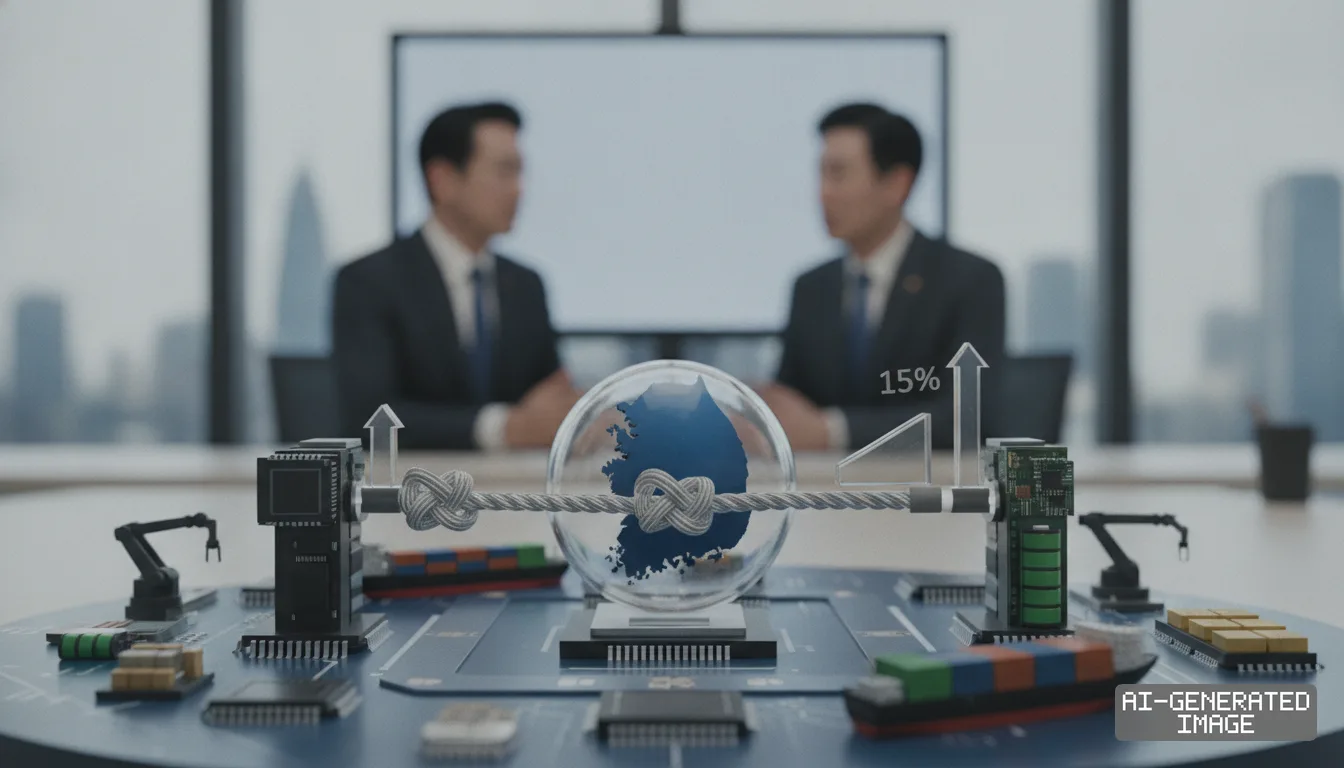
South Korea's trade minister pressed the United States on Oct. 2 to honor an agreed 15% tariff ceiling across all incoming trade remedies, resisting Washington's push for steeper protectionist barriers.
Minister for Trade Park Jung-sung met United States Trade Representative Jamieson Greer during the Group of 20 trade ministers' gathering in Milwaukee, the Ministry of Trade, Industry and Energy said. The talks followed two days of multilateral sessions focused on supply chains and structural industrial overcapacity.
Seoul secured the 15% tariff ceiling in late 2025 by committing to a $350 billion investment package in the United States. That package allocates $200 billion to strategic manufacturing and energy projects and $150 billion to commercial and naval shipbuilding cooperation.
Park told Greer that no combination of incoming trade measures should push cumulative duties above that 15% threshold. South Korea faces compounding administrative actions as Washington reconstructs its tariff architecture under older trade statutes.
The Office of the United States Trade Representative imposed a 12.5% tariff on Korean goods under Section 301 of the Trade Act on July 23. That proceeding penalized 60 economies over the enforcement of forced-labor import restrictions.
The United States also opened a Section 301 investigation into structural excess manufacturing capacity on March 12. Korean trade officials expect the findings to yield recommendations for additional punitive border levies on industrial goods.
Korean exporters face mounting operational uncertainty as the overcapacity report approaches publication. Trade authorities in Seoul argue that the bilateral investment memorandum established an absolute ceiling of 15% regardless of the statutory mechanism Washington selects.
Automotive shipments already operate under the negotiated ceiling. The United States published a Federal Register notice on Dec. 4, 2025, applying a 15% tariff retroactively to Nov. 1, 2025, for Korean passenger vehicles and automotive components.
That automotive rule protects sedan and sport utility vehicle exports from higher rates, but pickup trucks remain subject to a 25% duty. Hyundai Motor and affiliate Kia assemble roughly half their American sales locally, leaving hundreds of thousands of exported units exposed to the 15% rate.
Steel exports face far steeper barriers outside the bilateral ceiling. South Korean steel shipments carry a 50% tariff under Section 232 of the Trade Expansion Act, which Washington applied across the full customs value of imported metals in April.
Greer urged trade partners to erect coordinated trade defense walls during the Global Forum on Steel Excess Capacity ministerial meeting in Milwaukee on Sept. 30. Park rejected mandatory trade barriers during the forum, the ministry said.
Park argued that governments must address industrial gluts through voluntary corporate restructuring and World Trade Organization rules. He warned against measures that slide into overprotection outside international legal frameworks, according to the ministry statement.
Posco Holdings and Hyundai Steel bear the direct burden of the metals regime. Both mills operate under the 50% duty on high-value steel products, preventing them from utilizing price concessions granted to other Korean export sectors.
The current regulatory friction stems from the restructuring of American trade policy. The U.S. Supreme Court struck down reciprocal tariffs enacted under the International Emergency Economic Powers Act in February.
The Trump administration replaced those reciprocal duties with a temporary 10% global levy under Section 122 of the Trade Act for 150 days. As that measure expired on July 24, trade officials pivoted to Section 301 actions to rebuild tariff revenue.
South Korea avoided the full compound impact of the July forced-labor duties through administrative indexing. Under that formula, goods with most-favored-nation tariffs below 12.5% were raised to 12.5%, while products with higher rates incurred no additional Section 301 duties.
Seoul contends that any duty arising from the pending overcapacity inquiry must fit within the remaining 2.5-percentage-point margin beneath the 15% cap. Korean trade officials maintain that exceeding 15% would breach the terms of the investment package.
The commercial stakes center on South Korea's execution of its outbound capital commitments. Seoul confirmed the construction of a gas-fired power plant in Encinal, Texas, as the maiden project under the strategic portfolio.
Subsequent phases involving eight large commercial nuclear reactors and liquefied natural gas procurement from Alaska remain subject to intergovernmental negotiation. Korean officials have emphasized that future capital outlays depend on Washington maintaining predictable market access.
The ministry notice does not state the confirmed date for the bilateral joint committee meeting, and trade officials have not published the detailed project list for the second phase of the $350 billion U.S. investment commitment.
Park and Greer agreed to schedule the joint committee around the formal launch of the Texas power plant. USTR staff are reviewing public testimony submitted under the overcapacity docket ahead of a final determination.
Impact map
How this development propagates across the region and out to global buyers.
| Event | Korea | China | Japan | Global impact |
|---|---|---|---|---|
| U.S. 15% tariff cap enforcement | Hyundai Motor and Kia hold vehicle export tariffs at 15% while Posco absorbs 50% steel duties | faces compounding Section 301 overcapacity and forced-labor tariffs without bilateral ceiling | holds 12.5% MFN cap under Section 301 while negotiating parity on auto duties | supply chain costs rise as U.S. transitions from Section 122 duties to Section 301 tariffs |
In this story
- Companies
- Hyundai MotorKiaPosco HoldingsHyundai Steel
- Tickers
- 005380.KS000270.KS005490.KS004020.KS
- Policy
- TariffsTrade Expansion ActSection 301
- Impact
- Cost StructureCompliancePricing
Track every Tariffs development →
Related briefings
- Asian Shipyard Heavy Plate Costs Diverge as Mills and Builders Clash Over Contract Pricing Also on Hyundai Steel, POSCO Holdings, Tariffs
- Korea Links Commercial Electric Van Grants to Battery Recyclability Also on Kia, Hyundai Motor, Compliance
- Hyundai, LG Energy launch used battery storage pilot for EVs Also on Kia, Hyundai Motor, Compliance
- Hyundai tests used EV battery storage on South Korea's grid Also on Kia, Hyundai Motor, Cost Structure
Sources
Primary documents
Reporting
Confidence: high — how we grade this
The documents behind this briefing are linked above. East Asia Brief produces its English text with AI assistance under human editorial review, and does not translate or republish other outlets' articles. See our methodology and AI policy. Spotted an error? Tell us.
The Morning Brief
What changed in Korean, Chinese and Japanese industry overnight — and what it means for your supply chain. One email, weekday mornings, US time. Free.
The Morning Brief is in preparation. Leave your address and we will write to you once — when the first issue is ready. Nothing before that.