China curbs exports of 40 AI, solar and biotech technologies
Joint rules from trade and science ministries ban 14 critical processes outright and require immediate pre-export registration for 26 others before a public review closes Nov. 15.
China's Ministry of Commerce and the Ministry of Science and Technology proposed export restrictions Oct. 16 on 40 emerging technologies across artificial intelligence, advanced solar manufacturing and biotechnology.
The joint announcement splits the targeted assets into 14 prohibited technologies and 26 restricted technologies. An interim registration rule took effect the same day, requiring trade filings for pending and uncompleted transactions.
The package marks Beijing's broadest revision to its technology export catalogue since late 2023. The measure erects legal barriers around core production know-how in industries where domestic manufacturers hold dominant manufacturing shares.
Artificial intelligence accounts for 23 of the entries. The draft restricts frontier foundation models, autonomous software agents, high-density computing clusters and sensitive information-processing tools, according to the ministry notice.
The ministries excluded public-domain technologies from the controls. AI tools released through open-source repositories or published in academic journals do not require export filings, the commerce ministry said in an accompanying briefing.
Facilitated licensing applies when Chinese AI groups build server centers abroad or tape out semiconductors at overseas foundries. Routine outbound software interfaces remain eligible for expedited reviews, the commerce ministry said.
Frontier foundation models trained on sensitive data remain strictly controlled. AI systems capable of automated software vulnerability discovery and malicious code generation are proposed for complete export prohibition.
The restrictions directly affect Chinese software developers including Baidu, Alibaba Group Holding and Tencent Holdings. Domestic AI groups hold dozens of proprietary foundation models, but foreign deployments must now secure commercial clearance.
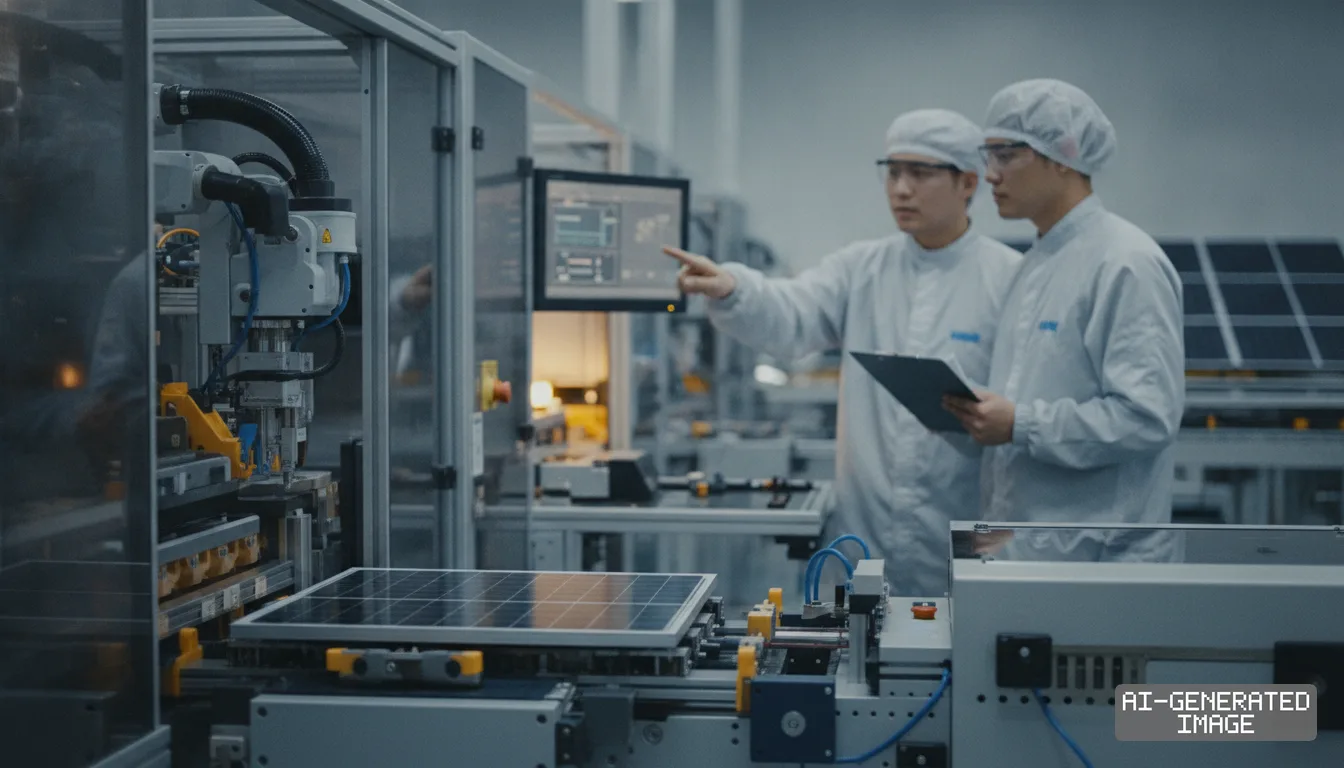
Photovoltaics accounts for 12 of the proposed items. The draft places complete export bans on next-generation perovskite and tandem solar cell production technologies, according to the ministry notice.
The prohibition covers tandem manufacturing using silicon wafers measuring at least 182 millimeters with cell conversion efficiencies reaching 30% or higher. Perovskite slot-die coating lines with widths of 1.1 meters or wider are also banned.
The draft places export restrictions on crystalline silicon ingot pulling, wafer slicing and heterojunction cell manufacturing. Polysilicon engineering lines designed with single-line annual capacities of 30,000 metric tons or more require export licences.
China produces more than 80% of global polysilicon and over 90% of solar wafers, according to industry estimates. The draft targets the physical machinery that embeds the manufacturing formulas, not shipments of finished solar panels.
Chinese solar giants face immediate administrative checks on overseas capacity expansions. Tongwei Co. and LONGi Green Energy Technology, which together control over 75% of global polysilicon output, must register equipment transfers abroad.
Specialist developers of perovskite pilot lines also face the ban. Module maker UtmoLight, which operates commercial tandem pilot lines in eastern China, cannot sell its proprietary production processes to foreign buyers.
Foreign solar module plants rely heavily on Chinese tooling. Assemblers in India, Vietnam and Malaysia that source turn-key lines from Chinese vendors face delivery disruptions during licensing reviews.
Biomedicine accounts for five technologies in the draft. The notice lists proprietary cell and gene therapy platforms, small nucleic acid therapeutics and pathogen handling technologies for restricted oversight.
The commerce ministry exempted outbound patent licences that do not transfer underlying technology ownership. Those outbound pharmaceutical cross-licensing deals remain eligible for automatic licensing approvals, according to the briefing.
Chinese biotech companies including CARsgen Therapeutics and Legend Biotech develop chimeric antigen receptor cell therapies. Outright transfers of their genetic engineering manufacturing processes will require ministry sign-off.
The immediate pre-export registration mechanism runs until the formal catalogue takes effect. Exporters must submit transaction filings online through the unified technical trade portal at ecomp.mofcom.gov.cn before moving assets.
The filing mandate applies retroactively to existing contracts where transfers have started but are not yet complete, the ministry notice said. Corporate compliance desks must audit pending overseas line installations.
The commerce ministry opened a 30-day public comment window running through Nov. 15. Officials stated that the list will undergo dynamic adjustments as technical baselines advance.
The notice does not state the specific computational calculation thresholds or raw floating-point performance cutoffs required to classify proprietary AI model weights under Annex 1.
Impact map
How this development propagates across the region and out to global buyers.
| Event | Korea | China | Japan | Global impact |
|---|---|---|---|---|
| China export catalogue revision | Hanwha Qcells faces tighter Chinese equipment supply for overseas tandem cell development lines | LONGi and Tongwei must clear pre-export reviews before shipping 30,000-ton polysilicon lines | Solar equipment importers face review delays for cell manufacturing machinery | Overseas solar cell capacity rollouts face extended equipment delivery schedules |
In this story
- Companies
- LONGi Green Energy TechnologyTongwei Co.UtmoLight
- Tickers
- 601012.SS600438.SS
- Exposed
- Alibaba Group HoldingBaiduTencent Holdings
- Policy
- Export Controls
- Impact
- Supply ChainComplianceCapex
Track every Export Controls development →
Related briefings
- XPeng Scales Humanoid Robot Line with Electric Vehicle Parts in 2026 Also on Alibaba Group Holding, Tencent Holdings
- China Tightens Connected Vehicle Data Rules With Mandatory Local Sensor Scrubbing Also on Baidu, Export Controls, Compliance
- Xi Jinping plans business delegation for Donald Trump summit Also on Tencent Holdings, Export Controls, Compliance
- China RISC-V Chipmakers Tap Domestic 14nm Nodes for Industrial AI Also on Alibaba Group Holding, Export Controls
Sources
Primary documents
Reporting
Confidence: high — how we grade this
The documents behind this briefing are linked above. East Asia Brief produces its English text with AI assistance under human editorial review, and does not translate or republish other outlets' articles. See our methodology and AI policy. Spotted an error? Tell us.
The Morning Brief
What changed in Korean, Chinese and Japanese industry overnight — and what it means for your supply chain. One email, weekday mornings, US time. Free.
The Morning Brief is in preparation. Leave your address and we will write to you once — when the first issue is ready. Nothing before that.