Samsung Heavy Backs San Diego Shipyard R&D for U.S. Fleets
The South Korean builder launched funded robotics and welding projects at San Diego State University to train local labor and support joint Pacific naval programs.
San Diego State University and Samsung Heavy Industries kicked off joint maritime research projects on Oct. 19, targeting manufacturing automation and workforce training for American shipyards.
The initiative channels research backing from South Korea's state-run Korea Evaluation Institute of Industrial Technology and the Geoje-based shipbuilder into advanced welding and simulation tools on the U.S. West Coast.
The university announcement did not disclose the total dollar value of the funding packages, which support three faculty research tracks at the binational center.
South Korea's Ministry of Trade, Industry and Energy finances the workforce development program through the institute to address severe labor bottlenecks across American commercial and naval shipyards.
The state-backed project deploys virtual reality tools and artificial intelligence agents to replicate instructor technique during high-precision tasks such as ship hull coating and surface painting.
Trainees build motor memory in simulation before handling physical materials, cutting instructional hours and costly paint waste during shipyard apprenticeships, university officials said.
The software incorporates feedback gathered from master yard painters in South Korea, converting individual tactile experience into algorithmic guidance for American trainees.
Samsung Heavy Industries directly finances two mechanical engineering research tracks at the university's SHI-SDSU Advanced Maritime Center, which opened its campus facilities in March.
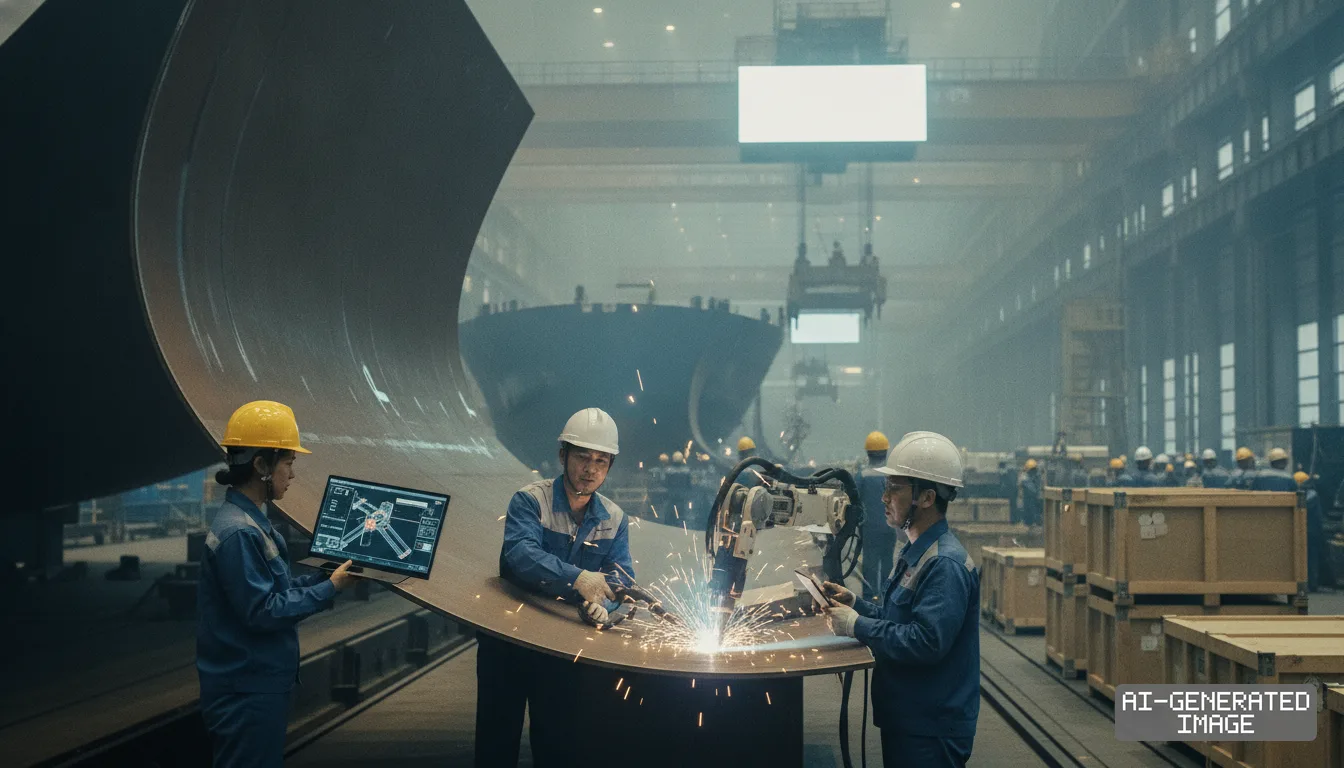
One project, led by mechanical engineering department chair Patrick Kwon, aims to extend tool life during friction stir welding on heavy structural steel panels.
Friction stir welding joins metal plates using rotational frictional heat without melting the base metal, but mechanical friction on thick marine steel causes rapid pin wear.
Tool degradation forces frequent line stoppages and raises consumables expenses on complex commercial hulls and naval auxiliary ships, limiting automated adoption in American yards.
The second direct track, led by associate professor John Sungbum Kang, builds an artificial intelligence quality framework to detect weld anomalies in real time.
That system merges multimodal sensor inputs with deep learning models to inspect seams continuously during assembly, eliminating lengthy post-weld ultrasonic testing delays.
Sensor fusion captures acoustic emission, thermal radiation and vision data during the arc cycle, flagging porosity and micro-cracks before assemblies move to drydocks.
The university unveiled the research tracks during an Oct. 16 ceremony attended by defense contractors, regional development officials and retired naval flag officers.
Participants included executives from General Dynamics NASSCO, ship repairer Vigor Marine, defense contractor SAIC and retired Navy Vice Admiral David Boone of the San Diego Military Advisory Council.
San Diego functions as the operational core for U.S. Pacific Fleet surface maintenance and hosts the only full-cycle shipyard on the U.S. West Coast.
General Dynamics NASSCO operates that yard, where it holds contracts to build 20 John Lewis-class fleet replenishment oilers and designs future submarine tenders.
The yard delivered more than 150 government and commercial vessels since the 1950s, but faces chronic trade labor shortages that slow vessel completion schedules.
South Korean shipbuilders are positioning automation technologies in U.S. waterfront hubs to help alleviate drydock congestion and secure naval engineering footholds.
Samsung Heavy Industries signed a three-party agreement in December with General Dynamics NASSCO and engineering house DSEC to cooperate on domestic ship manufacturing.
The alliance secured early-stage conceptual design work for the U.S. Navy's Next Generation Logistics Ship program, a class expected to reach at least 13 vessels.
Samsung Heavy Industries runs hull form optimization and hydrodynamic testing for that naval auxiliary program through its 400-meter towing tank in Daejeon.
That auxiliary logistics vessel design contract runs through March 2027, establishing an operational runway for collaborative manufacturing and engineering workflows.
The partnership also positions Samsung Heavy Industries to pursue maintenance, repair and overhaul contracts across the U.S. Pacific Fleet alongside regional shipyard partners.
By embedding software and tooling inside San Diego State University, the shipbuilder creates a trained pipeline of American engineers familiar with Korean yard methods.
DSEC supplies detailed engineering models and procurement packages, bridging Asian manufacturing standards with U.S. Coast Guard and naval vessel specifications.
Vigor Marine maintains extensive repair facilities in the Pacific Northwest and California, offering drydock capacity for joint naval maintenance bids.
The research projects also reflect South Korea's bilateral industrial strategy to anchor its top shipbuilders in allied defense and energy logistics supply chains.
Automated fabrication lines, including automated pipe spool assembly systems deployed at Geoje, provide reference models for potential West Coast shipyard modernization.
The university announcement does not state the total dollar grant allocated by the Korea Evaluation Institute of Industrial Technology and Samsung Heavy Industries.
The institution also has not published project completion deadlines or intellectual property licensing splits between the commercial yard and faculty researchers.
Samsung Heavy Industries and General Dynamics NASSCO continue joint conceptual design work on the auxiliary logistics ship program ahead of the March 2027 review.
Impact map
How this development propagates across the region and out to global buyers.
| Event | Korea | China | Japan | Global impact |
|---|---|---|---|---|
| U.S.-Korea shipyard R&D kickoff | Samsung Heavy Industries expands U.S. defense engineering base through 400m test tank and smart yard tech | Chinese state yards face tighter U.S. naval auxiliary containment across Pacific routes | Japanese yards face heightened competition in allied naval logistics and auxiliary design bids | U.S. naval auxiliary and commercial fleet bottlenecks gain automated welding and workforce capacity |
In this story
- Companies
- Samsung Heavy IndustriesGeneral Dynamics NASSCO
- Tickers
- 010140.KSGD
- Exposed
- DSECVigor MarineSAIC
- Policy
- Subsidies
- Impact
- Supply ChainOrder BookCost Structure
Track every Subsidies development →
Related briefings
- KOGAS Plans LNG Carrier Tender to Test Domestic Tank Design Also on Samsung Heavy Industries, Cost Structure, Order Book
- Shipyard labor policies diverge as Korea, Japan, and China tackle yard manning gaps Also on Samsung Heavy Industries, Cost Structure, Order Book
- Korean shipbuilders localize Arctic ice design software Also on Samsung Heavy Industries, Cost Structure, Order Book
- Hanwha Ocean taps GTT for LNG tanks on two new export carriers Also on Samsung Heavy Industries, Cost Structure, Order Book
Sources
Reporting
Confidence: medium — how we grade this
The documents behind this briefing are linked above. East Asia Brief produces its English text with AI assistance under human editorial review, and does not translate or republish other outlets' articles. See our methodology and AI policy. Spotted an error? Tell us.
The Morning Brief
What changed in Korean, Chinese and Japanese industry overnight — and what it means for your supply chain. One email, weekday mornings, US time. Free.
The Morning Brief is in preparation. Leave your address and we will write to you once — when the first issue is ready. Nothing before that.