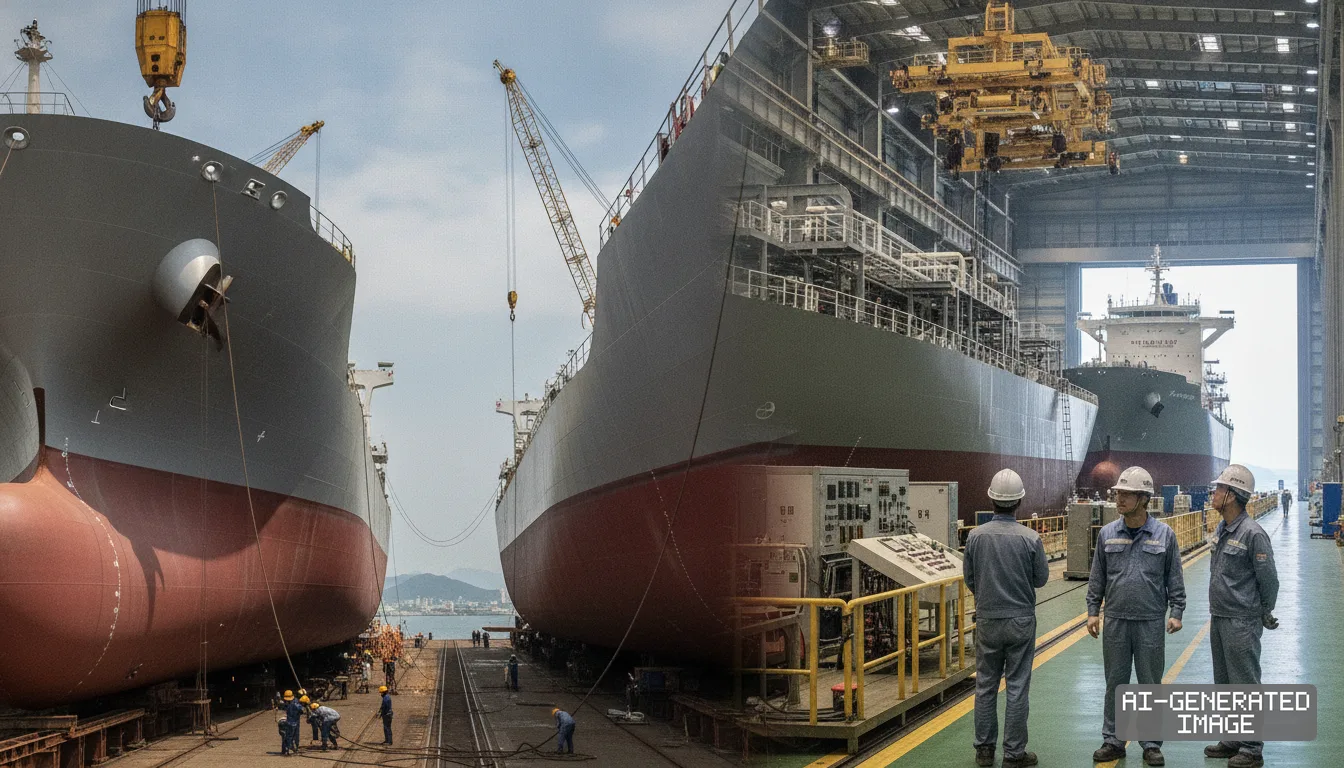
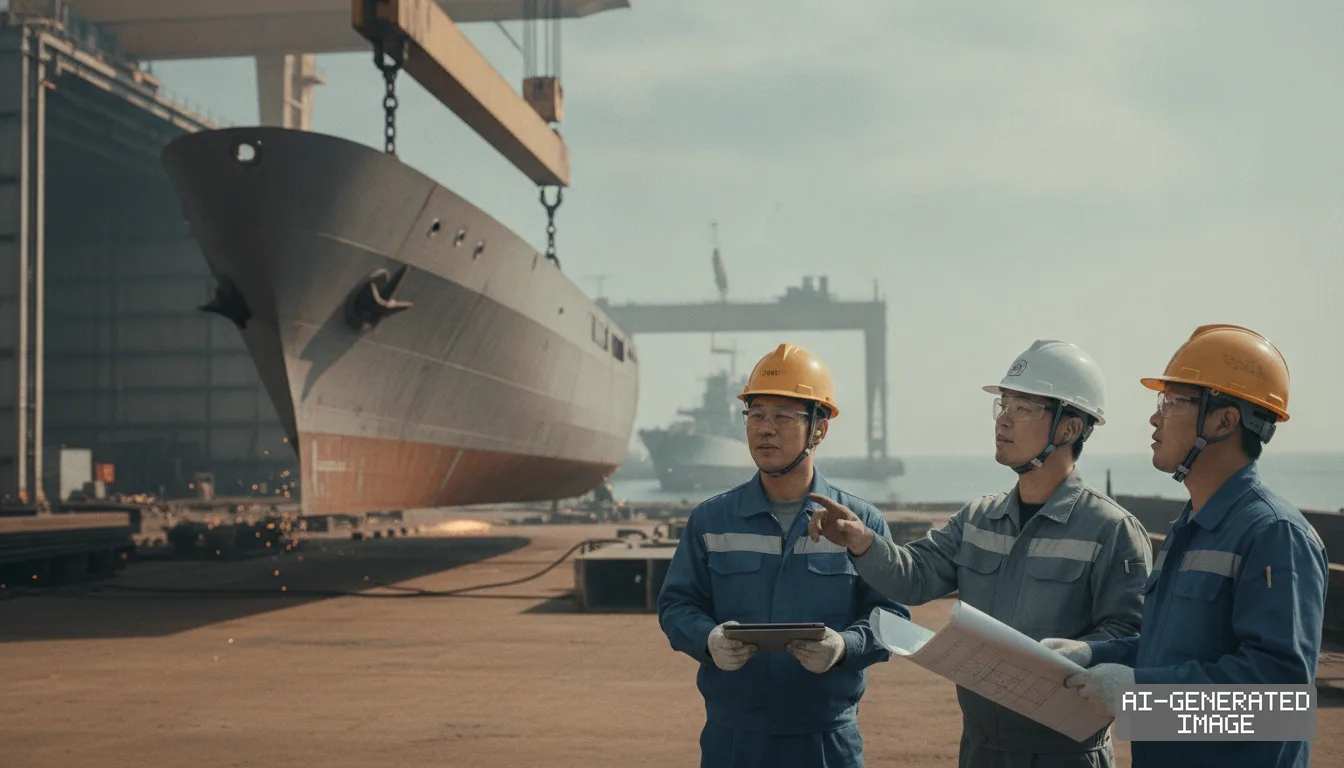
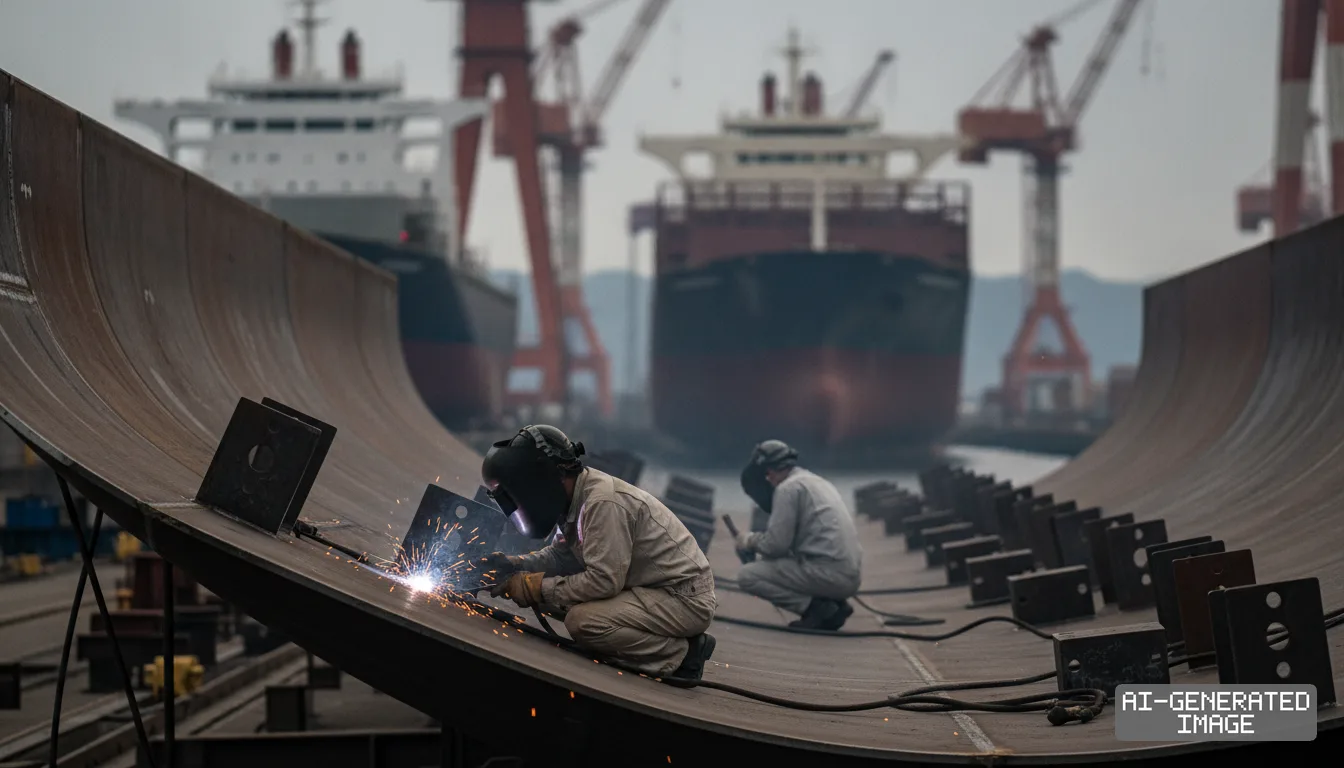
Samsung Heavy awards GTT tank design for two LNG carriers
The contract equips two vessels for Japanese shipowner K Line with Mark III Flex membranes, highlighting the yard's continued royalty payments to France.
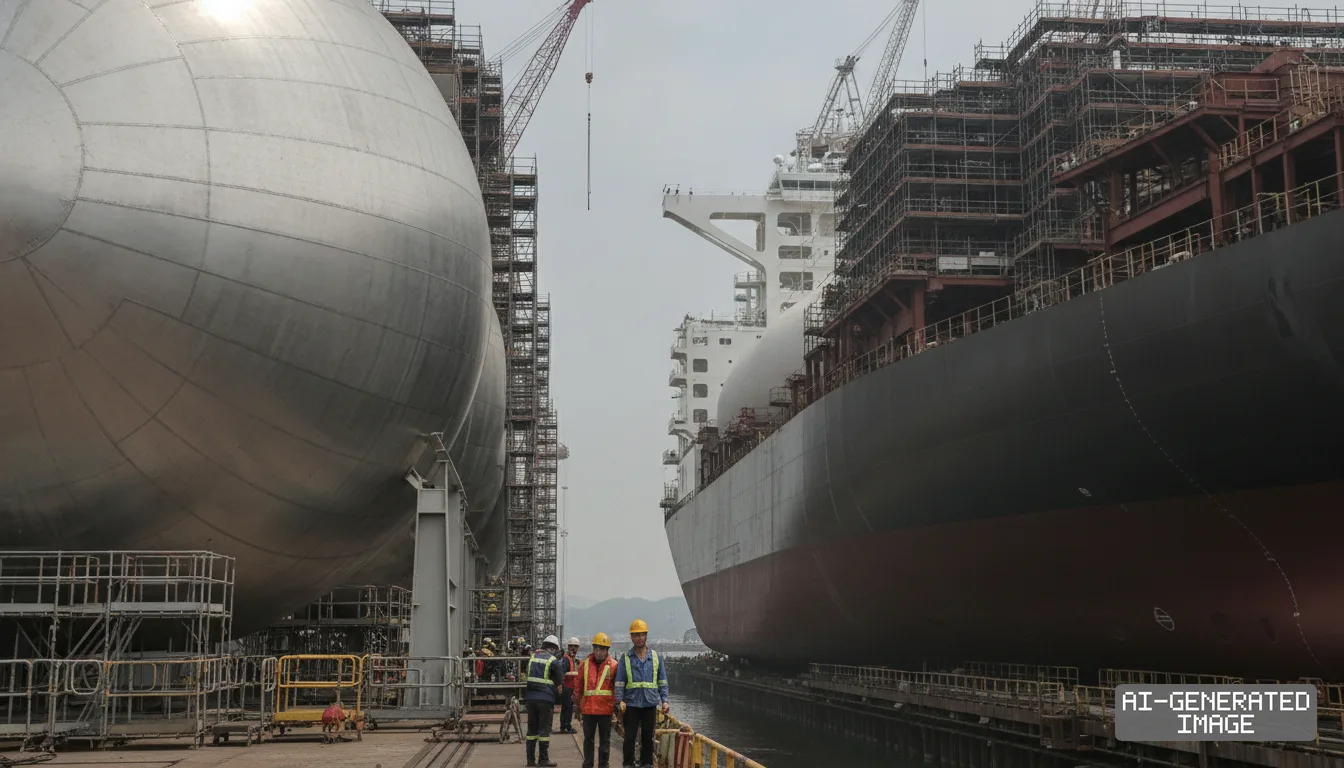
French engineering company GTT said Nov. 4 it won an order from Samsung Heavy Industries to design cryogenic cargo tanks for two liquefied natural gas carriers.
The vessels will each carry 174,000 cubic meters of liquefied natural gas. Samsung Heavy Industries will build the hulls for Japanese shipping company Kawasaki Kisen Kaisha, known as K Line.
Cryogenic membrane licensing consumes about 5% of total contract value on standard gas carriers, industry contract records show. That fee transfers roughly 10 billion won to 13 billion won ($7.3 million to $9.5 million) per vessel from South Korean yard revenues.
Samsung Heavy Industries will fit both vessels with GTT's proprietary Mark III Flex containment system. The technology uses corrugated stainless steel primary barriers backed by reinforced polyurethane foam insulation to store cargo at minus 162 degrees Celsius.
The design maintains a daily boil-off rate — cargo volume lost to vapor during transit — of 0.085%. Global energy charterers require that thermal benchmark before approving long-term shipping fixtures across transpacific routes.
Samsung Heavy Industries relies on GTT containment technology for nearly all its commercial export orders. The Geoje-based shipbuilder booked multiple design packages with the French firm earlier this year for Greek, European and Asian shipowners.
Japanese shipowner K Line selected the Mark III Flex design to guarantee charter compliance with international energy producers. Charterers financing long-term supply agreements routinely refuse vessels built with untested containment systems.
GTT holds more than 90% of the worldwide market for cryogenic membrane tank patents. South Korean shipyards dominate global construction slots for large gas carriers but depend on the French designer for core tank architecture.
South Korea's major shipbuilders have tried to break that intellectual property monopoly for more than a decade. State utility Korea Gas Corporation and domestic yards developed the indigenous KC-1 and KC-2 membrane containment systems to eliminate foreign licensing costs.
Technical disputes and cargo tank insulation defects on early KC-1 installations halted broader commercial deployment. The setbacks damaged international confidence in domestic containment alternatives among foreign vessel owners and charterers.
Samsung Heavy Industries engineered its own cargo tank architecture, known as KCS, in an effort to reduce dependency. Rival shipbuilder Hanwha Ocean developed a proprietary tank design branded Solidus with low daily boil-off ratings.
Neither proprietary domestic system has won standard commercial export contracts from major international shipping lines. Shipowners insist on decades of logged ocean transits before committing hundreds of millions of dollars to new hull designs.
The licensing structure leaves South Korean yards vulnerable to margin compression on complex vessels. While high global demand keeps newbuild prices near $260 million per vessel, fixed royalty outflows transfer substantial operating profit directly to Paris.
GTT also manages the qualification process for suppliers of specialized tank materials. Secondary barrier materials, glass-fiber joints and invar alloy sheets require GTT technical certification before shipyards can install them in containment holds.
That technical oversight limits the ability of South Korean builders to negotiate procurement discounts with material vendors. Insulation panels and membrane sheet metal must match strict engineering drawings approved by GTT inspectors.
Chinese shipbuilders face identical licensing constraints as they expand gas carrier capacity. State-owned yards, including Hudong-Zhonghua Shipbuilding and Jiangnan Shipyard, hold GTT licenses and account for more than 20% of new global gas carrier orders.
Competition from Chinese yards has not loosened GTT's grip on containment pricing. Because Chinese and South Korean yards both rely on Mark III Flex and NO96 patents, GTT collects royalties regardless of which yard wins the hull order.
South Korean shipyards delivered more than 70% of the world's operational LNG carriers over the last two decades. The continuous construction volume created an annuity-like revenue stream for GTT across multiple shipbuilding investment cycles.
Antitrust regulators in South Korea attempted to curb GTT's commercial practices in previous licensing disputes. Legal action focused on unbundling patent licenses from technical assistance packages, but yards remain reliant on comprehensive GTT engineering support.
Energy majors and maritime classification societies enforce rigorous technical standards for cryogenic containment. A structural leak in a loaded cargo tank can immobilize a carrier for months and inflict tens of millions of dollars in charterer damages.
Global demand for LNG carriers remains supported by new liquefaction terminals under construction in North America and Qatar. Rising project final investment decisions continue to book South Korean yard capacity through 2028 and 2029.
Delivery of the two vessels is scheduled for the first quarter of 2029, when Samsung Heavy Industries completes sea trials and transfers the hulls.
The notice does not state the exact engineering contract value or the specific royalty rate paid per hull, and Samsung Heavy Industries has not published a separate regulatory filing on the subcontract.
Impact map
How this development propagates across the region and out to global buyers.
| Event | Korea | China | Japan | Global impact |
|---|---|---|---|---|
| GTT membrane design order | Samsung Heavy Industries pays estimated 5% royalty per hull, absorbing yard gross margins | Hudong-Zhonghua and Jiangnan face identical GTT licensing fee burdens on export slots | K Line secures proven Mark III Flex tanks required by global LNG charterers | Containment monopoly preserves GTT licensing power across 90% of active order books |
In this story
- Companies
- Samsung Heavy IndustriesGTT
- Tickers
- 010140.KSGTT.PA
- Exposed
- Kawasaki Kisen KaishaHanwha Ocean
- Impact
- Cost StructureSupply ChainOrder Book
Related briefings
- Seven Japanese firms order ammonia car carriers for 2030 fleet Also on Kawasaki Kisen Kaisha, Order Book
- Hanwha Ocean awards GTT tank design for two new LNG carriers by 2029 Also on GTT, Samsung Heavy Industries, Hanwha Ocean
- Samsung Heavy orders GTT tank designs for four LNG ships Also on GTT, Samsung Heavy Industries, Hanwha Ocean
- Samsung Heavy taps GTT to design tanks for four LNG carriers Also on GTT, Samsung Heavy Industries, Cost Structure
Sources
Reporting
Confidence: medium — how we grade this
The documents behind this briefing are linked above. East Asia Brief produces its English text with AI assistance under human editorial review, and does not translate or republish other outlets' articles. See our methodology and AI policy. Spotted an error? Tell us.
The Morning Brief
What changed in Korean, Chinese and Japanese industry overnight — and what it means for your supply chain. One email, weekday mornings, US time. Free.
The Morning Brief is in preparation. Leave your address and we will write to you once — when the first issue is ready. Nothing before that.