Seven Japanese firms order ammonia car carriers for 2030 fleet
A seven-company alliance including NYK, K-Line and JERA will build four export vessels and a bunkering tanker, backed by 70,000 annual tonnes of green ammonia from India.
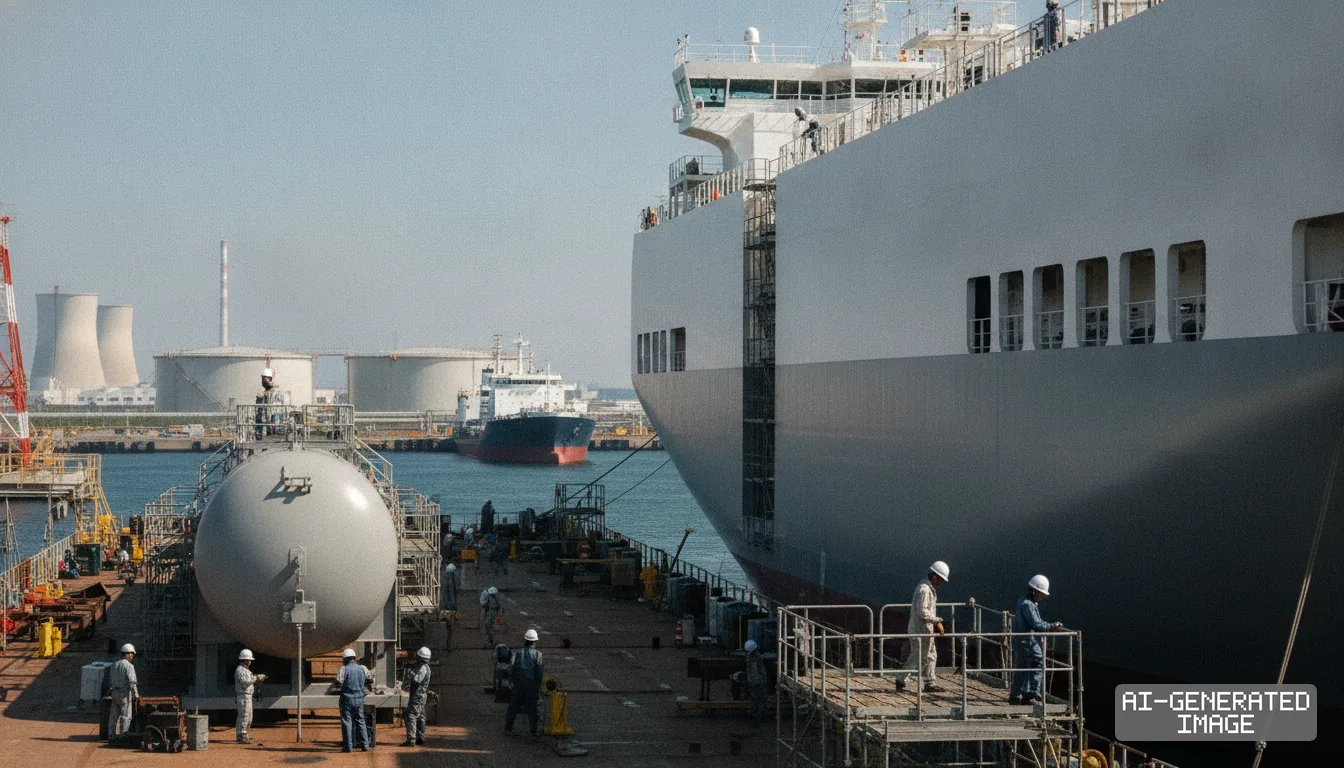
Seven Japanese shipping, shipbuilding and energy companies formed a joint consortium on Oct. 28, 2026 to build four ammonia-fueled car carriers and establish a domestic commercial bunkering supply chain.
Under the project agreement, Japanese power generator JERA signed a binding contract to purchase roughly 70,000 tonnes of green ammonia annually over five years from India's AM Green Ammonia.
The import volume provides the initial bunker baseline for the fleet, marking one of the shipping sector's first long-term procurement pacts for zero-emission marine fuel.
Nippon Yusen Kabushiki Kaisha (NYK) and Kawasaki Kisen Kaisha (K-Line) will each purchase, own and operate two of the four pure car and truck carriers.
The four vessels will transport finished export cars across intercontinental trade lanes, providing dedicated low-carbon maritime transport capacity for Toyota Motor Corporation from Japanese coastal assembly plants.
Shin Kurushima Dockyard will head the basic design phase for the specialized vehicle vessels, drawing on its existing production track record in automotive carrier construction.
Imabari Shipbuilding and Nihon Shipyard, a joint venture of Imabari and Japan Marine United, will then execute detailed engineering and split vessel construction with Shin Kurushima.
Each carrier will feature dual-fuel main engines capable of burning either ammonia or marine diesel, supported by cryogenic fuel tanks installed beneath the automotive cargo decks.
The onboard tanks will store enough ammonia to complete a trans-Pacific voyage without relying on fossil fuel, according to technical design targets published by the group.
Ammonia emits no carbon dioxide during combustion, but maritime deployment requires strict containment because the chemical is corrosive and presents lethal toxicity risks to ship crews.
The shipbuilders will integrate multilayered safety barriers, including automated toxic gas detectors, double-walled piping conduits and catalytic neutralization scrubbers to capture accidental leaks before vapor escapes.
To fuel the car carriers, Kyokuyo Shipyard will build one specialized ammonia bunkering vessel, with completion timed to match the car carrier delivery cycle.
NYK or a wholly owned NYK subsidiary will take delivery, assume vessel ownership and oversee daily marine navigation for the bunkering tanker.
NYK and K-Line will establish a 50:50 joint venture to purchase ammonia feedstock, sell marine bunkers to carriers and coordinate ship-to-ship fueling operations.
The bunkering enterprise will concentrate transfer operations at the Port of Nagoya and the Port of Mikawa, conducting vessel-to-vessel fuel transfers while car carriers load cargo.
Both ports anchor high-volume finished vehicle export hubs in Aichi Prefecture, where Toyota and regional component suppliers move vehicles destined for dealerships in North America and Europe.
JERA will install ship-loading infrastructure, transfer pipelines and dedicated bunkering berths at the ammonia import terminal adjacent to its Hekinan Thermal Power Station in Aichi Prefecture.
The Hekinan marine terminal will receive green ammonia shipments dispatched across the Indian Ocean from AM Green's production hub in Kakinada, located in Andhra Pradesh.
The Kakinada facility will synthesize green ammonia using alkaline water electrolyzers powered by dedicated wind farms, solar fields and integrated pumped-hydro power storage installations.
The fuel supply agreement represents JERA's first commercial foray into maritime bunkering, extending its ammonia logistics network beyond experimental co-firing tests at coal-fired electricity generation stations.
For Japan's maritime cluster, the joint enterprise functions as a coordinated defensive strategy against the rapid commercial expansion of Chinese and South Korean shipbuilding facilities.
Chinese shipbuilders captured more than 80% of global car carrier orders between 2021 and 2024, winning massive multi-ship contracts through lower yard costs and early dock availability.
Chinese yards such as China Merchants Jinling Shipyard constructed extensive series of vehicle carriers configured for liquefied natural gas dual-fuel propulsion, establishing dominant global market share.
South Korean shipbuilders have meanwhile locked up dock capacity through 2028 with lucrative liquefied natural gas carriers and large container vessels, leaving little berth space for car carriers.
Rather than contesting commoditized gas-fueled car carrier contracts on price, Japanese yards are attempting to leapfrog rivals by commercializing the first complete operational standard for ammonia.
Japanese shipping companies previously established the domestic standard for LNG bunkering by creating Central LNG Marine Fuel Japan, an operating consortium grouping NYK, K-Line, JERA and Toyota Tsusho.
The seven companies are repeating that cross-industry alignment model to resolve the simultaneous fleet and bunkering bottlenecks that typically stall commercial adoption of next-generation marine fuels.
Global car manufacturers face stricter greenhouse gas penalties under European Union maritime emissions rules, forcing shipping operators to eliminate fossil emissions rather than relying on transitional fossil gas.
Automotive exporters such as Toyota require ocean carriers to demonstrate measurable supply-chain decarbonization pathways to comply with environmental reporting mandates in destination retail markets.
Deliveries of all four pure car carriers and the dedicated bunkering vessel are scheduled for 2030, aligning with the planned commercial startup of AM Green's Kakinada export plant.
The consortium does not state the total capital expenditure required for the five vessels, and the shipyards have not published individual construction hull allocations across their facilities.
Impact map
How this development propagates across the region and out to global buyers.
| Event | Korea | China | Japan | Global impact |
|---|---|---|---|---|
| Japan ammonia car carrier alliance | Major shipyards face early Japanese standardization in ammonia-fueled automotive transport | Commercial yards face challenge to LNG dominance as Japan moves directly to zero-emission ammonia | Seven companies anchor vehicle exports to domestic bunkering and shipbuilding infrastructure | Ocean car transport gains first scalable ammonia supply chain linking India, Japan and trans-Pacific routes |
In this story
- Companies
- NYK LineKawasaki Kisen KaishaJERAImabari ShipbuildingShin Kurushima DockyardNihon ShipyardKyokuyo Shipyard
- Tickers
- 9101.T9107.T
- Exposed
- Toyota Motor CorporationAM Green
- Policy
- Standards
- Impact
- Supply ChainCapexOrder Book
Track every Standards development →
Related briefings
- Japan Clears $635 Million in Subsidies to Modernize Shipyards by 2035 Also on Shin Kurushima Dockyard, Imabari Shipbuilding, Order Book
- Imabari Shipbuilding wins two Aframax tankers from Carlova by 2030 Also on Nihon Shipyard, Imabari Shipbuilding, Order Book
- Imabari and JMU consolidate dry bulk engineering to standardize ammonia dual-fuel vessels Also on Nihon Shipyard, Imabari Shipbuilding, Order Book
- HD Hyundai secures ClassNK design approval for 35,000 cbm ammonia carrier Also on JERA, Order Book
Sources
Reporting
Confidence: medium — how we grade this
The documents behind this briefing are linked above. East Asia Brief produces its English text with AI assistance under human editorial review, and does not translate or republish other outlets' articles. See our methodology and AI policy. Spotted an error? Tell us.
The Morning Brief
What changed in Korean, Chinese and Japanese industry overnight — and what it means for your supply chain. One email, weekday mornings, US time. Free.
The Morning Brief is in preparation. Leave your address and we will write to you once — when the first issue is ready. Nothing before that.