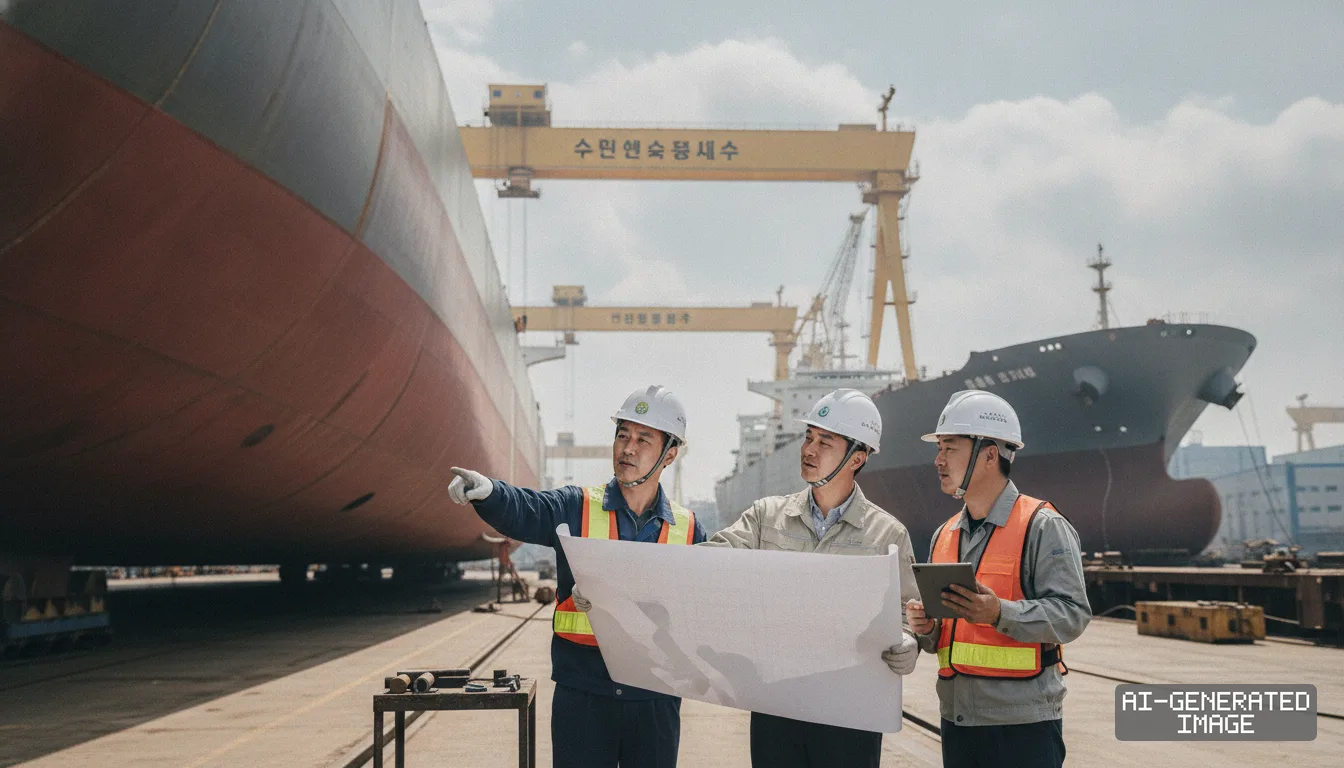
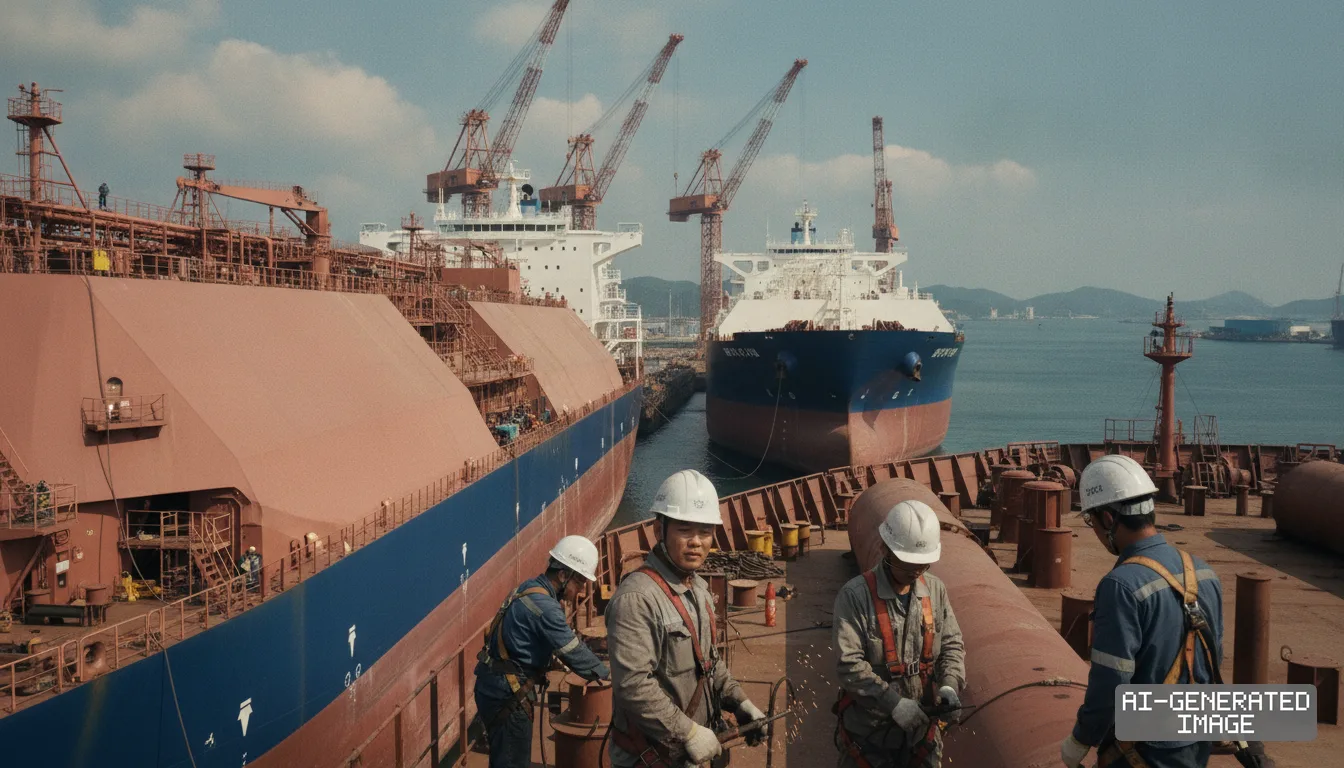
India courts Korean shipbuilders for mega yard in Tamil Nadu
New Delhi and HD Hyundai advance joint venture talks for a 2.5 million gross ton dock in Thoothukudi as India seeks five percent of global shipbuilding output.
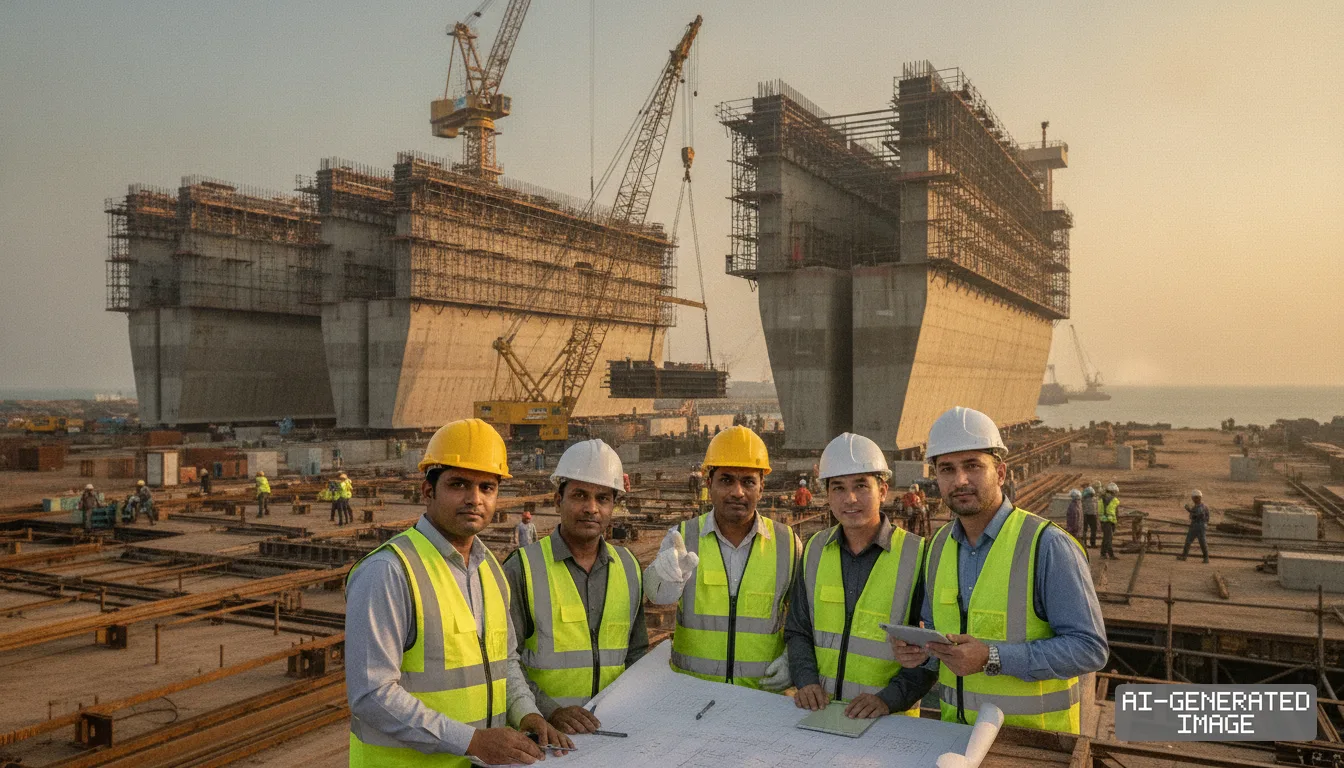
India's Ministry of Ports, Shipping and Waterways concluded bilateral yard negotiations on Oct. 30, 2026, formalizing joint venture talks with South Korean shipbuilders to construct commercial dry docks.
The flagship proposal centers on a greenfield yard in Thoothukudi, Tamil Nadu, designed for 2.5 million gross tons of annual capacity. That facility represents 55% of New Delhi's long-term national shipbuilding target.
The initiative anchors Maritime Amrit Kaal Vision 2047, a master plan targeting 4.5 million gross tons of yearly output. The policy aims to position India among the world's five largest shipbuilding nations.
Union Minister Sarbananda Sonowal completed a four-day mission across Seoul and Busan, meeting Korean shipyard executives and diaspora engineers to pitch joint equity investments, according to ministry releases.
Sonowal met HD Hyundai Chairman Chung Ki-sun in Seoul on Oct. 28, 2026. Both sides agreed to set up a Joint Working Group to steer project development and hammer out a corporate joint venture.
The partners agreed to finalize a Detailed Project Report within six months. That engineering and commercial study will establish the final equity structure and operational specifications before April 2027.
The project formalizes a tripartite memorandum signed on April 20, 2026 between HD Korea Shipbuilding & Offshore Engineering, state enterprise NSHIP-TN and Sagarmala Finance Corporation.
That initial agreement was exchanged under VOYAGES, a bilateral framework established during state-level summit discussions in New Delhi to link Korean shipyard engineering with Indian maritime infrastructure.
South Korean yards face severe physical constraints at home. HD Korea Shipbuilding & Offshore Engineering holds order backlogs extending past three years, with primary docks running above 100% utilization.
High-value liquefied natural gas carriers and dual-fuel container vessels occupy more than 70% of Korean drydock capacity. That backlog leaves little operational space to construct bulkers, tankers and offshore modules.
Severe domestic labor shortages worsen the capacity ceiling. Korean yards employ more than 15,000 foreign production workers on specialized visas, driving domestic shipbuilders to seek overseas hull-block manufacturing bases to compress costs.
India offers an expanding industrial workforce with baseline welding and fabrication wages roughly 70% below South Korean shipyard payrolls. Indian coastal states also possess deep-water waterfront parcels that domestic Korean yards lack.
Hanwha Ocean and Samsung Heavy Industries also confront tight berth availability at their Geoje shipyards. High-margin gas carriers account for roughly 60% of their order books, restricting space for merchant hulls.
Sonowal held talks with Indian engineers working at HD Hyundai, Hanwha Ocean and Samsung Heavy Industries in Busan on Oct. 25, 2026, urging them to transfer advanced yard management skills back home.
To attract foreign yard operators, New Delhi established the Shipbuilding Financial Assistance Scheme with 247.36 billion rupees ($2.95 billion) in funding to offset structural cost disadvantages against foreign competitors.
The Indian government also established a 250 billion rupee ($2.98 billion) Maritime Development Fund to finance long-term shipyard infrastructure, appointing SBI Ventures as the principal fund manager in May 2026.
On Oct. 30, 2026, the Korea Marine Equipment Association opened its first India liaison office in Mumbai. The facility establishes a dedicated channel for South Korean component suppliers entering Indian maritime hubs.
The association represents more than 280 Korean marine machinery and equipment manufacturers. The Mumbai office will coordinate localized manufacturing of cryogenic equipment, piping packages and structural steel assemblies across Indian coastal zones.
For South Korean shipbuilders, partnering on Indian dry docks offers a viable path to decentralize production. Sub-assembled blocks and complete vessel hulls built in Tamil Nadu can support domestic construction schedules or serve regional buyers.
India currently accounts for less than 1% of global commercial shipbuilding volume. Domestic yards face high coastal shipping taxes, limited local steel plate sizing options and longer customs clearance intervals than East Asian yards.
While Indian mills provide basic structural steel, domestic yards still import propulsion systems, cryogenic containment materials and advanced navigation packages, requiring established South Korean suppliers to anchor local manufacturing clusters.
The ministry notice does not state the capital expenditure split or the exact equity shareholding between HD Korea Shipbuilding & Offshore Engineering and Indian state partners.
The joint working group will convene its initial technical session in New Delhi in January 2027 to assess site surveys before the detailed project report review closes in late April.
Impact map
How this development propagates across the region and out to global buyers.
| Event | Korea | China | Japan | Global impact |
|---|---|---|---|---|
| India-Korea mega shipyard partnership | HD KSOE secures low-cost block fabrication base to relieve domestic drydock bottlenecks | State shipyards face long-term low-end bulk and tanker competition from subsidized Indian yards | Imabari and Nihon Shipyard face pricing pressure as Indian capacity comes online under Korean design licenses | Commercial fleet renewal expands as 2.5 million gross tons of annual greenfield berth capacity enters construction pipeline |
In this story
- Companies
- HD Korea Shipbuilding & Offshore EngineeringHD Hyundai
- Tickers
- 009540.KS267250.KS
- Exposed
- Hanwha OceanSamsung Heavy Industries
- Policy
- Subsidies
- Impact
- CapexSupply ChainOrder Book
Track every Subsidies development →
Related briefings
- HD Hyundai will automate shipyards with digital twins by 2030 Also on HD Hyundai, HD Korea Shipbuilding & Offshore Engineering, Samsung Heavy Industries
- South Korea commits $1 billion to shipyard robots and yard AI Also on HD Hyundai, Samsung Heavy Industries, Hanwha Ocean
- Hormuz Tanker Transits Plunge as Freight Costs Spike Also on HD Hyundai, Samsung Heavy Industries, Hanwha Ocean
- HD Hyundai Heavy union votes down wage deal, reopening talks Also on HD Hyundai, Samsung Heavy Industries, Hanwha Ocean
Sources
Primary documents
Reporting
Confidence: high — how we grade this
The documents behind this briefing are linked above. East Asia Brief produces its English text with AI assistance under human editorial review, and does not translate or republish other outlets' articles. See our methodology and AI policy. Spotted an error? Tell us.
The Morning Brief
What changed in Korean, Chinese and Japanese industry overnight — and what it means for your supply chain. One email, weekday mornings, US time. Free.
The Morning Brief is in preparation. Leave your address and we will write to you once — when the first issue is ready. Nothing before that.