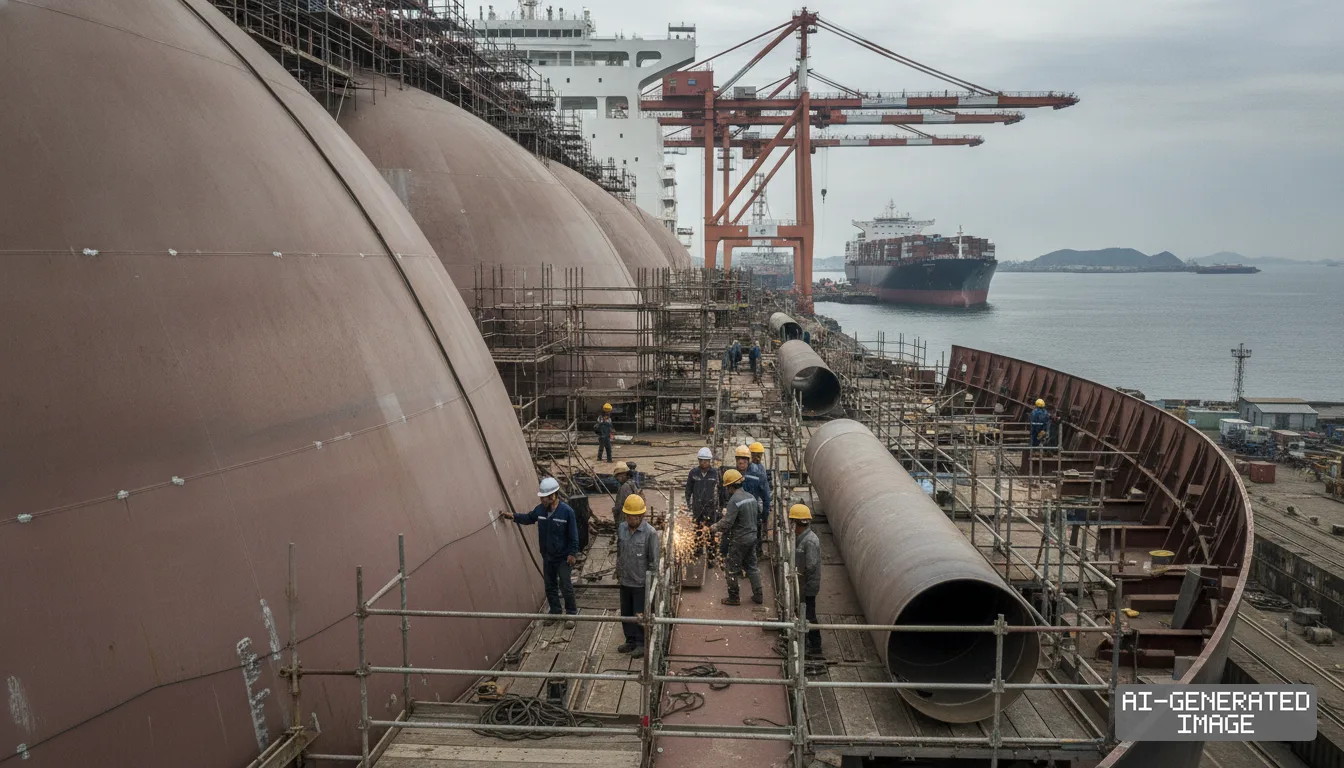
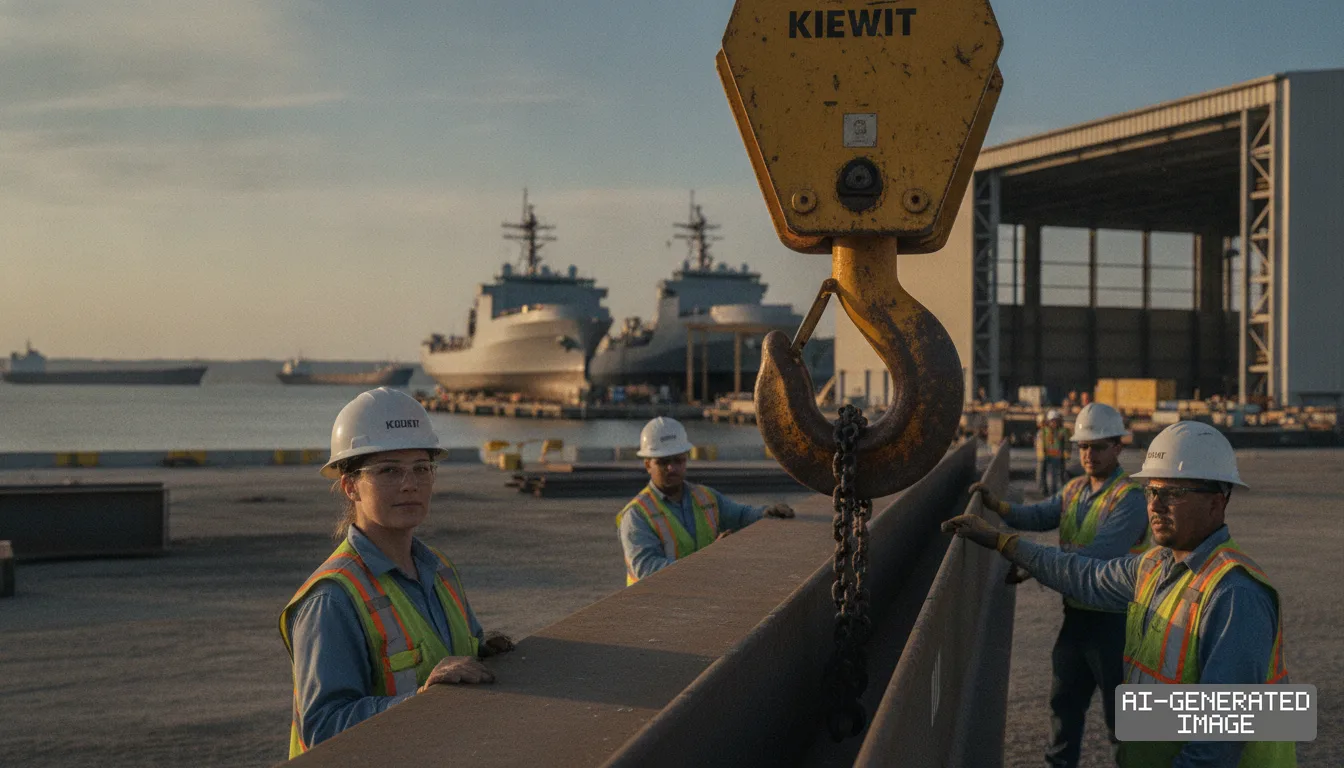
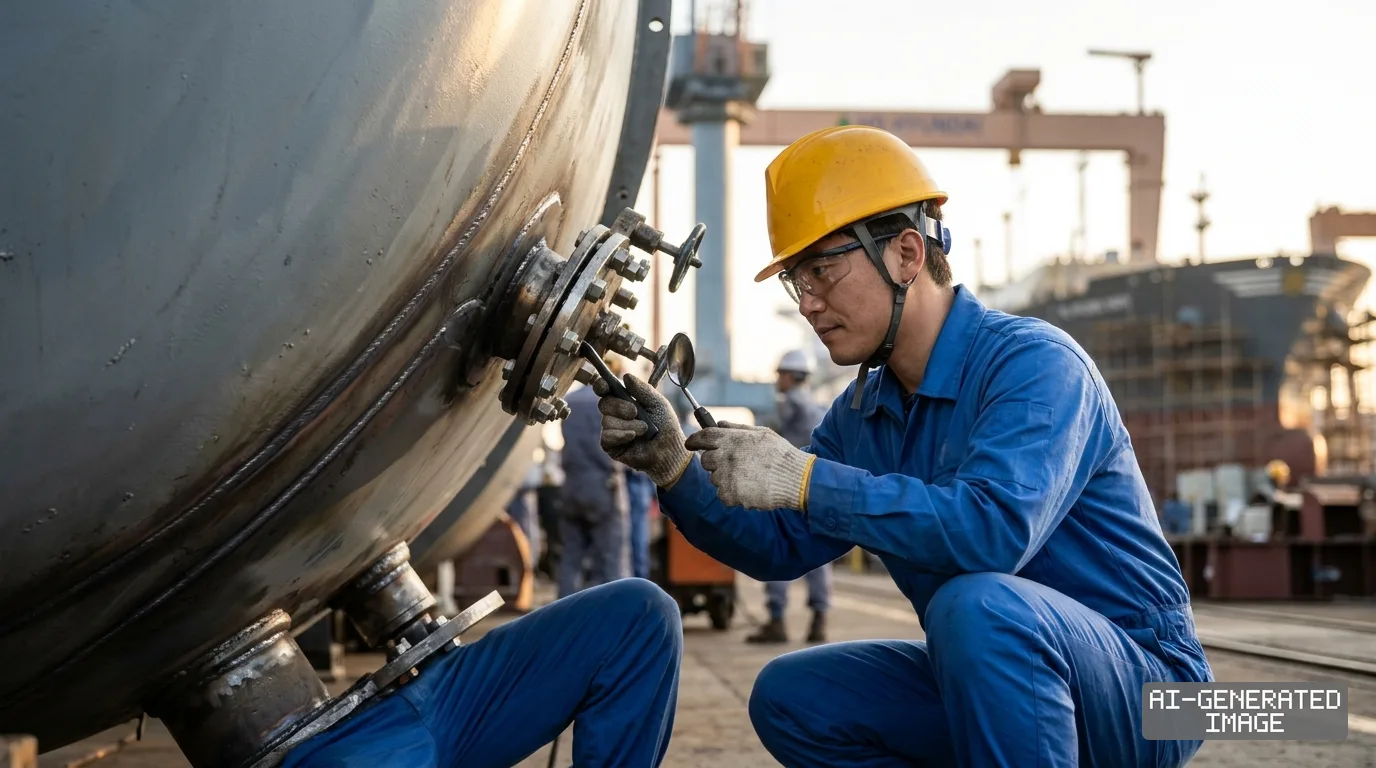
HD Hyundai displays automated LNG tank assembly on $280M carrier
Fitting 11,000 stainless steel sheets at Ulsan shields yard margins against 5% membrane license royalties owed to French designer GTT.
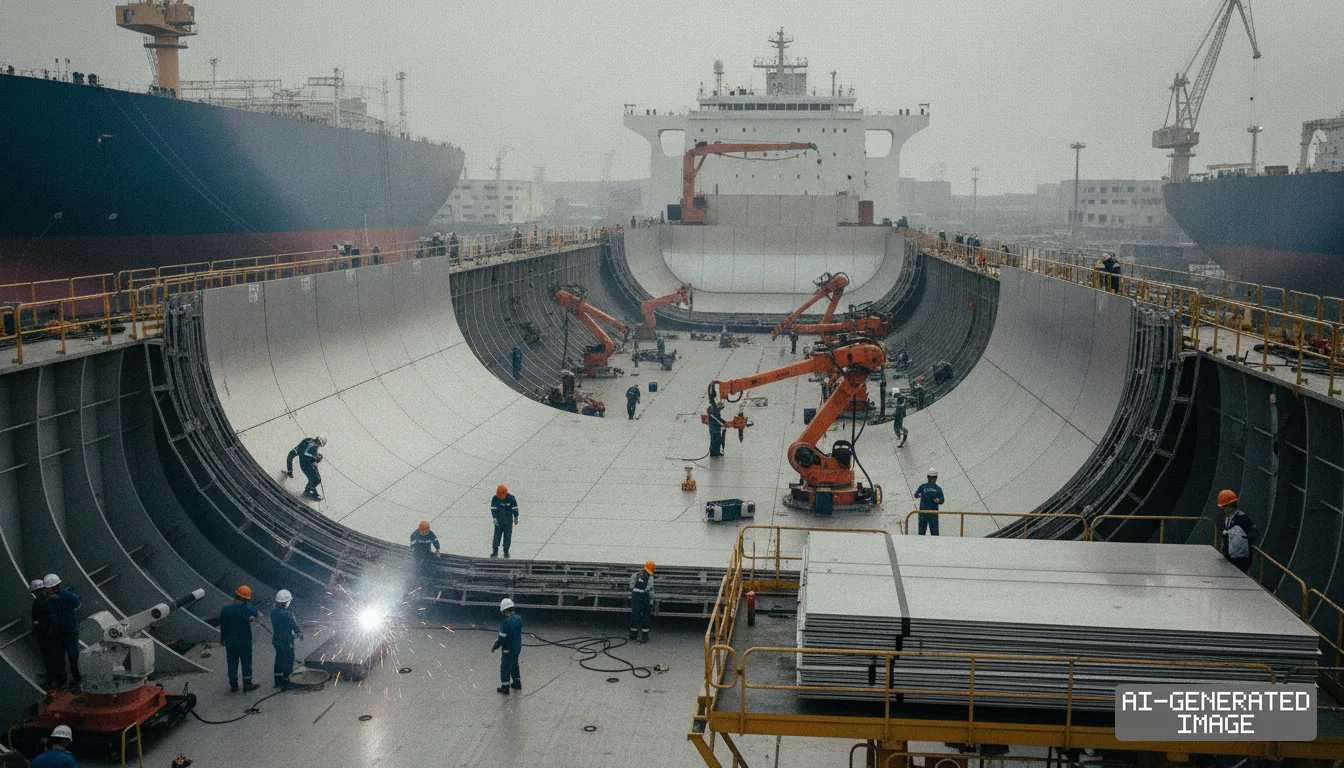
HD Hyundai Heavy Industries opened its Ulsan assembly docks on Nov. 15, 2026, displaying the manual and automated fitting of 11,000 stainless steel sheets inside an export-bound liquefied natural gas carrier hold.
The tour showcased a 174,000-cubic-meter LNG carrier ordered by a European shipping line for roughly 370 billion won ($280 million). The vessel measures 300 meters in length, 46 meters in beam and 35 meters in depth.
Royalties paid to French engineering specialist Gaztransport & Technigaz claim about 5% of that contract price, or roughly $14 million per vessel. That structural fee applies to virtually all large-scale membrane carriers ordered globally.
The primary barrier of each cargo hold consists of 1.2-millimeter-thick corrugated stainless steel plates measuring three meters by one meter. Workers weld roughly 11,000 sheets to line the cryogenic hold and contain liquefied gas chilled to minus 163 degrees Celsius.
Total welding lines stretch between 60 kilometers and 190 kilometers across the vessel's cargo tanks. A single microscopic breach in the seam can allow boiling gas to crack the ship's outer structural hull.
Behind the metallic membrane sits a 48-centimeter-thick insulation layer backed by a secondary barrier of composite material known as triplex. The insulation assembly can withstand cryogenic liquid leaks for up to 15 days without compromising the carbon-steel hull.
Constructing the vessel requires 26 months from initial fabrication to handoff. HD Hyundai Heavy Industries allocates 12 months for design and engineering work, followed by 14 months of physical production at its Ulsan shipyard.
A dedicated insulation workforce of roughly 2,000 specialists handles cargo hold outfitting at the yard. That labor pool allows the shipbuilder to outfit three vessels, or 12 individual cargo holds, at the same time.
HD Hyundai Heavy Industries has secured construction contracts for 22 LNG carriers so far in 2026, marking an annual record for the company. The builder delivered the showcased vessel into the water in July 2026 for outfitting.
The demonstrated containment architecture does not rely on an indigenous Korean containment system. The Ulsan shipyard builds under license from Paris-based Gaztransport & Technigaz, using standard Mark III Flex membrane blueprints shared across Asian shipbuilders.
Both South Korean and Chinese shipbuilders purchase identical tank drawings from the French licensor, LNG production manager Chung Kang-wook said during the yard tour. The competitive gap between competing yards rests entirely on installation speed and seam precision.
By deploying mechanized plasma arc welding systems, HD Hyundai Heavy Industries limits manual torch errors across tens of kilometers of seams. The yard achieves zero-defect clearance under pressurized helium tests before vessels enter gas trials.
Executing the insulation and welding sequence faster lets the shipbuilder rotate hulls through dry docks ahead of rival Asian yards. That dock velocity protects operating margins despite the royalty payments remitted to France.
To capture structural savings beyond installation speed, HD Hyundai Heavy Industries partnered with Gaztransport & Technigaz to develop a three-tank cargo architecture. Eliminating one transverse bulkhead expands usable cargo capacity from 174,000 cubic meters to 176,800 cubic meters.
Shipping company BW LNG ordered four 177,000-cubic-meter vessels featuring the three-tank configuration. Those contracts carry an aggregate value exceeding $1 billion and will be constructed by group affiliate HD Hyundai Samho.
The simplified hull geometry reduces total cargo surface area, cutting the daily boil-off rate to 0.08%. Norwegian classification society DNV approved the structural design after extensive testing for cryogenic sloshing loads.
The shipbuilder did not disclose the internal manufacturing cost of its proprietary automated plasma welding rigs, and company filings do not specify the exact margin gap between its four-tank and three-tank construction sequences.
Quayside finishing work on the showcased 174,000-cubic-meter carrier continues through the winter in Ulsan. The European shipowner takes delivery of the finished vessel in April 2027, while deliveries for the four-ship BW LNG series run from late 2028 through 2029.
Impact map
How this development propagates across the region and out to global buyers.
| Event | Korea | China | Japan | Global impact |
|---|---|---|---|---|
| LNG cargo tank fabrication | HD Hyundai Heavy Industries leverages 2,000 insulation workers to build 22 LNG carriers in 2026 | Competing yards rely on identical GTT blueprints but lag behind Ulsan dock rotation cycles | Domestic yards remain absent from standard 174,000-cbm large-carrier order books | GTT captures ~5% of newbuild vessel prices while European owners secure deliveries through 2029 |
In this story
- Companies
- HD Hyundai Heavy IndustriesGaztransport & Technigaz
- Tickers
- 329180.KSGTT.PA
- Exposed
- BW LNGDNV
- Policy
- Standards
- Impact
- Cost StructureCapexSupply Chain
Track every Standards development →
Related briefings
- HD Hyundai Unveils Three-Tank LNG Carrier Design at Gastech Also on BW LNG, DNV
- HD Hyundai Samho builds three-tank LNG carriers for BW LNG Also on BW LNG, Gaztransport & Technigaz, Cost Structure
- SK On and GS Caltex Advance Immersion Cooling Packs for High-Voltage EV Fleets Also on DNV, Cost Structure
- Samsung Wins Class Approval for Hybrid Tanker Also on DNV, Cost Structure
Sources
Reporting
Confidence: medium — how we grade this
The documents behind this briefing are linked above. East Asia Brief produces its English text with AI assistance under human editorial review, and does not translate or republish other outlets' articles. See our methodology and AI policy. Spotted an error? Tell us.
The Morning Brief
What changed in Korean, Chinese and Japanese industry overnight — and what it means for your supply chain. One email, weekday mornings, US time. Free.
The Morning Brief is in preparation. Leave your address and we will write to you once — when the first issue is ready. Nothing before that.