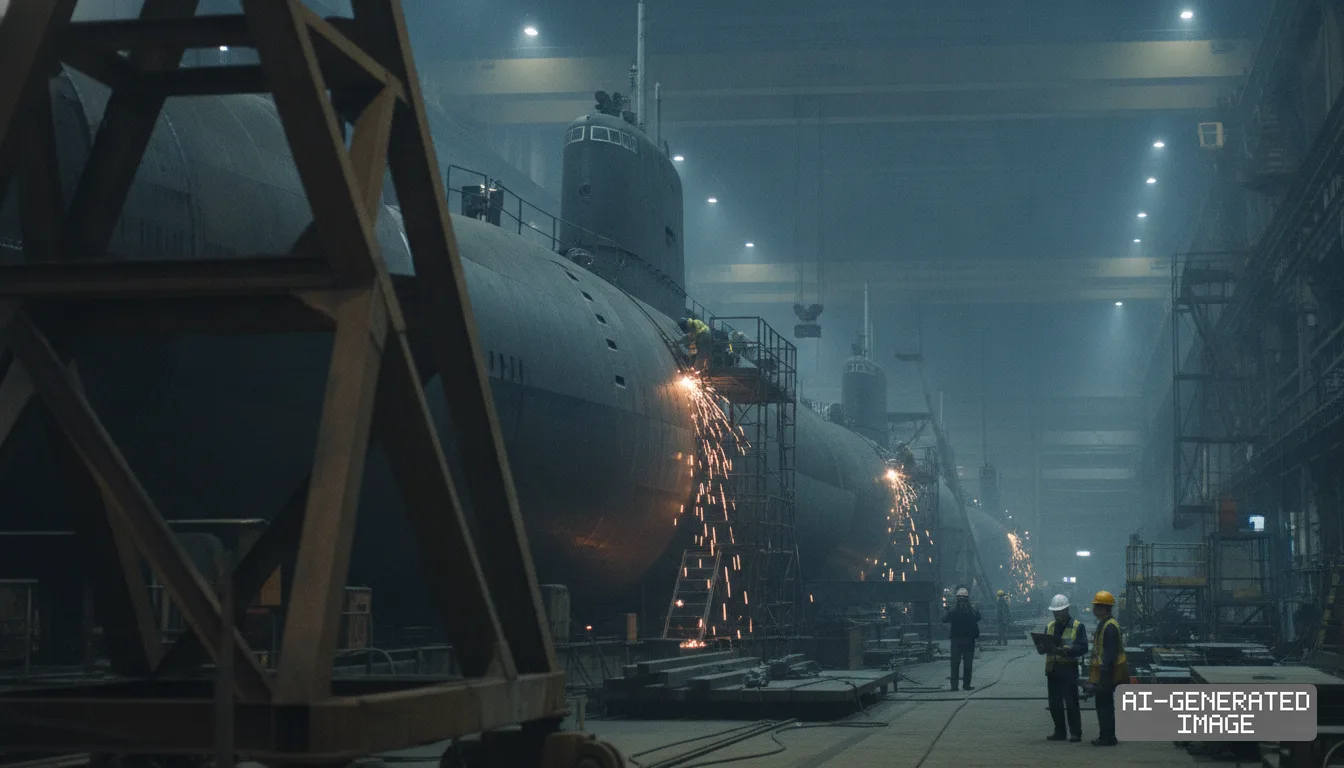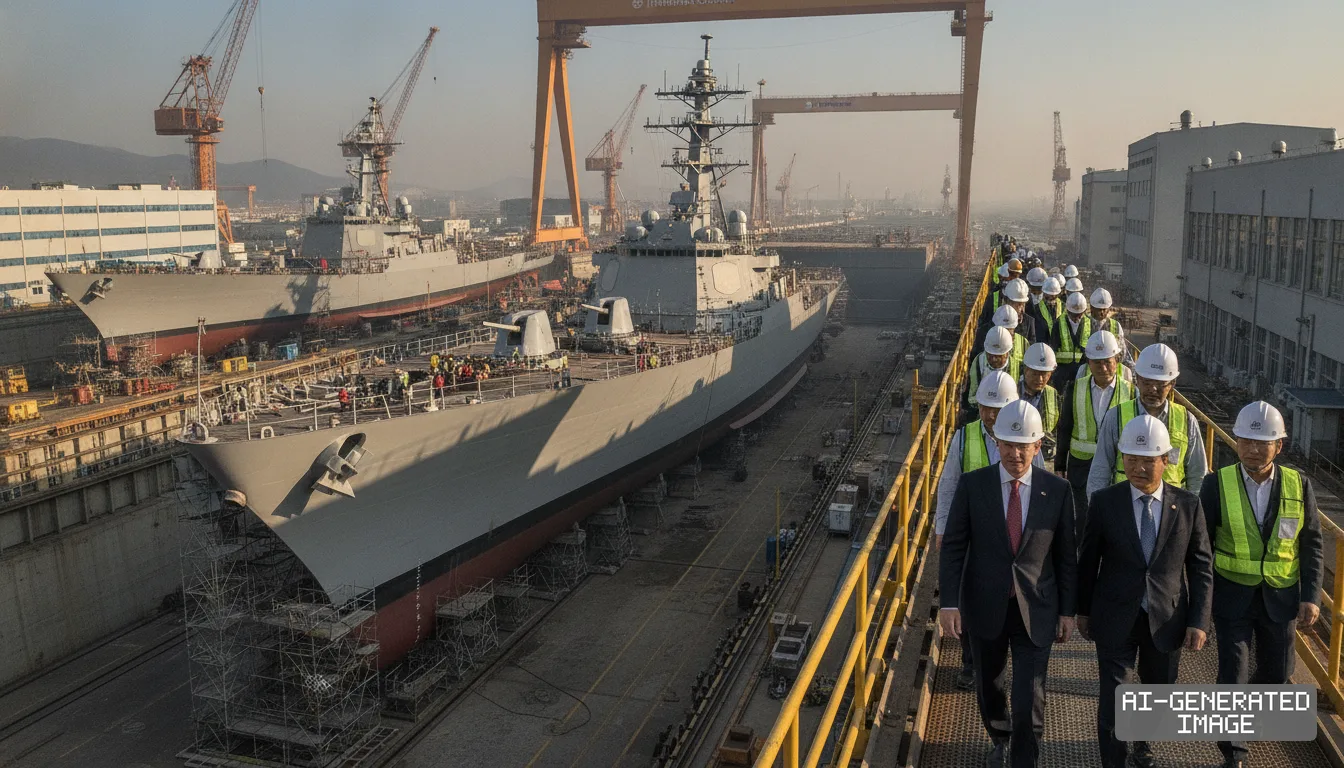
Chinese shipyards apply commercial mega-block assembly to naval replenishment hulls
CSSC subsidiary COMEC cuts dry dock occupancy to under six months for a 271-meter auxiliary at Longxue, transferring commercial tanker methods to fleet logistics.
China State Shipbuilding Corporation (CSSC) has reduced dry dock assembly intervals for large naval auxiliary vessels by applying commercial mega-block manufacturing techniques across its primary southern shipyard in Guangzhou. Commercial satellite imagery and shipyard facility observations confirm that CSSC Offshore & Marine Engineering (Group) Company Limited (COMEC) moved a newly erected fleet replenishment hull from its dry dock into an adjacent outfitting basin in July 2026, completing structural hull consolidation in under six months. The platform represents the largest naval auxiliary constructed in China, exceeding the dimensions and cargo volume of existing fast combat support vessels.
The vessel measures approximately 271 meters in length with a beam of roughly 37 meters, substantially exceeding the 240-meter length and 31.5-meter beam of the People's Liberation Army Navy's two operational Type 901 fast combat support ships, Hulunhu and Chaganhu. Assembled at COMEC's Longxue Island yard in the Nansha district of Guangzhou, the auxiliary features a twin-superstructure layout, an expansive aft flight deck with twin helicopter hangars, and structural deck foundations configured for multi-station underway replenishment gantries. Naval architects assess the platform as a next-generation fleet replenishment vessel engineered to supply carrier strike group formations during sustained open-ocean operations.
The assembly timeline demonstrates how Chinese shipbuilders transfer commercial productivity workflows directly to high-tonnage defense construction. COMEC's Longxue facility operates dual 300,000-deadweight-ton building docks, anchored by a 490-meter by 103-meter dry dock serviced by 600-metric-ton and 900-metric-ton gantry cranes. The yard constructs the hull through pre-outfitted mega-blocks weighing up to 800 metric tons, assembled in climate-controlled indoor fabrication halls. Workers install major machinery foundations, internal fluid pipe networks, ventilation shafts, and electrical cable trays into the blocks prior to dock craning, minimizing manual welding and fitting inside the dry dock basin.
This advanced modular sequence compresses the slipway and dock occupancy period that historically constrained auxiliary ship delivery rates. While surface combatants such as guided-missile destroyers require extensive dry dock time for specialized sonar domes, propulsion alignment, and radar integration, replenishment vessels are fundamentally high-volume cargo carriers. Naval architects at CSSC's 708th Research Institute the design center responsible for the Type 901 and Type 903 programs designed the hull structure to utilize commercial steel plate processing, automated panel lines, and robotic welding rigs commonly deployed on commercial crude tankers and bulk carriers.
The production efficiency directly affects the operational endurance of the People's Liberation Army Navy as its carrier fleet expands. The navy operates more than a dozen Type 903 and Type 903A replenishment oilers displacing roughly 23,000 metric tons, but these platforms have top speeds of 19 to 20 knots and limited cargo volume for aircraft ordnance and jet fuel. The two 45,000-ton Type 901 vessels delivered in 2017 and 2018 resolved transit speed limitations for carrier groups, yet two hulls remain insufficient to support rotating carrier deployments across multiple theaters. The new 271-meter vessel expands simultaneous transfer capacity for liquid fuels, dry stores, and containerized munitions needed by catapult-equipped aircraft carriers during long-range task group operations.
Integrating naval auxiliary construction into commercial dry dock rotations also protects shipyard profit margins and asset utilization. COMEC maintains an annual commercial shipbuilding capacity of 3.5 million deadweight tons, with active construction lines for chemical tankers, liquefied petroleum gas carriers, and heavy-lift vessels. Building a naval auxiliary hull within the 490-meter dock alongside merchant vessels allows the yard to maximize heavy crane cycles without idling dry dock floor space. The modular erection approach isolates structural assembly from outfitting, enabling the shipyard to clear the dry dock for commercial hull blocks once the auxiliary achieves watertight structural integrity.
The shortened dock cycle shifts scheduling demands onto equipment suppliers providing marine propulsion, cargo handling systems, and underway replenishment hardware. Because mega-blocks undergo outfitting before dry dock positioning, domestic equipment suppliers must deliver cargo pumps, high-capacity liquid transfer rigs, and electrical switchboards several months earlier than under conventional build schedules. Component manufacturers in Jiangsu and Zhejiang provinces, along with CSSC-affiliated machinery plants, must synchronize component deliveries with automated block assembly lines to avoid workshop congestion at the Longxue facility.
Neither the Chinese Ministry of National Defense nor CSSC has officially published the vessel's class designation, displacement tonnage, or delivery target date. Following the dock flooding and float-out in July, the hull remains moored at Longxue's 2,224-meter outfitting pier. Shipyard technicians are installing underway replenishment masts, deck crane machinery, and internal power cabling ahead of harbor mooring trials scheduled for the fourth quarter of 2026.
Impact map
How this development propagates across the region and out to global buyers.
| Event | Korea | China | Japan | Global impact |
|---|---|---|---|---|
| Modular auxiliary assembly | commercial yard competition | dry dock cycle compressed | naval supply tracking | fleet endurance expansion |
In this story
- Companies
- China State Shipbuilding CorporationCSSC Offshore & Marine Engineering Group
- Tickers
- 600685.SS00317.HK
- Exposed
- Hudong-Zhonghua Shipbuilding
- Policy
- Economic Security
- Impact
- Supply ChainOrder BookCapex
Track every Economic Security development →
Related briefings
- HD Hyundai wins DNV approval on 271,000 cbm LNG hull design Also on Hudong-Zhonghua Shipbuilding, China State Shipbuilding Corporation, Order Book
- China State Shipyards Reconfigure Dry Docks for Dual-Fuel Mega-Boxships Also on Hudong-Zhonghua Shipbuilding, China State Shipbuilding Corporation, Order Book
- Shipyard labor policies diverge as Korea, Japan, and China tackle yard manning gaps Also on Hudong-Zhonghua Shipbuilding, China State Shipbuilding Corporation, Order Book
- HD Hyundai and Hanwha Ocean Lock In LNG Carrier Berth Slots Through 2029 Also on Hudong-Zhonghua Shipbuilding, Order Book
Sources
Primary documents
Reporting
Confidence: high — how we grade this
The documents behind this briefing are linked above. East Asia Brief produces its English text with AI assistance under human editorial review, and does not translate or republish other outlets' articles. See our methodology and AI policy. Spotted an error? Tell us.
The Morning Brief
What changed in Korean, Chinese and Japanese industry overnight — and what it means for your supply chain. One email, weekday mornings, US time. Free.
The Morning Brief is in preparation. Leave your address and we will write to you once — when the first issue is ready. Nothing before that.