Japan funds ¥16.4B deep-sea trial to extract rare earth mud in February
The 50-day operation off Minamitorishima targets 350 metric tons of mud daily from depths of 6,000 meters, backed by $108 million in supplementary budget financing.
Japan's Cabinet Office confirmed Nov. 20, 2026, that it will launch a 50-day deep-sea mining trial on Feb. 2, 2027, to extract heavy rare earth mud off Minamitorishima.
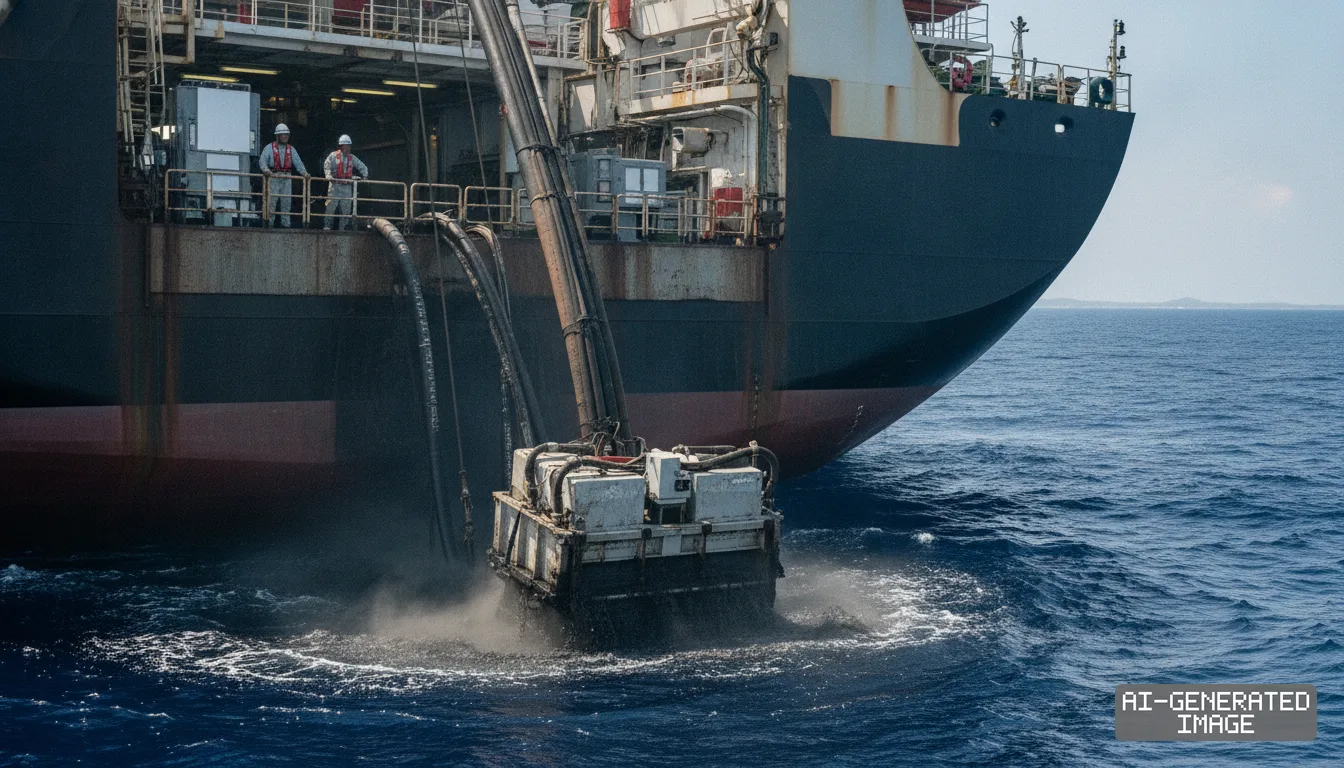
The offshore operation targets an extraction rate of 350 metric tons of mud per day from depths of 6,000 meters. The Japanese government allocated ¥16.4 billion ($108 million) in supplementary budget funding to finance the engineering work.
Shoichi Ishii, program director for the Strategic Innovation Promotion Program at the Cabinet Office, detailed the operational timetable during an industry briefing in Tokyo. The trial will deploy specialized continuous-lift equipment aboard deep-water drilling vessels.
A comprehensive economic feasibility assessment will conclude by March 2028, Ishii said. That evaluation will determine whether ocean mud recovery can produce refined heavy rare earths at costs competitive with foreign mining operations.
The planned run expands on a successful engineering test completed earlier this year by the Japan Agency for Marine-Earth Science and Technology, known as JAMSTEC. In July, JAMSTEC documented the recovery of 50 metric tons of deep-sea sediment.
JAMSTEC conducted that earlier mission between Jan. 12 and Feb. 14 using the deep-sea scientific drilling vessel Chikyu. The vessel lowered a 5,569-meter riser pipe to draw seafloor slurry directly to surface collection tanks.
Assays of the recovered mud confirmed that medium and heavy rare earth elements made up 53.9% of total rare earth content. Heavy elements command premium value because of their role in high-stress industrial applications.
Yttrium accounted for 29.9% of the mineral volume, while dysprosium made up 4.6%, JAMSTEC test records showed. Dysprosium provides essential heat resistance to neodymium permanent magnets used in electric vehicles, wind turbines and precision military hardware.
Gadolinium, used in magnetic resonance imaging and neutron-shielding materials, made up another major share of the recovered sample. The deposit lies entirely within Japan's exclusive economic zone, roughly 1,900 kilometers southeast of Tokyo.
Japanese manufacturers consume roughly 20,000 metric tons of rare earths each year, with nearly all heavy elements imported from Chinese suppliers. Beijing controls more than 90% of global heavy rare earth refining and separation capacity.
China tightened export licensing for heavy rare earths, antimony and permanent magnet components throughout 2025 and 2026. The export restrictions disrupted procurement cycles for Japanese precision motor builders and defense contractors.
Japan's Headquarters for Ocean Policy issued prime ministerial instructions on June 29 to prepare commercial deep-sea mining by 2028. The policy directive mandated commercialization frameworks to reduce vulnerability to external trade blockades.
The February trial will evaluate an integrated offshore logistics model connecting Minamitorishima to mainland smelters. Excavation crews will dewater the extracted mud on the island before loading dry mineral concentrate onto cargo barges.
Barges will transport the concentrate to domestic chemical plants for separation and smelting tests. Refining trials will establish whether standard solvent extraction can process marine sediments without excessive chemical reagent costs.
The mining system uses a closed-loop slurry circuit to limit environmental damage across deep-sea ecosystems, project managers said. Slurry refers to a mixture of mineral-rich mud and seawater pumped under high pressure.
The closed loop prevents particulate plumes from leaking into mid-water ocean layers during ascent. Researchers will monitor water quality and sediment dispersal using subsea acoustic sensors and automated environmental DNA collectors.
Diplomatic momentum behind the project broadened following high-level bilateral talks in Toyama on Nov. 12. Japanese and United States officials signed a critical minerals partnership agreeing to support commercial investment in Minamitorishima.
The United States agreement covers joint investment frameworks and downstream refining cooperation. Both governments seek alternative rare earth processing chains that operate independently of Chinese state-backed smelters.
The Cabinet Office has not published capital expenditure estimates for commercial dredge vessels, and officials have not announced the corporate members of the planned production consortium. Total development costs remain undisclosed.
Offshore operations will mobilize from mainland Japanese ports in late January to establish moorings over the extraction block. Offshore drilling and extraction runs will conclude in late March 2027.
Impact map
How this development propagates across the region and out to global buyers.
| Event | Korea | China | Japan | Global impact |
|---|---|---|---|---|
| Minamitorishima deep-sea mining trial | No seabed claims, relies on Chinese dysprosium imports for EV motor magnets | Controls over 90% of heavy rare earth processing, faces long-term seabed competition | Aims to displace Chinese dysprosium imports after March 2028 feasibility review | Deep-sea dredging offers non-Chinese heavy rare earth stream for electric motor supply chains |
In this story
- Companies
- JAMSTEC
- Policy
- Export ControlsSubsidies
- Impact
- Supply ChainCost Structure
Track every Export Controls development → Track every Subsidies development →
Related briefings
- India bans battery black mass exports under $180M recycling push Also on Export Controls, Subsidies, Cost Structure
- Japanese firms build tungsten scrap loops to counter Beijing Also on Export Controls, Subsidies, Cost Structure
- Moore Threads turns first profit on 1,774% GPU revenue surge Also on Export Controls, Subsidies, Cost Structure
- Quad ministers advance mineral refining network to bypass China Also on Export Controls, Subsidies, Cost Structure
Sources
Primary documents
Reporting
Confidence: high — how we grade this
The documents behind this briefing are linked above. East Asia Brief produces its English text with AI assistance under human editorial review, and does not translate or republish other outlets' articles. See our methodology and AI policy. Spotted an error? Tell us.
The Morning Brief
What changed in Korean, Chinese and Japanese industry overnight — and what it means for your supply chain. One email, weekday mornings, US time. Free.
The Morning Brief is in preparation. Leave your address and we will write to you once — when the first issue is ready. Nothing before that.