China critical mineral export controls expose $6.5 trillion in factory output
Prolonged restrictions on rare earth magnets and graphite threaten automotive, chip and defense supply chains outside China as licence deadlines loom.
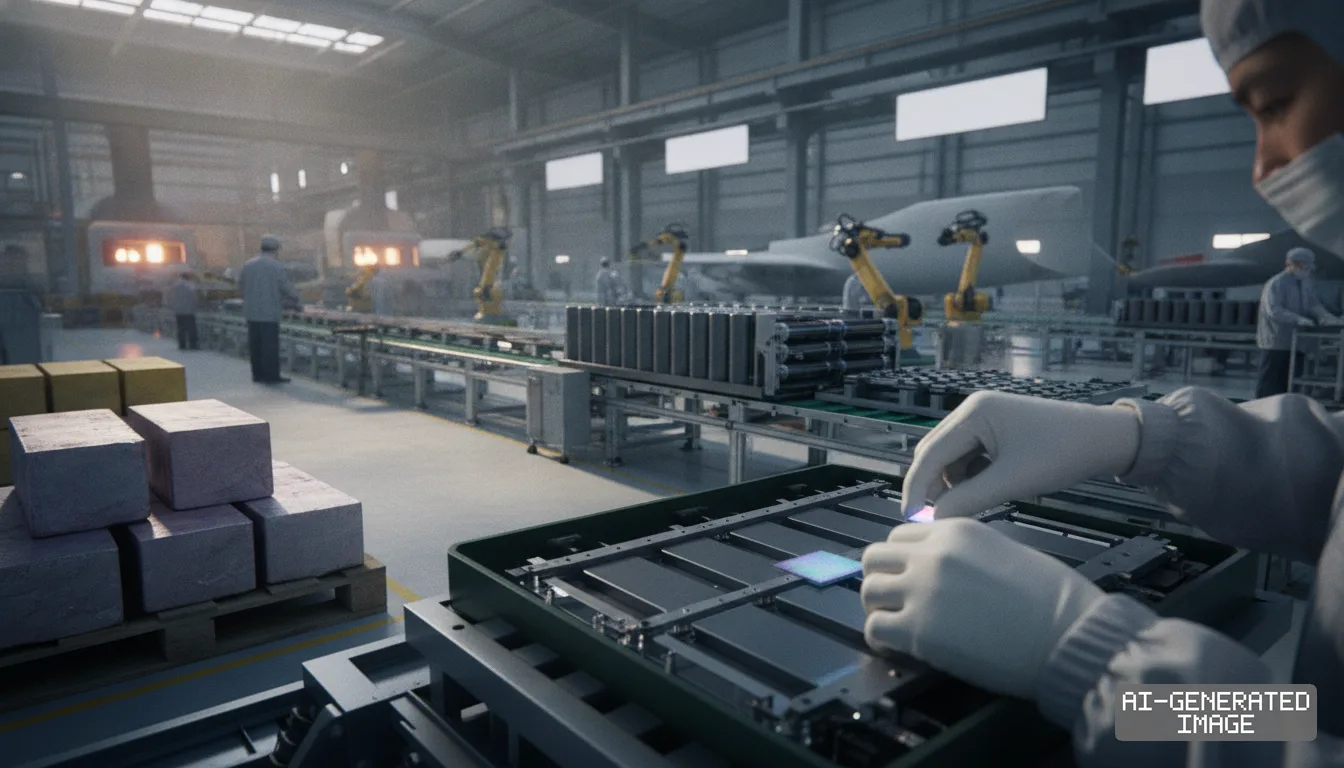
The International Energy Agency warned on Nov. 1, 2026, that prolonged Chinese export restrictions on critical minerals threaten $6.5 trillion in annual manufacturing production outside China.
The exposed output spans automotive assembly, semiconductors, aerospace and defense hardware that depend on Chinese mineral refining, the agency said in its assessment.
Permanent magnet materials represent the largest chokepoint, with total disruption risking $3.3 trillion in non-Chinese vehicle manufacturing and $1.0 trillion in electronics and chip assembly.
Commercial transport and aviation account for another $1.1 trillion of exposed production, while defense equipment manufacturers face $600 billion in vulnerable output.
Data center servers and digital infrastructure represent $400 billion in exposed manufacturing sales, according to the agency's supply chain model.
China's Ministry of Commerce established export licensing requirements on seven heavy rare earths, including dysprosium and terbium, in April 2025.
The ministry expanded those controls in October 2025 to cover overseas products manufactured with Chinese rare earth separation technology and magnet fabrication methods.
Battery materials carry parallel supply vulnerabilities, with graphite export licensing putting more than $300 billion in non-Chinese battery cell manufacturing at risk.
The annual global trade for magnet-grade rare earths totals less than $10 billion, yet that narrow flow anchors several trillion dollars in downstream goods.
Alternative separation and magnet fabrication capacity outside China has progressed slowly because of high capital intensity and strict environmental permitting.
Refining raw rare earth ores into separated oxides outside China costs between 50% and 100% more than domestic Chinese processing, the energy agency said.
Automakers bear the most immediate operational exposure because permanent magnet traction motors power most commercial electric vehicles.
Tesla equips roughly 85% of its electric passenger cars with neodymium-iron-boron magnet motors that rely on separated heavy rare earth inputs.
Wind turbine builders face similar hardware constraints, with Siemens Energy requiring approximately two metric tons of permanent magnets for each direct-drive offshore wind turbine generator.
Mining companies outside China still depend on Chinese processors to convert raw output into usable industrial metals.
MP Materials extracts rare earth ores at its Mountain Pass facility in California but historically routed more than 80% of its concentrate to Chinese refiners for chemical separation.
Lynas Rare Earths operates the Mt Weld mine in Australia and supplies roughly 45% of non-Chinese separated neodymium-praseodymium from its processing plant in Malaysia.
Both operators have expanded domestic cracking and refining capacity, but neither firm yet produces sufficient heavy rare earth elements to replace Chinese output.
Closing the supply gap outside China requires approximately $60 billion in capital investment across mining, oxide separation and magnet making over the next decade.
Refining plants account for nearly half of that capital requirement, while finished magnet fabrication plants require another third of the total outlay.
The Ministry of Commerce has not published the approval criteria for foreign dual-use export licence applications, leaving industrial buyers uncertain which exemptions will stand.
Bilateral negotiations between Washington and Beijing produced an interim extension that pushes the final enforcement deadline for the extraterritorial technology rules to Jan. 10, 2027.
Impact map
How this development propagates across the region and out to global buyers.
| Event | Korea | China | Japan | Global impact |
|---|---|---|---|---|
| Chinese critical mineral export controls | battery makers face graphite licensing overhead, motor assemblers seek alternative NdFeB supply | MOFCOM controls 90% of heavy rare earth separation, leverages supply chain against foreign end-users | magnet makers rely on stockpiles and Malaysian supply from Lynas to buffer 2027 enforcement | $6.5 trillion in manufacturing output exposed, vehicle assembly faces $3.3 trillion in potential disruption |
In this story
- Companies
- MP MaterialsLynas Rare EarthsTeslaSiemens Energy
- Tickers
- MPLYC.AXTSLAENR.DE
- Policy
- Export Controls
- Impact
- Supply ChainCost StructurePricing
Track every Export Controls development →
Related briefings
- EU puts China rare earth curbs on trade docket to cut deficit Also on Siemens Energy, Export Controls, Cost Structure
- Dysprosium prices jump outside China as buyers split supply Also on MP Materials, Lynas Rare Earths, Export Controls
- Benchmark says ex-China heavy rare earth prices jumped 150% in Q3 Also on MP Materials, Lynas Rare Earths, Export Controls
- VanEck rare earth fund plunges as yttrium supplies run short in West Also on MP Materials, Lynas Rare Earths, Export Controls
Sources
Primary documents
Reporting
Confidence: high — how we grade this
The documents behind this briefing are linked above. East Asia Brief produces its English text with AI assistance under human editorial review, and does not translate or republish other outlets' articles. See our methodology and AI policy. Spotted an error? Tell us.
The Morning Brief
What changed in Korean, Chinese and Japanese industry overnight — and what it means for your supply chain. One email, weekday mornings, US time. Free.
The Morning Brief is in preparation. Leave your address and we will write to you once — when the first issue is ready. Nothing before that.