Dysprosium prices jump outside China as buyers split supply
Benchmark and REEx data show heavy rare earths trading up to 17 times higher in Europe and North America as military rules mandate non-Chinese permanent magnets by 2027.
Rare Earth Exchanges said Oct. 3 that non-Chinese dysprosium traded at three to 17 times domestic Chinese prices as Western manufacturers accelerated procurement ahead of upcoming defense restrictions.
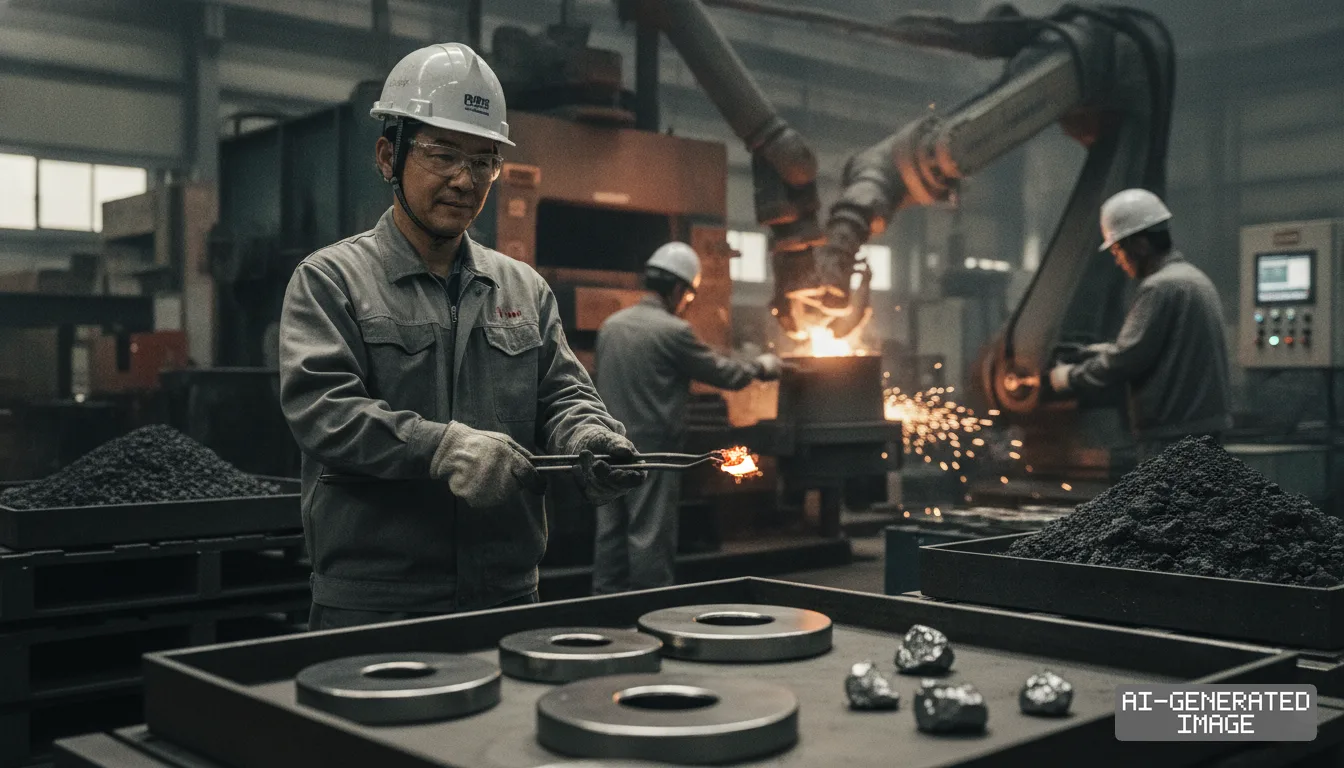
The divergence reflects a structural shortage of heavy rare earth processing facilities outside China. Dysprosium and terbium provide thermal stability in sintered neodymium permanent magnets used in vehicle traction motors and defense guidance hardware.
Benchmark Mineral Intelligence reported Sept. 25 that European spot dysprosium oxide averaged $3,500 per kilogram during the third quarter. That price represented a 150% surge from the second quarter and sat 16.3 times above domestic Chinese quotations.
Domestic Chinese dysprosium oxide traded near $215 per kilogram during the same period. That price spread shows how Chinese export licensing rules have insulated domestic consumers from Western bidding competition.
Terbium oxide delivered into Europe climbed 23% to $6,745 per kilogram in the third quarter, Benchmark said. In North America, spot terbium oxide was assessed at $7,500 per kilogram, according to Rare Earth Exchanges.
Certain small-volume over-the-counter transactions for non-Chinese terbium exceeded $12,000 per kilogram, Rare Earth Exchanges reported. Those spot trades highlight intense competition among manufacturers attempting to secure origin-certified raw materials.
The price explosion in heavy rare earths stands in contrast to the light rare earth market. Praseodymium-neodymium oxide outside China traded at only 1.1 to 1.4 times domestic Chinese levels.
Light rare earths form the bulk volume of neodymium magnets. Abundant mining output in Australia and the United States has kept light rare earth premiums narrow.
Heavy rare earths remain concentrated in Chinese separation facilities. China currently controls roughly 85% of global rare earth oxide output and 99% of global dysprosium and terbium refining capacity.
The immediate driver of Western demand is Section 854 of the US National Defense Authorization Act. The regulation amends the Defense Federal Acquisition Regulation Supplement to restrict defense procurement of critical materials.
Under the updated DFARS rule, defense contractors cannot deliver permanent magnets containing covered materials mined, refined, separated or melted in China, Russia, North Korea or Iran. That complete supply-chain ban takes effect Jan. 1, 2027.
The US Department of Defense previously granted waivers allowing Chinese-origin magnets in military hardware. A presidential executive order signed July 20 directed defense agencies to eliminate automatic waivers by the 2027 deadline.
Downstream magnet manufacturers are restructuring their supply chains to qualify for military sales. Arnold Magnetic Technologies produces DFARS-compliant permanent magnets for defense applications, where specialized magnetic components support precision actuators across missile and radar assemblies.
Arnold Magnetic Technologies said it aims to establish a fully compliant non-Chinese supply chain for neodymium and samarium-cobalt magnets ahead of the regulatory cutoff. Reaching compliance requires securing verified non-Chinese feedstock at prevailing spot premiums.
Upstream producers are building alternative supply lines with government support. MP Materials operates the Mountain Pass mine in California and sells light rare earths under a Pentagon contract that provides a price floor of $110 per kilogram.
Lynas Rare Earths operates a cracking and leaching plant in Australia and a separation facility in Malaysia. Lynas supplies material under an offtake agreement backed by Japan Australia Rare Earths, but heavy rare earth volume remains minimal compared to Chinese refining output.
The price gap creates a dual-tier cost structure for industrial component makers. Automotive tier-one suppliers producing electric vehicle motors must absorb non-Chinese material premiums if western automakers mandate diversified supply chains.
Standard electric vehicle traction motors use between 100 grams and 200 grams of dysprosium or terbium per unit to prevent demagnetization at operating temperatures above 100 degrees Celsius. At $3,500 per kilogram, heavy rare earths add hundreds of dollars per motor outside China.
Chinese motor manufacturers continue to procure domestic heavy rare earths at regulated internal rates. That price divergence gives Chinese component producers a significant cost advantage over Western competitors.
Market analysts said heavy rare earths no longer trade as fungible commodities. Access to material now depends on supply provenance, export permits and formal customer qualification rather than baseline market chemistry.
Pricing agencies did not publish aggregate physical trade volumes or counterparty records for private bilateral contracts, as non-Chinese heavy rare earth deals remain confidential transactions.
The updated DFARS Section 854 sourcing prohibition takes effect Jan. 1, 2027.
Impact map
How this development propagates across the region and out to global buyers.
| Event | Korea | China | Japan | Global impact |
|---|---|---|---|---|
| Heavy rare earth price bifurcation | Automotive suppliers absorb heavy rare earth premiums on export EV platforms | Domestic refiners retain cheap feedstock with dysprosium trading near $215 per kilogram | Magnet makers manage tight non-Chinese quotas to supply certified high-heat alloys | Defense contractors pay up to 17-fold premiums to secure DFARS-compliant magnet inventories |
| Heavy rare earth price bifurcation | Automotive suppliers absorb heavy rare earth premiums on export EV platforms | Domestic refiners retain cheap feedstock with dysprosium trading near $215 per kilogram | Magnet makers manage tight non-Chinese quotas to supply certified high-heat alloys | Defense contractors pay up to 17-fold premiums to secure DFARS-compliant magnet inventories |
In this story
- Companies
- Arnold Magnetic TechnologiesMP Materials
- Tickers
- MP
- Exposed
- Lynas Rare Earths
- Policy
- Export ControlsDefense Procurement
- Impact
- Cost StructureSupply ChainPricing
Track every Export Controls development →
Related briefings
- Hanwha Ocean Wins $508 Million Thai Stealth Frigate Program Also on Defense Procurement, Export Controls
- Benchmark says ex-China heavy rare earth prices jumped 150% in Q3 Also on MP Materials, Lynas Rare Earths, Export Controls
- Chinese rare earth suppliers halt shipments to US customers Also on MP Materials, Export Controls, Pricing
- China Rare Earth Group seeks control of Shenghe Resources Also on MP Materials, Export Controls, Pricing
Sources
Primary documents
Reporting
Confidence: high — how we grade this
The documents behind this briefing are linked above. East Asia Brief produces its English text with AI assistance under human editorial review, and does not translate or republish other outlets' articles. See our methodology and AI policy. Spotted an error? Tell us.
The Morning Brief
What changed in Korean, Chinese and Japanese industry overnight — and what it means for your supply chain. One email, weekday mornings, US time. Free.
The Morning Brief is in preparation. Leave your address and we will write to you once — when the first issue is ready. Nothing before that.