Samsung Heavy signs pact with KIRO to test humanoid robots
The non-binding agreement targets autonomous legged machines and AI systems for confined hull assembly and blasting shops at Geoje shipyard.
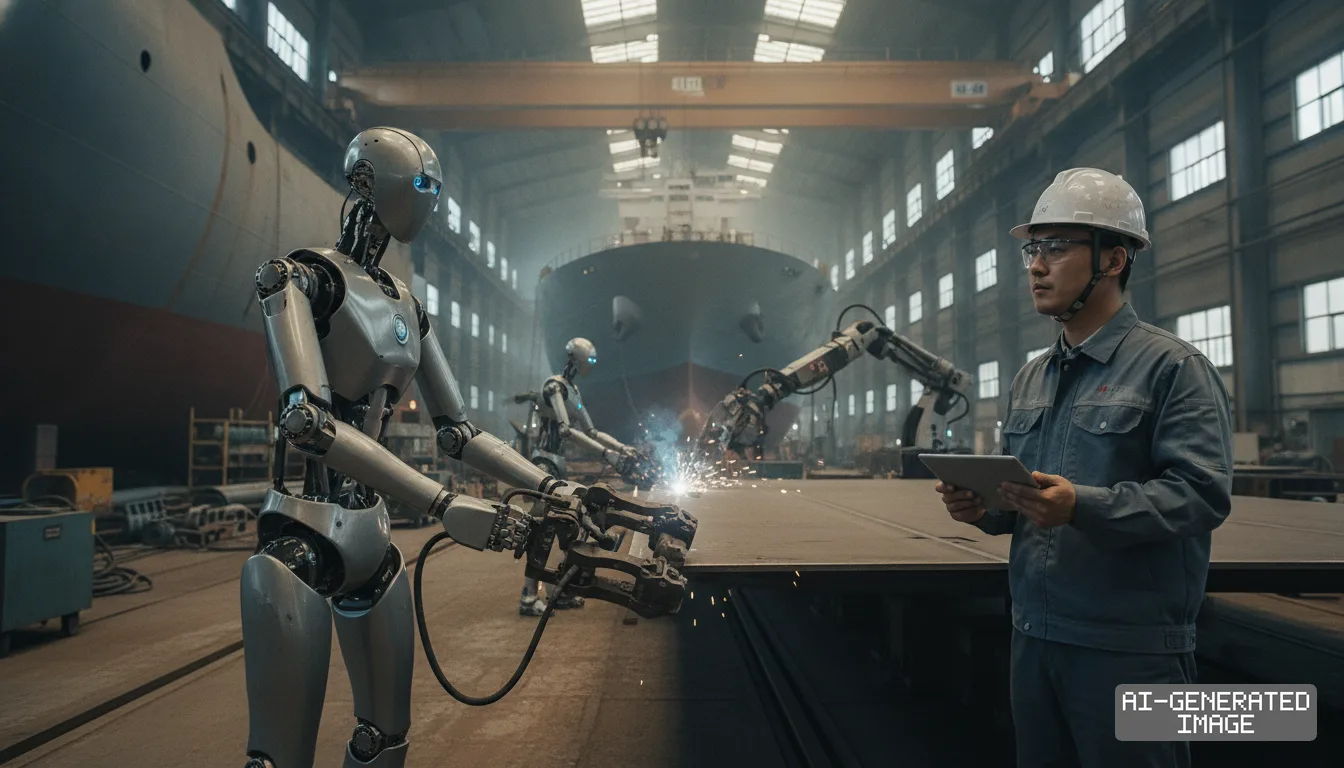
The Korea Institute of Robot and Convergence said Sept. 17 it had agreed with Samsung Heavy Industries to develop and field-test industrial humanoid robots inside commercial shipyard facilities.
The non-binding memorandum of understanding, signed Sept. 16 at the Geoje shipyard, connects public robotics research with heavy marine fabrication. Neither organization published a capital investment figure or target robot unit volume for the joint initiative.
Samsung Heavy Industries operates the Geoje facility as its primary shipbuilding base. The shipbuilder is evaluating autonomous bipedal systems to mitigate acute shortages of certified hull welders and structural assembly workers across South Korean shipyards.
Marine fabrication environments present severe physical constraints that prevent the use of standard wheeled automation. Hull block interiors feature multi-story steel framing, temporary staging ladders, narrow manholes and enclosed double bottoms that demand human-like mobility.
The bilateral agreement establishes three joint research priorities. The engineering teams will collaborate on shipyard-tailored autonomous mobile robots, multi-axis industrial manufacturing humanoids, and artificial intelligence software for dynamic motion planning in unstructured industrial environments.
Following the formal signing ceremony, researchers toured three primary production shops at the Geoje complex. The joint inspection covered the sub-assembly facility, the surface blasting plant and the curved plate cold-forming shop to evaluate robotic operational feasibility.
Sub-assembly shops weld internal stiffeners and transverse webs onto flat steel plates prior to mega-block erection. The continuous fillet welding processes generate dense fumes, high heat and intense ultraviolet radiation within restricted physical bays.
Surface blasting shops clean assembled steel surfaces using high-pressure metallic abrasive grit. The treatment strips mill scale and oxidation before primer application, creating an ambient environment saturated with airborne particulates and extreme noise.
Curved plate shops process thick steel plates into compound convex shapes for vessel bow and stern hulls. Fabricators rely on line heating torches and high-tonnage hydraulic presses, requiring precise heat tracking across uneven three-dimensional metal contours.
Choi Doo-jin, head of the Samsung Heavy Industries Robotics Transformation Center, led the production review with KIRO Vice President Seo Gap-ho. Both institutions assessed how robotic chassis could maintain balance while traversing uneven steel grating and temporary staging.
The new agreement expands a decade-long engineering relationship between the two entities. Samsung Heavy Industries and KIRO have collaborated since 2015 on specialized mobile welding apparatus designed for cramped double-hull vessel compartments.
Earlier collaborative projects produced tracked crawler carriages equipped with optical line tracking systems. Those robotic crawlers automated straight-line horizontal welds along longitudinal hull stiffeners, reducing manual torch time in hazardous structural voids.
Humanoid units represent an operational departure from dedicated track-mounted crawlers. General-purpose bipedal platforms can theoretically climb ladders, carry specialized end-effectors, swap welding torches and manipulate grinding tools without fixed rail infrastructure.
Domestic shipyards face severe demographic attrition among experienced metal fitters and structural welders. Major Korean shipbuilders have expanded recruitment of foreign technical personnel while funding automation initiatives to maintain vessel delivery schedules.
Operating sensitive humanoid systems inside active shipyard blocks requires overcoming severe physical and electrical hazards. Welding arcs produce high electromagnetic interference that can disrupt robotic actuator microcontrollers and optical lidar sensors.
Airborne steel grit and abrasive dust from adjacent blasting halls can penetrate joint bearings and gear reducers. Mechanical sealing, thermal shielding and active dust ingress prevention are mandatory prerequisites for survival in shipyard production cells.
Payload capacity and duty-cycle limitations also constrain immediate industrial humanoid deployment. Standard shipyard arc welding equipment, protective leads and pneumatic grinding tools exceed the payload thresholds of most experimental bipedal platforms.
Tetherless battery operations in unventilated hull cavities introduce additional safety and thermal management considerations. Enclosed steel compartments accumulate heat quickly, requiring explosion-proof certification and thermal runaway containment for high-density lithium power packs.
The cooperative framework includes cross-institutional personnel exchanges, shared access to experimental testing laboratories, and joint technical policy advisory committees. The organizations also agreed to host academic conferences covering maritime robotics standards.
The notice does not state which humanoid hardware platform will enter the yard, and Samsung Heavy Industries has not issued a regulatory filing on the partnership.
The memorandum carries no legally binding capital expenditure commitments or formal commercial delivery quotas. Engineering working groups will establish field validation protocols and safety metrics before initiating active hardware trials on production lines.
Impact map
How this development propagates across the region and out to global buyers.
| Event | Korea | China | Japan | Global impact |
|---|---|---|---|---|
| Shipyard humanoid robotics pact | Samsung Heavy tests legged robots at Geoje yard to mitigate welder shortages | CSSC yards expand automated gantry welding lines without deploying humanoids | Imabari Shipbuilding maintains manual assembly supported by foreign trainee labor | Marine engineering sector monitors feasibility of bipedal robotics in heavy fabrication |
In this story
- Companies
- Samsung Heavy Industries
- Tickers
- 010140.KS
- Exposed
- Korea Institute of Robot and Convergence
- Policy
- Economic Security
- Impact
- CapexSupply ChainOrder Book
Track every Economic Security development →
Related briefings
- Japan Clears $635 Million in Subsidies to Modernize Shipyards by 2035 Also on Samsung Heavy Industries, Order Book
- HD Hyundai and Hanwha Ocean Lock In LNG Carrier Berth Slots Through 2029 Also on Samsung Heavy Industries, Order Book
- Samsung Heavy expands Busan R&D center into offshore engineering hub Also on Samsung Heavy Industries, Order Book
- Hanwha Ocean secures 478 billion won order for three gas carriers through 2030 Also on Samsung Heavy Industries, Order Book
Sources
Primary documents
Reporting
Confidence: high — how we grade this
The documents behind this briefing are linked above. East Asia Brief produces its English text with AI assistance under human editorial review, and does not translate or republish other outlets' articles. See our methodology and AI policy. Spotted an error? Tell us.
The Morning Brief
What changed in Korean, Chinese and Japanese industry overnight — and what it means for your supply chain. One email, weekday mornings, US time. Free.
The first issue goes out shortly. Sign up now and you will not miss it.