Equinor exits South Korea offshore wind after 12 years of grid delay
The Norwegian state energy firm scrapped its 5.7 trillion won Bandibuli floating farm off Ulsan as grid congestion and permitting barriers blocked commercial execution.
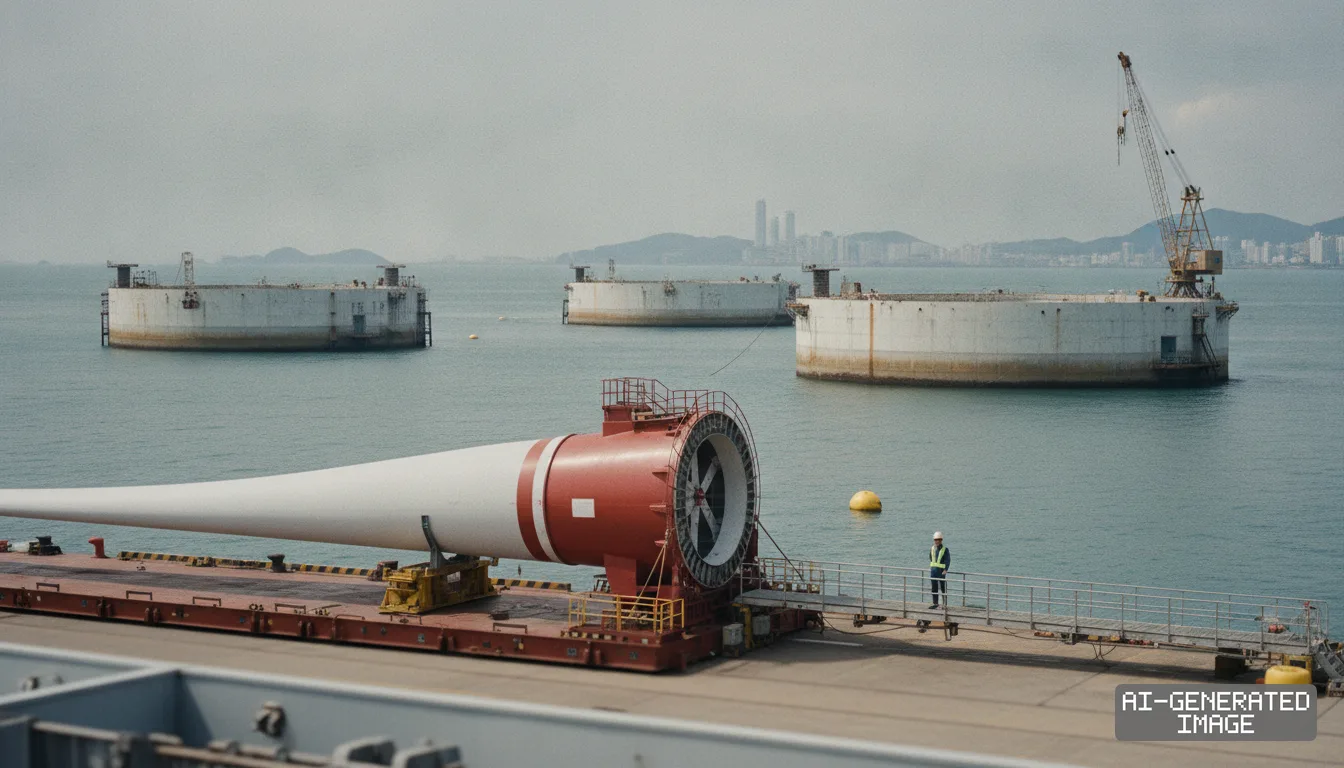
Equinor concluded its withdrawal from South Korea's offshore wind sector on Oct. 15, 2026, ending a 12-year development presence after grid transmission bottlenecks and permitting delays halted its multi-trillion-won projects.
The Norwegian state-controlled producer halted its 750-megawatt Bandibuli floating offshore wind farm off the coast of Ulsan, budgeted at 5.7 trillion won ($4.2 billion). The site represented roughly 30% of Ulsan's planned floating offshore wind capacity.
Equinor said on its corporate registry that it will not pursue future offshore wind opportunities in South Korea. The company cited a strategic reorganization focused on integrated power markets in core geographies, shrinking its operational footprint across East Asia.
The exit closes a market presence that began in 2014. Equinor initially used its Seoul office to manage offshore platform fabrication contracts with Korean shipyards before expanding into commercial floating wind developments in 2018.
Commercial momentum stalled after Equinor failed to execute a 20-year Renewable Energy Certificate contract with the Korea Energy Agency by the final deadline of Jan. 3, 2026.
Under Article 31-7 of the national renewable power market operational rules, that contract failure triggered a mandatory two-year ban on Equinor participating in fixed-price wind auctions.
Equinor formally terminated the 750-megawatt Bandibuli project in late May after concluding the project could not achieve commercial viability. The decision followed four consecutive deadline extensions granted by Korean energy regulators.
A persistent bottleneck was interconnection to the high-voltage transmission grid operated by state utility Korea Electric Power Corp. (KEPCO).
KEPCO substations and trunk lines along South Korea's southeastern coastline reached technical capacity limits, preventing developers from securing firm grid injection timelines.
Offshore projects in Ulsan faced grid queues extending beyond 2031, shifting the carrying costs of capital expenditures onto project developers without power delivery guarantees.
The withdrawal removes major fabrication volumes from Korean industrial suppliers. Samsung Heavy Industries had been selected to manufacture the semi-submersible floating foundations for the 50 planned 15-megawatt turbines.
LS Cable & System lost anticipated manufacturing awards for the project's 230-kilovolt subsea export lines, designed to bridge the 70-kilometer offshore gap between the turbine array and the Onsan industrial port landfall.
Doosan Enerbility had signed local assembly agreements for nacelles with turbine supplier Siemens Gamesa, leaving domestic assembly bays without the expected 750-megawatt baseline order.
Regulatory friction compounded the transmission logjam. South Korea requires developers to obtain more than 20 individual statutory permits across 10 ministries, including defense radar consultations with the Ministry of National Defense.
Equinor had previously abandoned its 2.37-gigawatt Chujado offshore project off Jeju Island after local resistance and maritime zoning reviews blocked permitting progress.
The withdrawal exposes systemic constraints in South Korea's offshore licensing model. Unlike Taiwan and Japan, which designate offshore development zones with state-led grid connections, Seoul requires private developers to secure seabed rights, environmental approvals and substation access independently.
South Korea has set a national target of installing 14.3 gigawatts of offshore wind capacity by 2030, compared to less than 200 megawatts in commercial operation in 2026.
Equinor's departure leaves rival developers off Ulsan, including Corio Generation and TotalEnergies, facing identical power line saturation and rising financing costs on their respective floating projects.
Corporate filings do not state whether Equinor has completed the formal corporate liquidation of its Korean operating subsidiaries or divested its remaining equity in the 200-megawatt Donghae 1 demonstration venture with Korea National Oil Corporation.
Equinor's two-year bidding penalty under Korea Energy Agency procurement regulations runs through Jan. 3, 2028, though the developer has excluded Korean capital expenditure from its five-year offshore asset allocation plan.
Impact map
How this development propagates across the region and out to global buyers.
| Event | Korea | China | Japan | Global impact |
|---|---|---|---|---|
| Equinor Korean offshore wind exit | KEPCO grid deficit delays 14.3GW national wind target; Samsung Heavy and LS Cable lose 5.7 trillion won order pipeline | Chinese subsea cable and foundation suppliers gain cost leverage across non-Korean Asian wind tenders | METI accelerates government-led central grid tenders to prevent foreign developer flight | Offshore wind capital shifts to integrated power markets in Europe and North America |
In this story
- Companies
- EquinorKorea Electric Power Corp.
- Tickers
- EQNR.OL015760.KS
- Exposed
- Samsung Heavy IndustriesLS Cable & SystemDoosan EnerbilityKorea National Oil Corporation
- Policy
- Economic SecuritySubsidies
- Impact
- CapexSupply ChainOrder Book
Track every Economic Security development → Track every Subsidies development →
Related briefings
- LG Energy Solution locks US lithium supply in Smackover pact Also on Equinor
- South Korea confirms $120 billion civil nuclear pact with US Also on Doosan Enerbility, Order Book
- Cameco backs $120B US-Korea nuclear pact for eight reactors Also on Doosan Enerbility, Order Book
- Doosan Robotics and DEEPX develop AI nuclear welding robots Also on Doosan Enerbility, Order Book
Sources
Reporting
Confidence: medium — how we grade this
The documents behind this briefing are linked above. East Asia Brief produces its English text with AI assistance under human editorial review, and does not translate or republish other outlets' articles. See our methodology and AI policy. Spotted an error? Tell us.
The Morning Brief
What changed in Korean, Chinese and Japanese industry overnight — and what it means for your supply chain. One email, weekday mornings, US time. Free.
The Morning Brief is in preparation. Leave your address and we will write to you once — when the first issue is ready. Nothing before that.