HD Hyundai Robotics cuts robot setup 63% with Palantir tools
A trial deployment of machine learning agents in South Korea lowered factory troubleshooting cycles from 21.5 days to 7.9 days, shifting automation competition toward operational software.
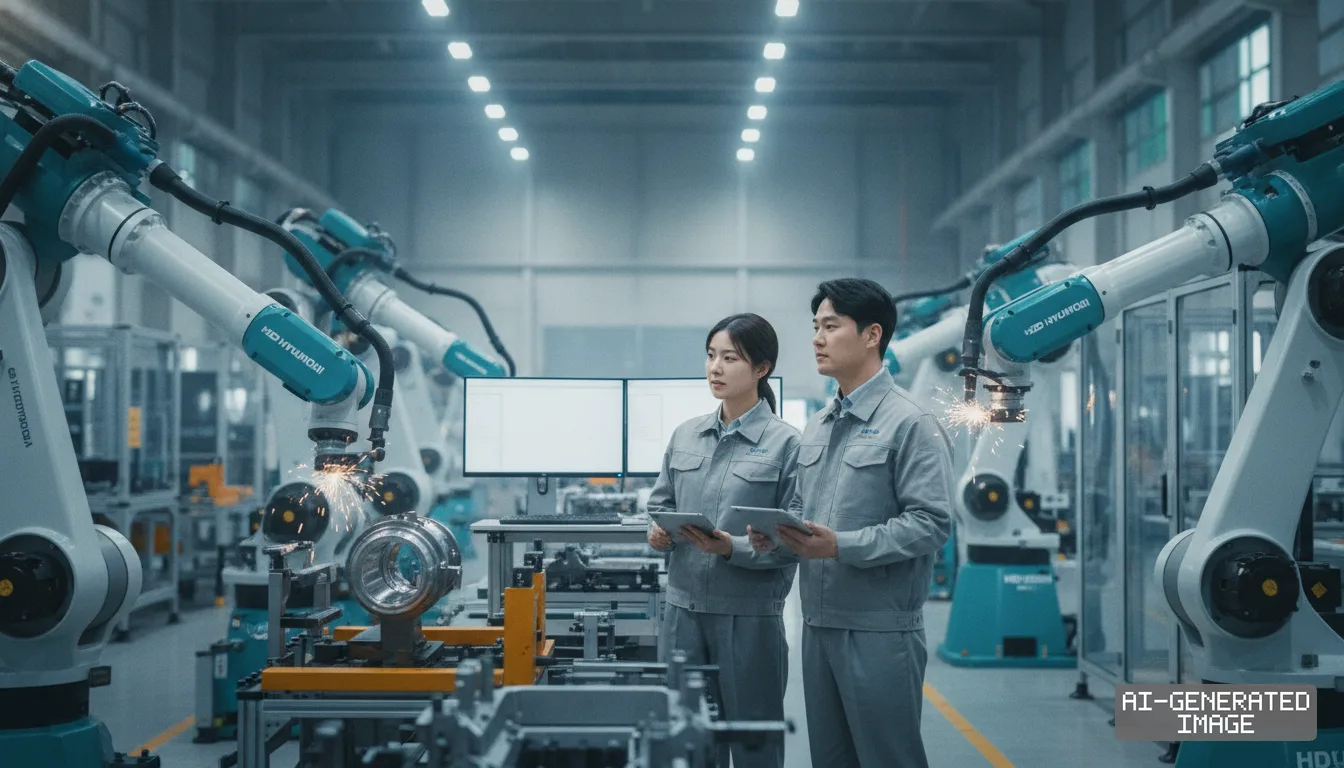
HD Hyundai Robotics said Nov. 1 it cut industrial robot programming times by 63% after deploying artificial intelligence agents developed with Palantir Technologies across its manufacturing lines.
The operational deployment reduced average troubleshooting cycles from 21.5 days to 7.9 days during initial test runs launched in August. The company expects the algorithmic system to lower robot programming expenses by more than 50%.
Ahn Sung-hwan, chief technology officer at HD Hyundai Robotics, presented the trial metrics during a keynote address in New York at Palantir's third Sovereignty Bootcamp. The event drew 450 executives from 250 commercial and state entities.
Palantir organized the corporate forum to demonstrate how industrial operators deploy machine learning models while safeguarding internal intellectual property. The software company hosted three bootcamp sessions in New York between July and October.
HD Hyundai Robotics operates as the automation equipment manufacturing arm of South Korean industrial conglomerate HD Hyundai. Palantir licenses enterprise data platforms — software that connects dispersed operating sensors and business records — to corporate clients.
The reported efficiency gains stem from a group-level partnership expansion executed on Jan. 20, 2026. That agreement extended Palantir's data orchestration tools from oil refining and shipbuilding yards into HD Hyundai's robotics manufacturing business.
HD Hyundai began using Palantir's Foundry system in 2021 at oil refiner HD Hyundai Oilbank to manage crude feedstock selection and predictive plant maintenance. The group subsequently integrated the platform into construction machinery design and shipyard tracking.
HD Hyundai Executive Vice Chairman Chung Ki-sun and Palantir Chief Executive Officer Alex Karp met at the World Economic Forum in Davos in January to broaden software access across robotics, electrical power equipment and marine maintenance divisions.
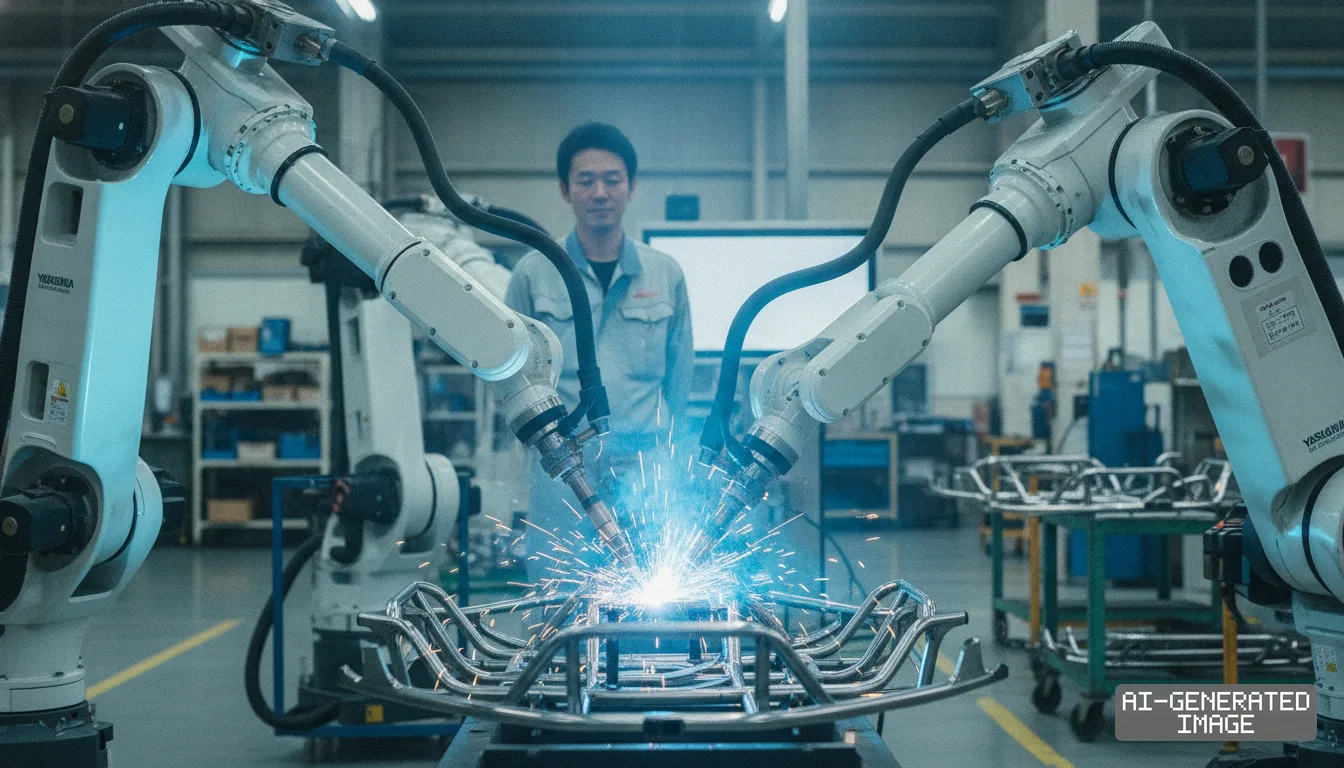
Industrial robot deployment has historically relied on physical tuning by manual programmers. Specialists observe robotic arms directly on factory floors, adjusting motion trajectories, operating sequences and motor speeds across thousands of weld and assembly points.
That legacy calibration method depended heavily on individual worker intuition, creating persistent bottlenecks when configuring automated assembly lines. Complex robot teaching — the physical recording of positional coordinates — frequently delayed factory commissioning schedules by several weeks.
Under the automated architecture, Palantir algorithmic agents review existing robot program files to identify motion bottlenecks and suggest optimized motion paths. Specialized simulation tools calculate kinematic profiles before physical manipulators execute the routines on the floor.
Factory engineers subsequently verify and adjust the proposed motion scripts using operational experience, the company said. The hybrid workflow eliminates repetitive visual verification while retaining human oversight over critical safety and mechanical clearance constraints.
The revised workflow aims to reposition factory programmers from routine code editors into on-site solution experts, Ahn said. Engineers formulate broader technical parameters while generative models handle detailed joint trajectory calculations and program compilation.
HD Hyundai Robotics recently displayed its proprietary dual-arm intelligent manipulator at the FIX 2026 automation exhibition in Daegu on Oct. 21. The hardware unit features integrated machine vision systems targeted at flexible industrial handling.
Global competition in factory robotics is moving from purely mechanical arm construction toward intelligent shopfloor software layers. Precision gear reducers and motor assemblies have reached standardized durability tolerances across builders in South Korea, Japan and China.
System integration and software setup account for more than half of total deployment expenses when outfitting automated manufacturing lines. Lowering commissioning cycles from three weeks to eight days reduces overall engineering capital outlays for plant operators.
HD Hyundai Robotics and Palantir agreed to institutionalize a regular joint steering committee featuring senior corporate executives, the company said. The body will review project performance benchmarks and select additional factory processes for machine learning deployment.
The two corporate partners also plan to open a joint training center to instruct factory staff in analytical modeling tools. Field implementation will expand across high-mix welding cells and heavy fabrication lines throughout next year, the company said.
The announcement does not disclose the financial value of the software contract, and the company has not published whether a separate binding commercial agreement was executed on Nov. 1.
Impact map
How this development propagates across the region and out to global buyers.
| Event | Korea | China | Japan | Global impact |
|---|---|---|---|---|
| Industrial AI robot software deployment | HD Hyundai Robotics cuts setup duration 63% and lowers commissioning overhead | Domestic robot integrators face wider gap against US-allied software stacks | Fanuc and Yaskawa maintain hardware edge but see enterprise AI integration accelerate | Industrial robot procurement pivots from mechanical specs to automated deployment software |
In this story
- Companies
- HD Hyundai RoboticsPalantir Technologies
- Tickers
- PLTR
- Exposed
- HD Hyundai
- Impact
- Cost StructureSupply Chain
Related briefings
- HD Hyundai will automate shipyards with digital twins by 2030 Also on Palantir Technologies, HD Hyundai, Cost Structure
- POSCO Future M deploys Palantir AI to improve factory yields Also on Palantir Technologies, Cost Structure
- HD Hyundai Offers Welding Robots to U.S. Naval Shipbuilders Also on HD Hyundai Robotics, HD Hyundai
- HD Hyundai Robotics unveils dual-arm robot for assembly work Also on HD Hyundai Robotics, Cost Structure
Sources
Primary documents
Reporting
Confidence: high — how we grade this
The documents behind this briefing are linked above. East Asia Brief produces its English text with AI assistance under human editorial review, and does not translate or republish other outlets' articles. See our methodology and AI policy. Spotted an error? Tell us.
The Morning Brief
What changed in Korean, Chinese and Japanese industry overnight — and what it means for your supply chain. One email, weekday mornings, US time. Free.
The Morning Brief is in preparation. Leave your address and we will write to you once — when the first issue is ready. Nothing before that.