Samsung Heavy targets US Navy MRO work via Vigor partnership
The South Korean shipbuilder joins HD Hyundai and Hanwha Ocean in seeking fleet maintenance pacts as the Pentagon taps allied Asian yards to clear drydock backlogs.
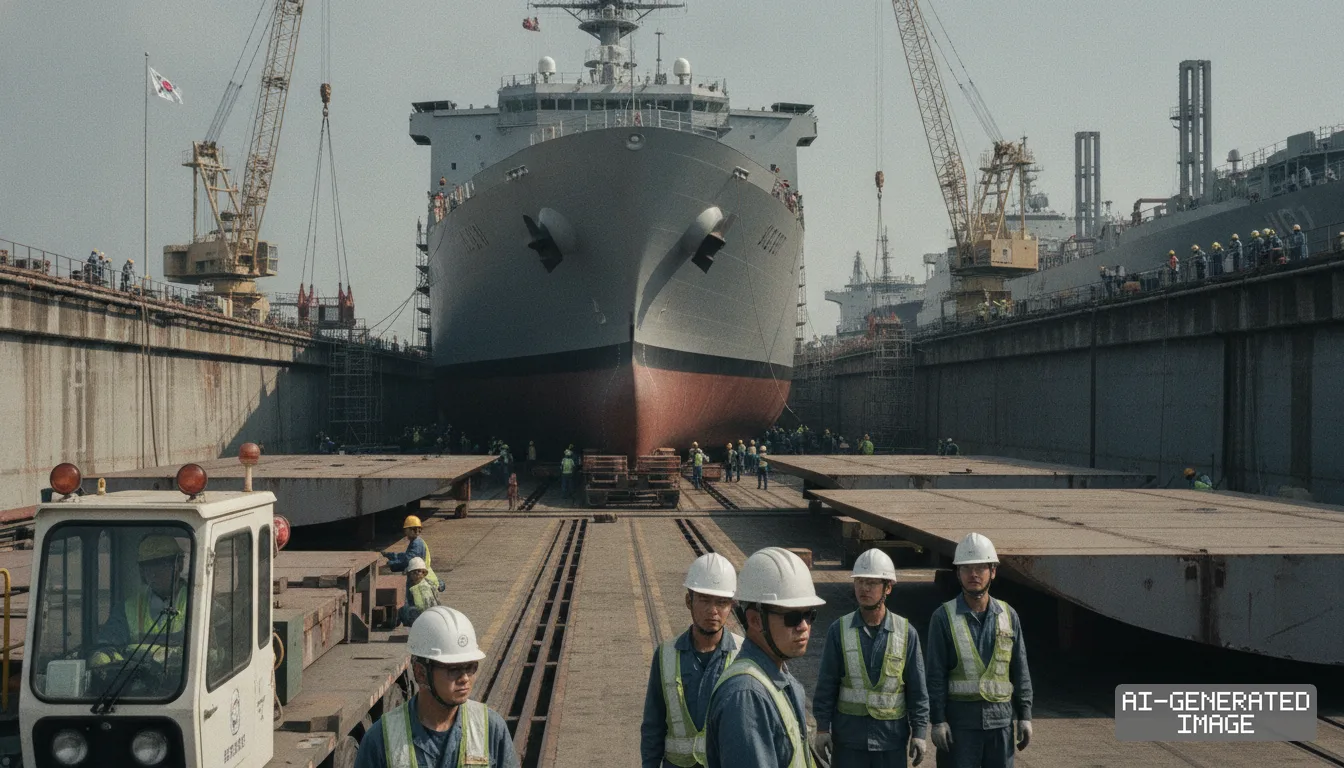
Samsung Heavy Industries stepped up its bid to enter the U.S. Navy ship repair market on Oct. 15, 2026, preparing shipyard docks in Geoje to execute forward-deployed fleet maintenance.
The initiative targets an annual U.S. naval maintenance, repair and overhaul market estimated at 20 trillion won ($14.5 billion). That work provides forward sustainment for Seventh Fleet combat logistics vessels operating across the western Pacific.
Samsung Heavy is working alongside Vigor Marine Group, a U.S. defense ship repairer operating five shipyards and eight drydocks. Under the arrangement, Vigor Marine bids as prime contractor while Samsung Heavy provides yard labor and drydocks in South Korea.
The push rounds out South Korea's big three shipbuilders competing for U.S. naval work. HD Hyundai Heavy Industries and Hanwha Ocean entered the military maintenance market in 2024, followed by mid-sized builder HJ Shipbuilding & Construction.
HJ Shipbuilding delivered the 40,000-ton dry cargo and ammunition ship USNS Amelia Earhart back to sea on Oct. 15. The vessel completed nine months of overhaul at the builder's Yeongdo shipyard in Busan, the company said.
That project was the first completed naval overhaul by a mid-tier Korean yard. Inspections revealed structural defects beyond the initial contract scope, extending dock time by six months and expanding contract value, according to company statements.
For Samsung Heavy, entering naval maintenance requires a distinct commercial route. Unlike rivals in Ulsan and Geoje, the company maintains no dedicated naval construction slips, focusing instead on commercial liquefied natural gas carriers and offshore floating production units.
The shipbuilder is seeking a Master Ship Repair Agreement — a five-year qualification from the U.S. Naval Supply Systems Command that certifies private foreign yards. The certification audits shipyard security, technical quality, drydock capacity and workforce safety standards.
Samsung Heavy prepared application documents for the Naval Supply Systems Command earlier this year, industry officials said. Securing the certification allows foreign builders to bid directly on non-combat auxiliary vessels and combatant ship hull maintenance.
Vigor Marine is currently bidding on multiple Seventh Fleet auxiliary repair tenders, industry officials said. If Vigor wins prime awards, Samsung Heavy will perform the physical repair work at its primary yard in Geoje.
Choi Sung-an, vice chairman of Samsung Heavy, confirmed in late April that the shipbuilder had bid on its first Seventh Fleet logistics vessel. The company expects commercial auxiliary ship repairs to anchor broader American defense industrial ties, Choi said.
Rival Hanwha Ocean has moved fastest among domestic yards. Hanwha Ocean secured its maintenance qualification in July 2024 and acquired Philly Shipyard in Pennsylvania for $100 million, while completing maintenance on the fleet replenishment ship USNS Wally Schirra in 2025.
Hanwha Ocean has booked four naval repair contracts to date, industry data show. The shipbuilder is using its U.S. operating presence and domestic naval building berths to capture follow-on tenders for fleet replenishment oilers and auxiliary transports.
HD Hyundai Heavy Industries also secured its five-year maintenance agreement in July 2024. The company has since won repair orders for 40,000-ton replenishment vessels, executing maintenance at its primary shipyard in Ulsan, according to military procurement records.
U.S. Navy logistics rely heavily on Military Sealift Command vessels, which supply fuel, food and ammunition to forward carrier strike groups. American public shipyards face multi-year repair backlogs, forcing the Pentagon to shift maintenance overseas to treaty allies.
The Pentagon policy leverages allied drydocks in South Korea and Japan to shorten transit times. Repairing logistics ships in East Asia keeps vessels near western Pacific patrol zones rather than routing them across the Pacific to continental American facilities.
Samsung Heavy is simultaneously building ties with American defense designers. In March, a consortium of Samsung Heavy and General Dynamics NASSCO won a concept design contract for the Next-Generation Logistics Ship, a planned 13-vessel auxiliary procurement program.
The company also agreed in July to establish an advanced welding and painting training center with Vigor Marine in the Pacific Northwest. That initiative forms part of bilateral workforce development programs backed by South Korea's Ministry of Trade, Industry and Energy.
Private foreign yards must navigate strict security firewalls to handle naval communications, hull coatings and propulsion gear. Commercial shipbuilders reconfigure dock security fencing and monitor foreign national workforce access before receiving naval clearance, shipyard executives said.
What the public record does not settle is contract timing. Samsung Heavy has not disclosed the value of pending Seventh Fleet bids, and regulatory filings do not confirm whether the U.S. Navy has selected Vigor Marine for active hull tenders.
HJ Shipbuilding holds qualification clearance through Jan. 22, 2031, while the Naval Supply Systems Command is scheduled to review Samsung Heavy's certification portfolio before the close of 2026.
Impact map
How this development propagates across the region and out to global buyers.
| Event | Korea | China | Japan | Global impact |
|---|---|---|---|---|
| U.S. Navy auxiliary MRO expansion | Samsung Heavy joins HD Hyundai and Hanwha in 20 trillion won naval repair race | Exclusion from U.S. defense sustainment widens naval logistics gap in Pacific | Regional commercial yards compete for Seventh Fleet forward drydock space | Military Sealift Command reduces Pacific transit maintenance delays by 30 to 45 days |
In this story
- Companies
- Samsung Heavy IndustriesHD Hyundai Heavy IndustriesHanwha OceanHJ Shipbuilding & Construction
- Tickers
- 010140.KS329180.KS042660.KS097230.KS
- Exposed
- General DynamicsVigor Marine Group
- Policy
- Economic SecuritySubsidies
- Impact
- Order BookSupply ChainCapex
Track every Economic Security development → Track every Subsidies development →
Related briefings
- Pentagon awards Elmet $2.45B to cut China tungsten reliance by 2027 Also on General Dynamics
- Korean shipbuilders localize Arctic ice design software Also on Samsung Heavy Industries, Hanwha Ocean, HD Hyundai Heavy Industries
- Hanwha Ocean Procures 1,800-Ton Goliath Crane as RIEC Starts Build Also on Samsung Heavy Industries, Hanwha Ocean, HD Hyundai Heavy Industries
- HD Hyundai and Hanwha Ocean Lock In LNG Carrier Berth Slots Through 2029 Also on Samsung Heavy Industries, Hanwha Ocean, HD Hyundai Heavy Industries
Sources
Primary documents
Reporting
Confidence: high — how we grade this
The documents behind this briefing are linked above. East Asia Brief produces its English text with AI assistance under human editorial review, and does not translate or republish other outlets' articles. See our methodology and AI policy. Spotted an error? Tell us.
The Morning Brief
What changed in Korean, Chinese and Japanese industry overnight — and what it means for your supply chain. One email, weekday mornings, US time. Free.
The Morning Brief is in preparation. Leave your address and we will write to you once — when the first issue is ready. Nothing before that.