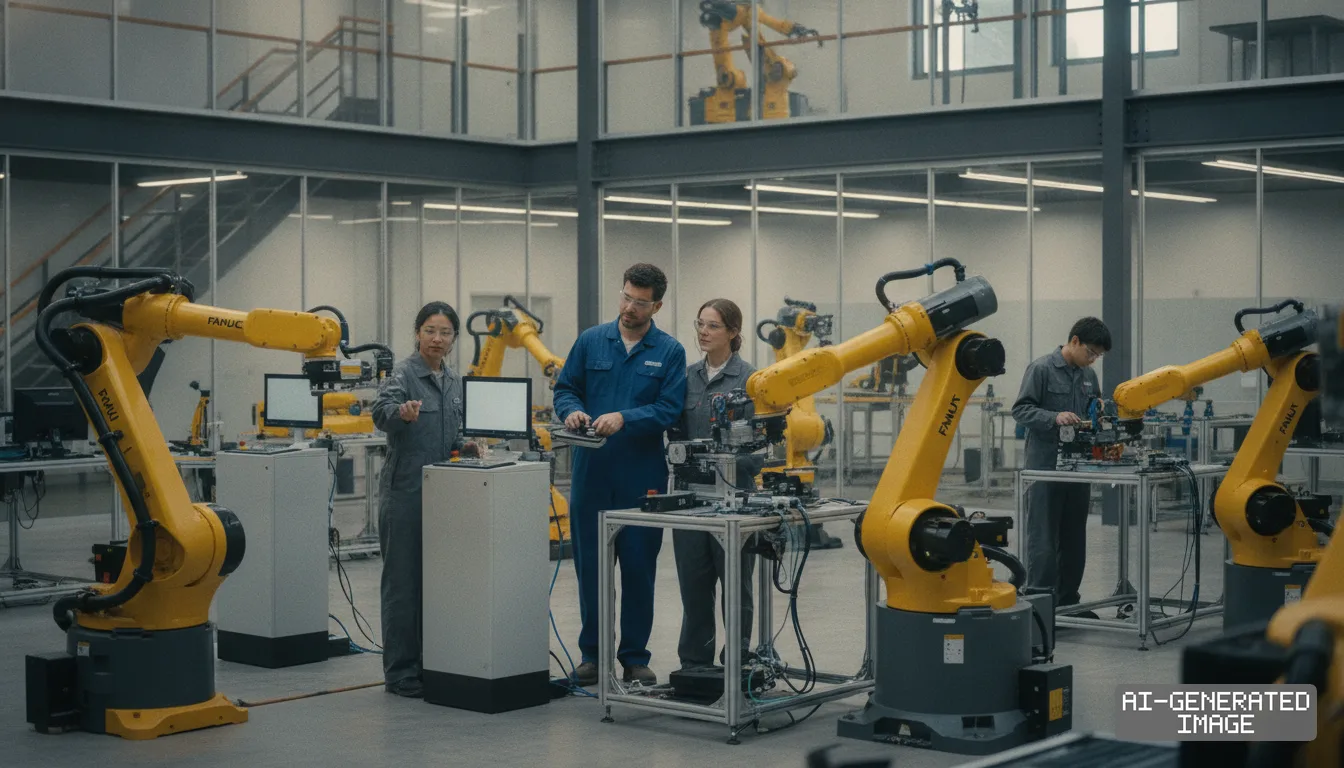
Fanuc holds SCARA line steady as robotics revenue tops 44% of sales
Corporate disclosures confirm no hardware update occurred on Oct. 28, keeping the Japanese automation vendor focused on vision AI and controller integration for electronics assembly.
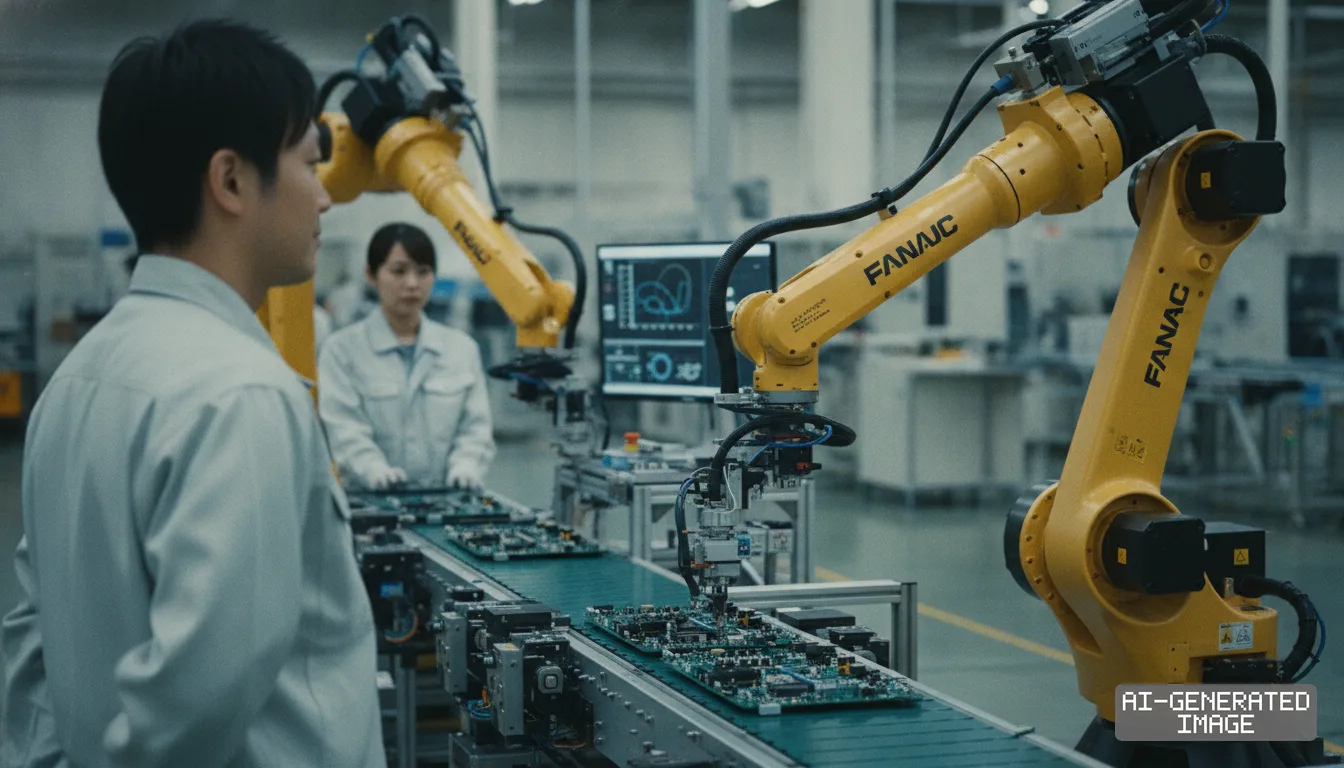
Fanuc Corporation recorded no new SCARA robot line launch on Oct. 28, 2026, according to company disclosures, leaving its precision assembly catalog anchored by earlier hardware.
The robot division generated ¥378.61 billion ($2.51 billion) in net sales for the fiscal year ended March 31, 2026. That division accounted for 44.1% of Fanuc's ¥857.83 billion in consolidated revenue.
The figures establish the division as the primary revenue generator for the Japanese automation builder. First-quarter sales for the period ended June 30 rose to ¥231.0 billion across all business segments.
Market reports circulating on Oct. 28 claimed Fanuc launched next-generation SCARA units for electronics packaging. Fanuc product registries in Japan and overseas units show no such hardware release occurred.
The company instead introduced three robotics control products on Oct. 27. The releases targeted machining integration, mobile robot controllers and embedded factory floor safety systems.
Among the releases was AI Masterless Vision, a physical artificial intelligence system. The software identifies workpieces without manual programming, cutting setup steps for pick-and-place lines, the company said.
Fanuc also unveiled a direct-current controller engineered for collaborative robot arms. The unit connects directly to autonomous mobile robots — driverless transport platforms moving parts across plant floors.
The third release added a software programmable logic controller directly into robot mainframes. That integration removes separate external safety hardware, lowering total system procurement costs for factory integrators, Fanuc said.
SCARA robots — four-axis arms designed for high-speed lateral motion — handle delicate semiconductor handling and component packaging. Fanuc last expanded that specific hardware line in August 2025.
That model, the SR-9iA/R, began customer shipments in April 2025. It carries a 9-kilogram payload with a 620-millimeter reach and completes a round-trip motion cycle in 0.7 seconds.
Fanuc engineered the SR-9iA/R as a rack-mounted unit for solar module handling. The configuration preserves floor space by perching the mechanical arm directly above conveyor tracks.
Before that release, the company introduced the ceiling-mounted SR-3iA/U in June 2023. That arm handles 3-kilogram payloads across a 350-millimeter reach with zero dead zones in its working envelope.
The heavier SR-20iA entered production in December 2020. That unit provides a 20-kilogram payload capacity and an 1,100-millimeter reach for bulk tray handling and heavier electronics packaging.
The original SR-3iA and SR-6iA models debuted in November 2017. Those models established the mechanical baseline for Fanuc's high-speed pick-and-place offering in competitive Asian assembly markets.
Electronics contract manufacturers rely on SCARA arms to populate printed circuit boards and seal finished handheld devices. Cycle speeds down to tenths of a second determine overall assembly line yield.
Industrial automation buyers require high repeatability in small-part placement to minimize microchip package defects. Kinematic rigidity in mechanical joints prevents arm vibration during abrupt deceleration stops.
Catalog revisions issued in October 2026 shifted broader robot configurations toward the R-50iA controller series. The architecture runs alongside legacy R-30iB Plus platforms to support high-speed trajectory calculation.
Fanuc robots support open-source Robot Operating System drivers and Python programming libraries. That software interface links vision sensors directly to motion planners without proprietary middleware.
Competitors across Japan and China have introduced rival four-axis arms to capture packaging demand. Fanuc has defended its footprint by bundling arms with proprietary servo motors and numerical controllers.
Consolidated operating income reached ¥53.5 billion for the quarter ended June 30, up from ¥42.4 billion a year earlier. Net income for the three-month period totaled ¥51.0 billion, company filings show.
The robot division recorded rising deliveries across China and the Americas during the first fiscal quarter. Automotive demand in Japan remained sluggish, shifting capital outlays toward general assembly automation.
Industrial data networking forms another layer of vendor lock-in. Fanuc widened its FIELD system Basic Package IoT platform on Oct. 22 to link factory machinery directly with Microsoft Copilot.
Hitachi entered a strategic partnership with Fanuc on Sept. 30 to deploy physical AI in production plants. Hitachi generated ¥10,586.7 billion in annual revenue and operates 606 consolidated subsidiaries.
Fanuc also teamed with Google in May to connect open-source robotic operating systems with generative models. Over 1,000 Fanuc industrial robots have shipped for physical AI applications since December 2025.
The company has not published any specification, part number or pricing document for a new SCARA model, and Fanuc's regulatory filings contain no record of an Oct. 28 hardware release.
Full-year consolidated net sales are projected to reach ¥948.1 billion for the fiscal year ending March 31, 2027. Operating income is forecast at ¥218.0 billion, according to company projections.
Fanuc scheduled the release of its financial results for the six months ended Sept. 30 for late October. The disclosure provides updated regional order numbers across Asian electronics markets.
Impact map
How this development propagates across the region and out to global buyers.
| Event | Korea | China | Japan | Global impact |
|---|---|---|---|---|
| SCARA product cadence | Samsung and packaging vendors keep existing high-speed pick lines | Domestic robot vendors maintain price pressure across electronics fabs | Fanuc prioritizes software controllers over mechanical SCARA redesigns | Packaging line builders retain existing 0.7-second cycle tooling |
In this story
Related briefings
- FANUC retains hollow-arm robot fleet for factory automation Also on Hitachi, Microsoft, Order Book
- Hitachi and Fanuc unite on physical AI to automate factories Also on Hitachi, FANUC, Order Book
- Hitachi and FANUC partner to deploy physical AI in factories Also on Hitachi, FANUC, Order Book
- Hitachi and FANUC Launch Physical AI Pact to Automate Plants Also on Hitachi, FANUC, Order Book
Sources
Reporting
Confidence: medium — how we grade this
The documents behind this briefing are linked above. East Asia Brief produces its English text with AI assistance under human editorial review, and does not translate or republish other outlets' articles. See our methodology and AI policy. Spotted an error? Tell us.
The Morning Brief
What changed in Korean, Chinese and Japanese industry overnight — and what it means for your supply chain. One email, weekday mornings, US time. Free.
The Morning Brief is in preparation. Leave your address and we will write to you once — when the first issue is ready. Nothing before that.