Fanuc and Google launch AI welding robot to read blueprints
The system eliminates manual teaching by turning 2D and 3D schematics into robot motion, with commercial shipments planned for December.

Fanuc and Google Cloud unveiled an autonomous welding robot system Sept. 10, 2026, using generative artificial intelligence to interpret engineering blueprints without manual teaching by human operators.
The software links Fanuc industrial arms with Google Gemini Enterprise foundation models to convert two-dimensional and three-dimensional schematics directly into motion coordinates. Shipments will begin in December 2026 under a subscription model, Nikkei reported Sept. 10.
Fanuc maintains an installed base of 1.1 million industrial robots worldwide, accounting for roughly one-fifth of global operational factory manipulators. The Japanese builder has shipped more than 1,000 units configured for physical AI applications since December 2025.
Traditional robotic welding requires dedicated engineers to program every joint path, torch angle and voltage setting with a teach pendant. Teaching a single custom structural workpiece can consume several days of specialized engineering labor before production begins.
The new system reads structural drawings, welding symbols and handwritten shop annotations directly from standard digital files. Software agents then calculate collision-free torch trajectories, standoff distances and weld seams without manual calibration, Google Cloud said Sept. 10.
Praveen Rao, global head of manufacturing industry at Google Cloud, detailed the deployment ahead of the International Manufacturing Technology Show in Chicago. The industrial exposition opens Sept. 14 and runs through Sept. 19, 2026.
Heavy fabrication sectors face acute labor shortages that limit production volume across East Asia and North America. Skilled welders represent an aging demographic in Japanese, South Korean and American shipyards, where manual structural welding remains standard practice.
Japanese shipbuilders and heavy machinery fabricators have struggled to automate low-volume, high-mix subassemblies. Because commercial vessels and industrial frames require unique joint geometries, conventional teaching costs make standard robotics uneconomical for short production runs.
South Korean and Japanese shipyards hold commercial order books stretching past 2028 but operate with chronic yard labor deficits. Automating variable welding passes directly from design office blueprints removes the primary bottleneck in steel block assembly shops.
The platform builds on a strategic partnership that Fanuc and Google established on May 13, 2026. Under that agreement, Fanuc integrated Google Cloud AI agents and robotics software across its industrial arm controller architecture.
Alphabet robotics subsidiary Intrinsic provides the open robot operating system layer that bridges Google cloud computing infrastructure with factory hardware. Fanuc robots connect to the software environment through standardized open-source drivers and programmable logic controller interfaces.
The underlying architecture relies on multimodal foundation models trained to parse technical schematics alongside natural-language assembly instructions. The software agent extracts critical welding parameters, including bevel geometry, root openings, material thicknesses and travel speeds, without human translation.
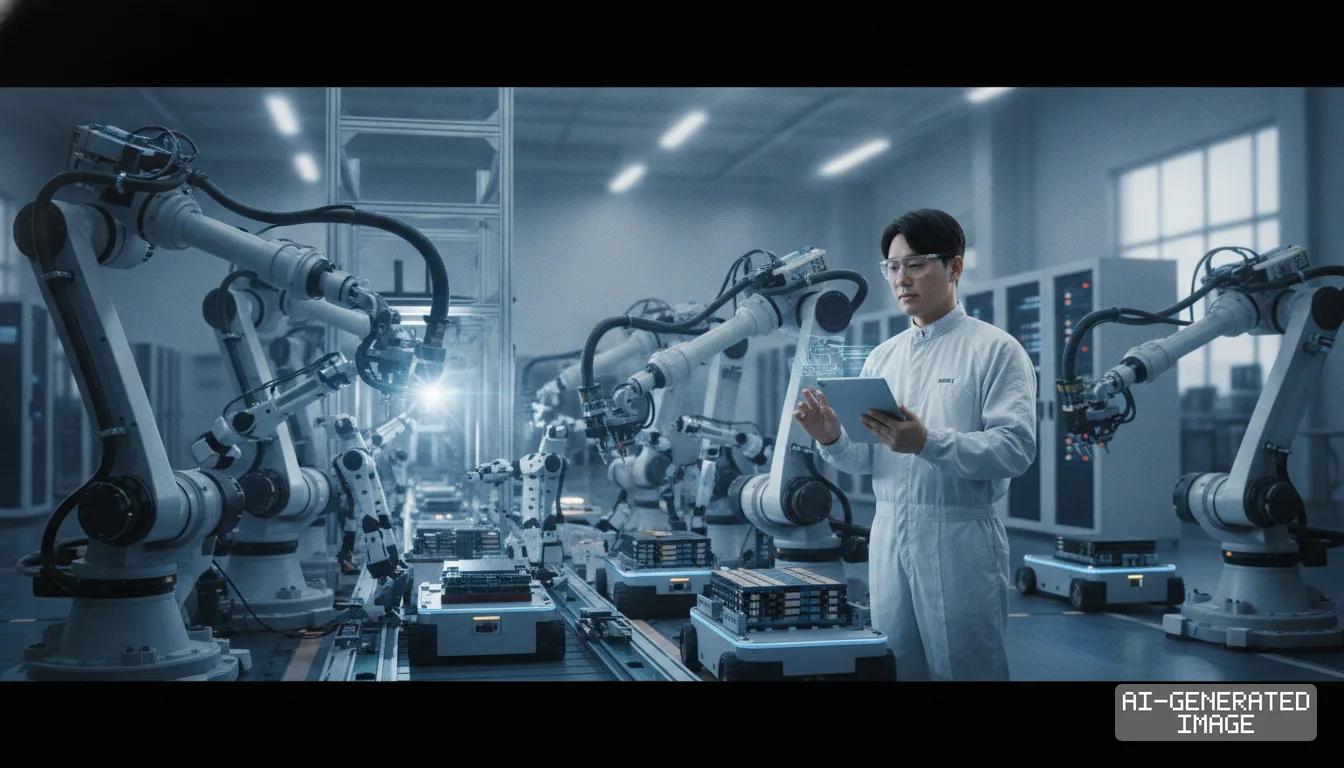
Once parameters are extracted, the system coordinates multi-robot cells to distribute complex tasks across multiple arms. One arm can hold or reposition heavy structural plates while secondary manipulators lay continuous multi-pass welds along designated seams.
Fanuc demonstrated an early version of the system during its first-quarter earnings briefing on July 31, 2026. That demonstration paired Gemini Enterprise reasoning models with lightweight CRX series collaborative robot arms executing teaching-free welding routines.
The commercial deployment model marks a strategic shift toward recurring software revenue for the Yamanashi-based robot maker. Industrial automation hardware vendors historically generated cash flow through upfront equipment sales rather than cloud-hosted software subscriptions.
Hardware competitors ABB, Yaskawa Electric and KUKA have similarly introduced vision-guided welding packages for factory cells. None has commercialized foundation models capable of parsing raw mechanical drawings into multi-robot motion control at industrial scale.
Fanuc America invested $90 million (approx. ¥14.3 billion) in March 2026 to expand manufacturing facilities in Michigan. The 840,000-square-foot facility supports growing North American demand for physical AI robotics and automated manufacturing systems.
The technical approach centers on physical AI, which pairs cognitive reasoning models with real-time deterministic motion controllers. Instead of relying on rigid trajectory coding, the robot reasons over spatial geometry and physical constraints before striking an arc.
High-mix fabrication shops in automotive tier-one supply chains and structural steel fabrication represent immediate commercial targets. These facilities process hundreds of distinct parts each month, making conventional offline programming overhead prohibitive for robotic adoption.
The companies have not published subscription pricing schedules or hardware bundling fees for the December commercial release. Fanuc also did not post a dedicated corporate announcement regarding commercial packaging on its investor relations portal Sept. 10.
Commercial shipments of the blueprint-reading welding package begin in December 2026 across Asian and North American markets. Live technical demonstrations will take place next week at the McCormick Place convention center in Chicago.
Impact map
How this development propagates across the region and out to global buyers.
| Event | Korea | China | Japan | Global impact |
|---|---|---|---|---|
| Blueprint-reading AI welding deployment | Shipbuilders gain access to teaching-free robotics to offset welder shortages in block assembly | Local robot makers face wider software gap against Japanese hardware paired with US AI models | Fanuc opens recurring subscription revenue channel across its heavy industrial customer base | Heavy fabrication cycle times drop as engineering blueprint programming overhead is eliminated |
In this story
- Companies
- FanucAlphabet
- Tickers
- 6954.TGOOGL
- Exposed
- ABBYaskawa ElectricKUKA
- Policy
- Economic Security
- Impact
- Supply ChainCost StructureOrder Book
Track every Economic Security development →
Related briefings
- FANUC America links factory robots to Palladyne AI platform Also on Alphabet, KUKA, ABB
- Estun Automation completes buyout of robotics unit Codroid Also on KUKA, Fanuc, ABB
- China Antimonopoly Review Imposes Harsher Operational Remedies on Automation Mergers Also on Fanuc, ABB, Yaskawa Electric
- FANUC UK restructures sales leadership to target aerospace and defense Also on KUKA, ABB, Order Book
Sources
Reporting
Confidence: medium — how we grade this
The documents behind this briefing are linked above. East Asia Brief produces its English text with AI assistance under human editorial review, and does not translate or republish other outlets' articles. See our methodology and AI policy. Spotted an error? Tell us.
The Morning Brief
What changed in Korean, Chinese and Japanese industry overnight — and what it means for your supply chain. One email, weekday mornings, US time. Free.
The first issue goes out shortly. Sign up now and you will not miss it.