European fusion developers seek Japanese superconducting tape
Munich-based Proxima Fusion outlined orders for 20,000 kilometers of high-temperature tape for its Alpha stellarator planned for the early 2030s.
European energy consortiums and fusion developers formalized supply-chain solicitations with Japanese component manufacturers on Nov. 7, 2026, targeting high-temperature superconducting tape and heating systems for pilot power plants.
The solicitations focus on securing industrial-scale hardware for magnetic confinement reactors. Commercial deployment timelines depend on specialized materials that European factories cannot currently deliver at volume.
Munich-based Proxima Fusion outlined requirements for roughly 20,000 kilometers of high-temperature superconducting (HTS) tape for Alpha, its planned stellarator demonstration reactor scheduled for the early 2030s.
Commercial deployment of the company's subsequent Stellaris power plant will require approximately 40,000 kilometers of HTS tape per unit. That represents a material procurement volume without precedent in the commercial fusion sector.
To address that deficit, Proxima Fusion and Fujikura concluded a preliminary pact to assess building an HTS tape manufacturing plant in Lower Saxony, Germany. The facility would combine Japanese production know-how with European project demand.
Fujikura manufactures rare-earth barium copper oxide coated conductors. The tape allows superconducting magnets to generate the intense magnetic fields required to confine fusion plasma at temperatures exceeding 100 million degrees Celsius.
German research authorities have backed the bilateral push with state resources to build resilient supply lines before prototype construction starts.
The German Federal Ministry of Research, Technology and Space has allocated €125 million ($143 million) across three national fusion hubs to accelerate domestic supply chains.
In tandem with magnet conductors, European developers face bottlenecks in heating hardware needed to initiate and sustain burning plasma inside non-tokamak confinement geometries.
Kyoto Fusioneering signed an agreement to provide specialized plasma heating and fuel-cycle systems to European developers, expanding engineering ties established during bilateral government summits in Tokyo.
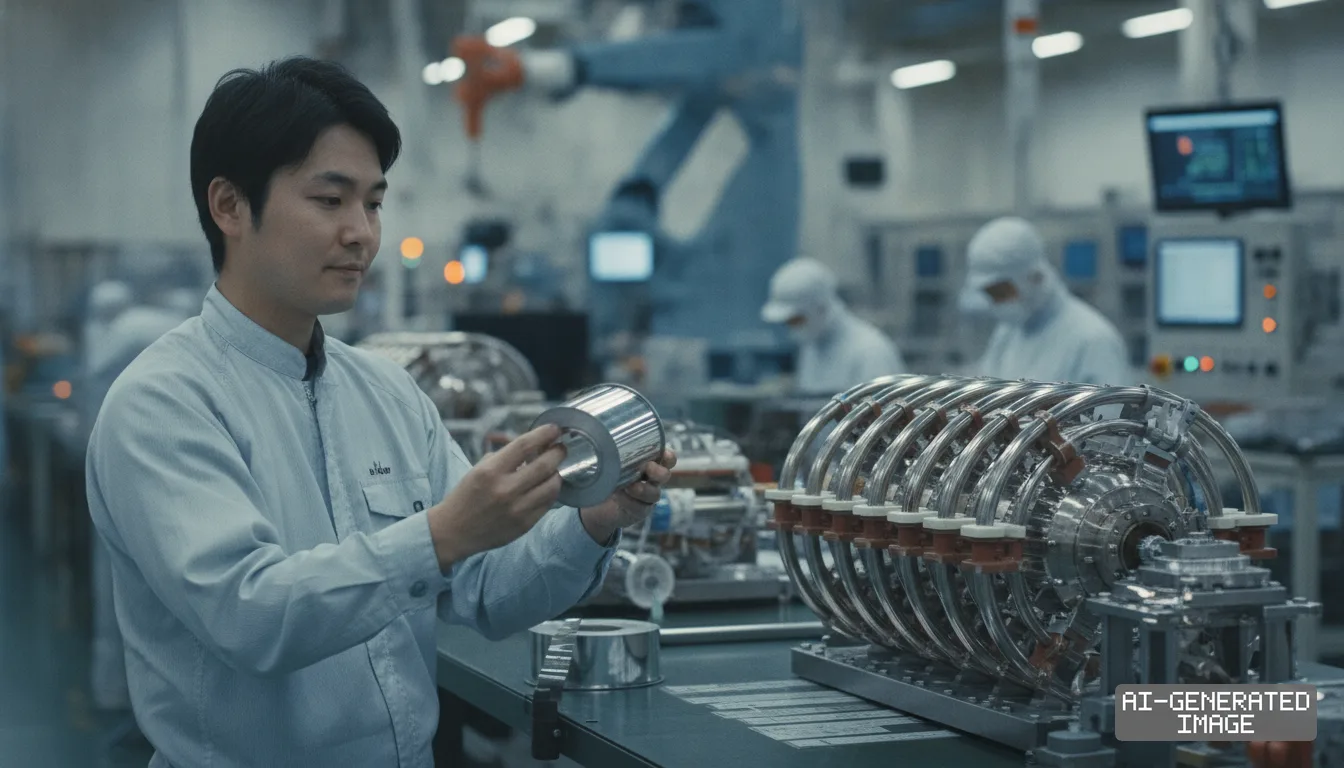
The Kyoto-based supplier will design and assemble 170-gigahertz gyrotron systems. The high-power microwave tubes heat plasma to ignition thresholds without requiring the electric currents used in conventional tokamaks.
Gyrotron hardware for the European pipeline will undergo integration and acceptance testing at Kyoto Fusioneering’s Shiga Innovation Factory before export, leveraging established Japanese precision machining networks.
The industrial outreach also encompasses tritium fuel-cycle technologies. The systems recover, purify and reinject unburned hydrogen isotopes during continuous plant operations to maintain closed-loop fuel sustainability.
Japan’s fusion hardware advantage stems from decades of state-sponsored experimental reactors, most notably the JT-60SA superconducting tokamak facility in Naka, Ibaraki Prefecture.
Heavy industrial contractors honed advanced metallurgy, vacuum fabrication and precision winding techniques during the construction of JT-60SA and component contributions to the ITER international project in France.
Mitsubishi Heavy Industries manufactured toroidal field coils and outer divertor components designed to endure immense mechanical stress and extreme thermal loads within fusion chambers.
Toshiba Energy Systems fabricated double-walled vacuum vessel sectors for JT-60SA, demonstrating sub-millimeter tolerances across multi-ton stainless steel structures.
European fusion ventures now rely on those Japanese competencies as private capital accelerates development schedules ahead of public demonstration timetables.
Venture-backed operators lack the multi-decade testing facilities required to qualify structural steels and magnet joints. That makes established Japanese suppliers the default partners for first-of-a-kind hardware.
Western governments have simultaneously moved to ring-fence fusion supply networks from geopolitical exposure, prioritizing allied industrial cooperation over low-cost Chinese alternatives.
Chinese manufacturers have expanded output of low-temperature superconducting magnets, but Japanese producers retain proprietary leads in mechanical durability and critical current densities under high magnetic fields.
The bilateral partnership faces commercial risks, including high initial capital costs for overseas manufacturing and the absence of standardized licensing frameworks for commercial fusion reactors.
The initial agreements do not disclose the projected capital expenditure for the Lower Saxony factory, and the companies have not published binding procurement volumes or unit prices.
Feasibility studies for the Lower Saxony superconducting wire plant will conclude in mid-2027, establishing whether local European production can meet Alpha’s procurement timetable.
Component deliveries for related auxiliary heating systems will run through 2029 under current manufacturing schedules, pacing prototype assembly toward early-2030s plasma trials.
Impact map
How this development propagates across the region and out to global buyers.
| Event | Korea | China | Japan | Global impact |
|---|---|---|---|---|
| European fusion supply partnerships | KSTAR research teams face tighter competition for high-field superconductor procurement | Domestic stellarator projects accelerate reliance on Chinese magnet winders | Fujikura and Kyoto Fusioneering secure anchor positions in European pilot reactor designs | Commercial fusion timelines shift dependency toward specialized East Asian industrial manufacturing |
In this story
- Companies
- FujikuraKyoto FusioneeringProxima Fusion
- Tickers
- 5803.T
- Exposed
- Mitsubishi Heavy IndustriesToshiba
- Policy
- Subsidies
- Impact
- Supply ChainOrder BookCapex
Track every Subsidies development →
Related briefings
- Kioxia Rejects SK hynix Flash Alliance to Guard SanDisk Ties Also on Toshiba, Subsidies
- Japan offers U.S. chip investment to win semiconductor tariff relief Also on Toshiba, Subsidies
- Kioxia merges Iwate fab subsidiary after ¥4.25 trillion half-year sales Also on Toshiba
- Toshiba trims Kioxia stake below 13% in NAND governance shakeup Also on Toshiba
Sources
Primary documents
Reporting
Confidence: high — how we grade this
The documents behind this briefing are linked above. East Asia Brief produces its English text with AI assistance under human editorial review, and does not translate or republish other outlets' articles. See our methodology and AI policy. Spotted an error? Tell us.
The Morning Brief
What changed in Korean, Chinese and Japanese industry overnight — and what it means for your supply chain. One email, weekday mornings, US time. Free.
The Morning Brief is in preparation. Leave your address and we will write to you once — when the first issue is ready. Nothing before that.