Panasonic Energy links with Delta-Q on industrial EV chargers
The partnership matches Japanese lithium-ion packs with charging hardware as non-automotive cells deliver 40% of the manufacturer's annual revenue.
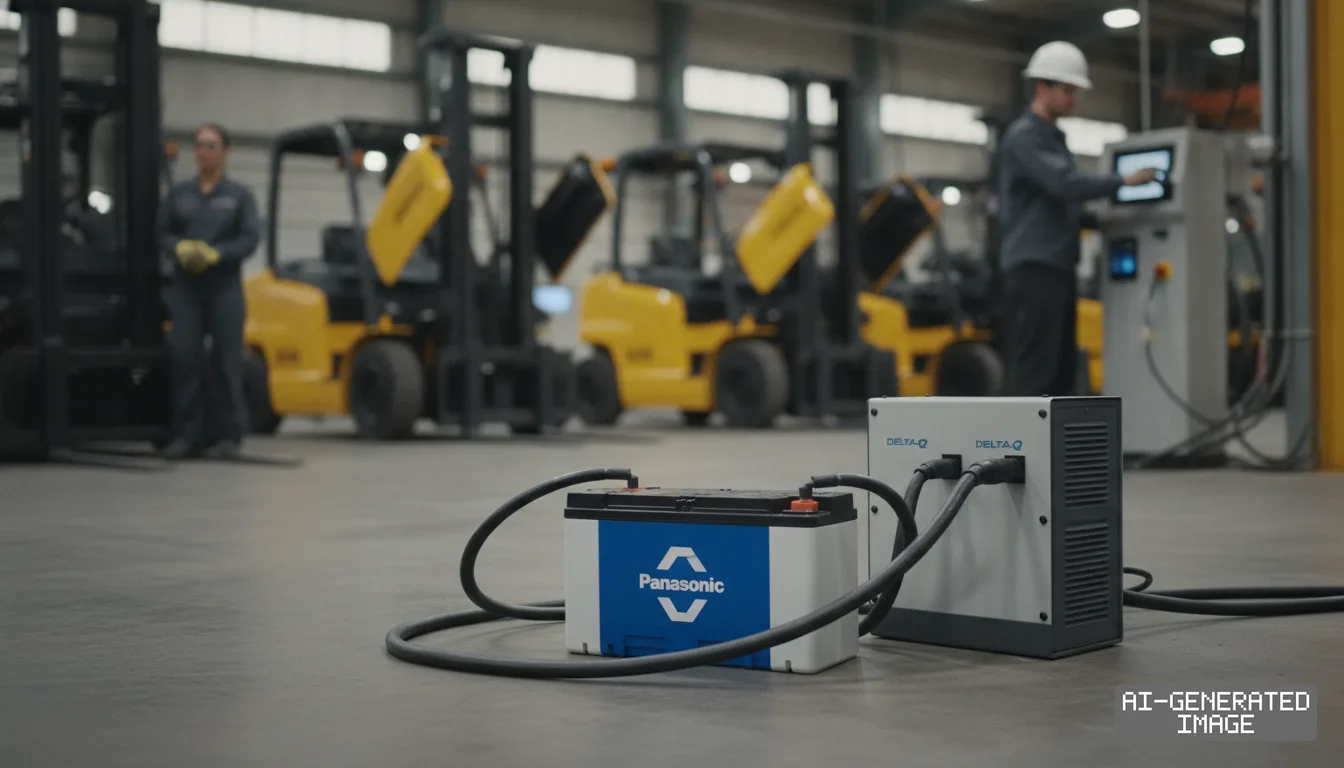
Panasonic Energy Sales Company of America joined Delta-Q Technologies' battery compatibility program on Nov. 7, 2026, establishing standardized charging systems for North American industrial machinery and commercial fleets.
The agreement pairs Panasonic lithium-ion battery packs with high-frequency charging hardware across off-road equipment. Panasonic Energy generated 984.2 billion yen ($6.4 billion) in net sales in fiscal 2026, with non-automotive industrial and consumer cells supplying roughly 40% of segment revenue.
That non-automotive unit booked 392.2 billion yen ($2.55 billion) in annual sales during the previous fiscal year. Panasonic Energy is expanding commercial operations in higher-margin specialty mobility as passenger electric vehicle adoption slows across North America.
Burnaby-based Delta-Q operates as the charging technology arm of Italy's ZAPI Group. The Canadian manufacturer has engineered industrial power electronics for 26 years, supplying power conversion systems to commercial original equipment manufacturers.
The Charged by Delta-Q compatibility program pre-validates battery packs alongside industrial chargers before machinery integration. This joint testing eliminates separate engineering qualification cycles for equipment manufacturers that purchase components from both suppliers.
Target vehicles include electric golf cars, warehouse lift trucks, compact excavators and agricultural utility haulers. These specialty sectors demand rugged power electronics capable of handling vibration, moisture and continuous workplace duty cycles.
Partnering with Panasonic Energy provides equipment makers with validated turnkey systems that combine chargers with advanced pack assemblies, Rod Dayrit, global business development director at ZAPI Group, said in a corporate statement.
Delta-Q holds deep engineering roots across non-road mobile machinery, Sergio Rodriguez, business development manager at Panasonic Energy Sales Company of America, said. The partnership will accelerate electrification across specialized vehicle platforms, Rodriguez said.
Delta-Q chargers use Controller Area Network communication—a vehicle data standard that lets microcontrollers exchange telemetry without a host computer—to govern current flow based on cell temperature and pack charge state.
Panasonic Holdings has faced margin pressure in its core automotive battery unit, which supplies cylindrical cells to Tesla. Passenger EV factory utilization in Japan and the United States softened over the past four quarters.
Panasonic Energy deferred some equipment installation schedules at its multi-billion-dollar plant under construction in De Soto, Kansas. The facility focuses on 2170 cylindrical cells designed primarily for highway passenger vehicles.
Industrial battery contracts deliver operating margins above 10%, compared with low-single-digit margins in commodity passenger automotive packs. Premium pricing in specialized machinery stems from custom pack enclosures, dedicated safety software and smaller purchase batches.
Panasonic Energy has expanded its stationary backup storage business for artificial intelligence data centers. The company repurposed selected domestic assembly lines to produce stationary cells after industrial storage revenue grew 28% in fiscal 2025.
The off-road vehicle market offers steady recurring demand insulated from consumer automotive purchase cycles. Fleet operators in logistics hubs and municipal parks replace legacy lead-acid batteries with lithium-ion systems to reduce maintenance labor and eliminate acid hazards.
Delta-Q has widened its compatibility roster to encompass multiple cell types. The company added Acculon Energy to the program on Oct. 5 to validate sodium-ion batteries for cold-storage logistics facilities and robotic delivery carts.
Adding Panasonic Energy introduces high-density nickel-based lithium chemistry into that charging network. High-capacity nickel-manganese-cobalt formulations provide maximum run times for heavier machines that operate across continuous eight-hour factory shifts without midday charging.
Japanese battery makers are increasingly avoiding direct price competition against Chinese lithium iron phosphate manufacturers in mass-market passenger cars. Tokyo-based suppliers are directing cell production into marine vessels, construction excavators and material handling equipment instead.
Section 45X of the United States Internal Revenue Code provides advanced manufacturing production tax credits of $35 per kilowatt-hour for domestic battery cells. Panasonic qualifies for those production subsidies across its Nevada manufacturing lines.
Delta-Q and Panasonic did not disclose the initial contract value or specify which cylindrical cell form factors will receive primary certification under the program.
The two manufacturers will begin joint technical integration reviews with North American original equipment makers on March 31, 2027, ahead of new equipment platform rollouts for the 2028 production cycle.
Impact map
How this development propagates across the region and out to global buyers.
| Event | Korea | China | Japan | Global impact |
|---|---|---|---|---|
| Industrial battery standard | LG Energy Solution faces stiffer non-EV pack competition in North American industrial fleets | CATL and Gotion lose standard integration slot in Tier-1 North American off-road OEM supply chains | Panasonic Energy secures high-margin off-road integration, offsetting slower Tesla automotive volume | Industrial equipment OEMs cut electrification qualification cycles by adopting pre-validated battery-charger pairings |
In this story
- Companies
- Panasonic HoldingsDelta-Q Technologies
- Tickers
- 6752.T
- Exposed
- TeslaAcculon Energy
- Policy
- Tax CreditsStandards
- Impact
- Supply ChainOrder BookCost Structure
Track every Tax Credits development → Track every Standards development →
Related briefings
- Delta-Q adopts Acculon sodium batteries for warehouse robots Also on Delta-Q Technologies, Acculon Energy, Cost Structure
- CATL Clears Battery Passport Trial Ahead of 2027 EU Mandate Also on Panasonic Holdings, Tesla, Standards
- Panasonic Energy unveils 150 C solid-state prismatic battery Also on Panasonic Holdings, Tesla, Cost Structure
- Panasonic Optimizes 4680 Battery Cell Yields at Wakayama Plant in Japan Also on Panasonic Holdings, Tesla, Cost Structure
Sources
Reporting
Confidence: medium — how we grade this
The documents behind this briefing are linked above. East Asia Brief produces its English text with AI assistance under human editorial review, and does not translate or republish other outlets' articles. See our methodology and AI policy. Spotted an error? Tell us.
The Morning Brief
What changed in Korean, Chinese and Japanese industry overnight — and what it means for your supply chain. One email, weekday mornings, US time. Free.
The Morning Brief is in preparation. Leave your address and we will write to you once — when the first issue is ready. Nothing before that.