Japan Separator Makers Accelerate Ceramic-Coated and Solid-State Film Expansion
Asahi Kasei and Toray are retooling production lines toward high-heat ceramic films and solid-electrolyte substrates to secure margins against standard wet-process overcapacity.
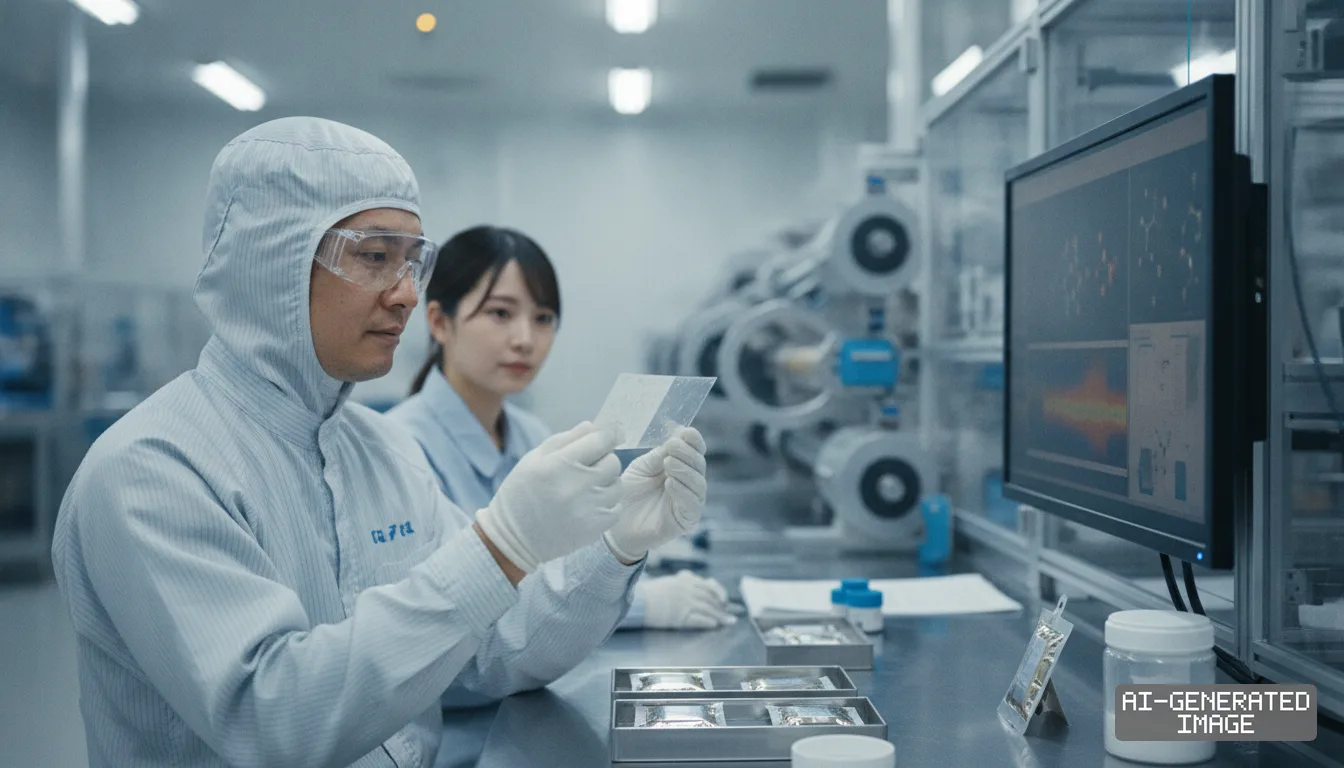
Japanese specialty chemical manufacturers Asahi Kasei Corporation and Toray Industries are accelerating the conversion of their separator production lines toward high-temperature ceramic-coated films and specialized substrate membranes designed for solid-state and high-nickel electric vehicle battery cells. The capital expenditures redirect manufacturing resources away from commoditized base polyolefin films toward highly engineered safety layers, addressing structural overcapacity in standard wet-process separators while capturing high-margin demand from premium automotive battery supply chains.
The strategic shift reflects a broader repositioning across Japan's battery materials sector as cell architectures transition toward higher energy densities. While standard microporous polyethylene and polypropylene separators face persistent pricing pressure from large-scale capacity additions in East Asia, high-nickel ternary chemistries and emerging semi-solid architectures require advanced thermal dimensional stability and dendrite-suppression capabilities. Ceramic-coated separators (CCS), which apply nanoscale layers of high-purity alumina or boehmite onto polymer substrates, prevent thermal runaway by maintaining structural integrity at temperatures exceeding 180 degrees Celsius, well above the melting points of conventional polyethylene base films.
Asahi Kasei, one of the world's largest lithium-ion battery separator producers, is concentrating capital deployment on its proprietary Hipore wet-process membrane lines and Celgard dry-process technologies to expand coated film output across facilities in Japan, North America, and Southeast Asia. The company is retrofitting existing coating assets to apply inorganic ceramic particles and specialized fluoropolymer binders with tighter thickness tolerances, reducing coating thickness from conventional four-to-five micrometer profiles down to two micrometers or less without compromising electrical insulation. The reduction in coating thickness allows battery cell manufacturers to package longer active electrode lengths within standardized prismatic and cylindrical form factors, directly increasing volumetric energy density.
Concurrently, Asahi Kasei is scaling development work on polymer-electrolyte hybrid substrates for next-generation solid-state batteries. These specialized porous films act as mechanical reinforcement matrices for sulfide- and oxide-based solid electrolytes, solving the brittleness and interface contact resistance issues that have slowed the commercial production of all-solid-state cells. The company has structured its research and commercial validation programs to align with automotive delivery schedules, targeting pilot and commercial qualification stages for solid-state battery platforms scheduled for vehicle deployment between 2027 and 2030.
Toray Industries is deploying an identical defensive and technological pivot across its battery materials division, prioritizing its high-heat-resistant microporous separator offerings. Toray has advanced commercial integration of its aramid-coated and ceramic-coated films, which utilize proprietary polymer formulation and phase-separation technologies to deliver zero thermal shrinkage at 200 degrees Celsius. The company's micro-porous membrane lines in Japan and South Korea are progressively dedicating higher capacity shares to high-tensile, ultra-thin substrate production, supplying Tier-1 automotive battery makers that manufacture prismatic cells for North American and European electric vehicle assembly plants.
The shift toward coated and solid-state membranes is altering procurement dynamics for Tier-1 cell manufacturers, including Panasonic Energy, Prime Planet Energy & Solutions, and South Korean battery makers. As automotive original equipment manufacturers demand nickel contents exceeding 90 percent in lithium nickel cobalt manganese (NCM) and lithium nickel cobalt aluminum (NCA) cathode formulations, separator specifications have become a critical design constraint. Higher nickel content lowers the thermal degradation onset temperature of the cathode, increasing the risk that localized short circuits or mechanical compression will trigger self-sustaining exothermic reactions. Cell designers are consequently mandating ceramic coatings on both sides of the base film, as well as uniform pore distributions to prevent uneven lithium-ion flux during ultra-fast charging cycles.
The engineering pivot by Japanese separator manufacturers carries direct cost and operational implications for global battery supply chains. Ceramic-coated separators command a pricing premium over uncoated commodity membranes due to the cost of raw material inputs, such as sub-micron boehmite particles and high-purity alumina, alongside the lower line speeds required to achieve defect-free coating uniformity. However, automotive pack designers offset these material premiums through module-level cost reductions, as higher thermal stability allows for simplified cell-to-pack cooling hardware and reduced mechanical fire-suppression insulation.
Upstream chemical and mineral suppliers are adapting product lines to match the stricter purity requirements of Japan's expanding coating operations. Producers of boehmite, high-purity alumina (HPA), and polyvinylidene fluoride (PVDF) binders are expanding specialized capacity to eliminate metallic and moisture impurities down to single-digit parts-per-billion levels. Unwanted metallic particles within the ceramic coating can act as nucleation sites for lithium micro-dendrite growth during repeated fast-charging cycles, leading to micro-shorts and accelerated cell capacity fading.
The capacity retooling in Japan also interfaces with economic security policies and supply chain localization incentives established by the Ministry of Economy, Trade and Industry (METI). Under Japan's Economic Security Promotion Act, advanced battery components and functional materials qualify for direct capital investment subsidies, provided that critical manufacturing technologies and intellectual property remain anchored domestically or within certified partner jurisdictions. The subsidy framework supports domestic facility upgrades for ceramic dispersion, thin-film extrusion, and automated optical defect inspection systems, ensuring that Japanese plants maintain technical differentiation against high-volume base film competitors.
Qualification programs between Japanese separator suppliers and automotive original equipment manufacturers continue to proceed through multi-stage validation gates. Tier-1 cell makers require between 18 and 24 months of continuous cycling and safety testing before approving a re-engineered coating formulation or a thinned substrate for serial vehicle production. Asahi Kasei and Toray are completing long-term testing protocols on these specialized ceramic-coated rolls and hybrid solid-state substrates, preparing commercial delivery commitments for multi-gigawatt cell manufacturing lines entering high-volume operations over the next three fiscal years.
Impact map
How this development propagates across the region and out to global buyers.
| Event | Korea | China | Japan | Global impact |
|---|---|---|---|---|
| Advanced separator shift | tier-1 cell procurement | base film price pressure | specialized coating expansion | high-nickel EV battery safety |
In this story
- Companies
- Asahi Kasei CorporationToray Industries
- Tickers
- 3407.T3402.T
- Exposed
- Panasonic EnergyPrime Planet Energy & Solutions
- Policy
- Economic SecuritySubsidies
- Impact
- Supply ChainCapexCost Structure
Track every Economic Security development → Track every Subsidies development →
Related briefings
- Japanese automakers standardize prismatic battery cold tests as EV timelines advance Also on Prime Planet Energy & Solutions, Cost Structure
- Panasonic Optimizes 4680 Battery Cell Yields at Wakayama Plant in Japan Also on Toray Industries, Panasonic Energy, Cost Structure
- Sumitomo Chemical shifts aramid separator lines to Korea as battery thermal rules tighten Also on Toray Industries, Cost Structure
- Japan tenders economic security subsidies for synthetic graphite anode substitutes Also on Panasonic Energy, Cost Structure
Sources
This briefing carries no sources block. It was written from our desks’ working knowledge of the sector rather than from documents retrieved for this piece. Read it as orientation and check any figure you intend to act on — how we source briefings.
This briefing carries no linked sources: it was written from our desks' working knowledge of the sector rather than from documents retrieved for this piece. East Asia Brief publishes no citation it cannot link. Our English text is produced with AI assistance under human editorial review. See our methodology and AI policy. Spotted an error? Tell us.
The Morning Brief
What changed in Korean, Chinese and Japanese industry overnight — and what it means for your supply chain. One email, weekday mornings, US time. Free.
The Morning Brief is in preparation. Leave your address and we will write to you once — when the first issue is ready. Nothing before that.