Changan and CATL Expand 75 GWh Cell Hub and Solid-State Line
Changan Automobile confirmed joint battery expansion with CATL while targeting 1,500-kilometer solid-state cells, raising competitive pressure on South Korean and Japanese rivals.
Changan Automobile clarified details of its partnership with Contemporary Amperex Technology on Oct. 14, 2026, confirming a 75-gigawatt-hour manufacturing target and joint research on all-solid-state cells.
The disclosures address market reports claiming an immediate standalone agreement for a 75-gigawatt-hour solid-state assembly line. Changan Automobile is China's fourth-largest state automaker by volume, while Contemporary Amperex Technology, known as CATL, is the world's largest battery producer.
The manufacturing figure refers to total cell capacity under Times Changan, a production joint venture formed in 2023. CATL holds a 51% controlling stake in the venture, Changan Automobile holds 30%, and electric vehicle affiliate Deepal holds the remaining 19%.
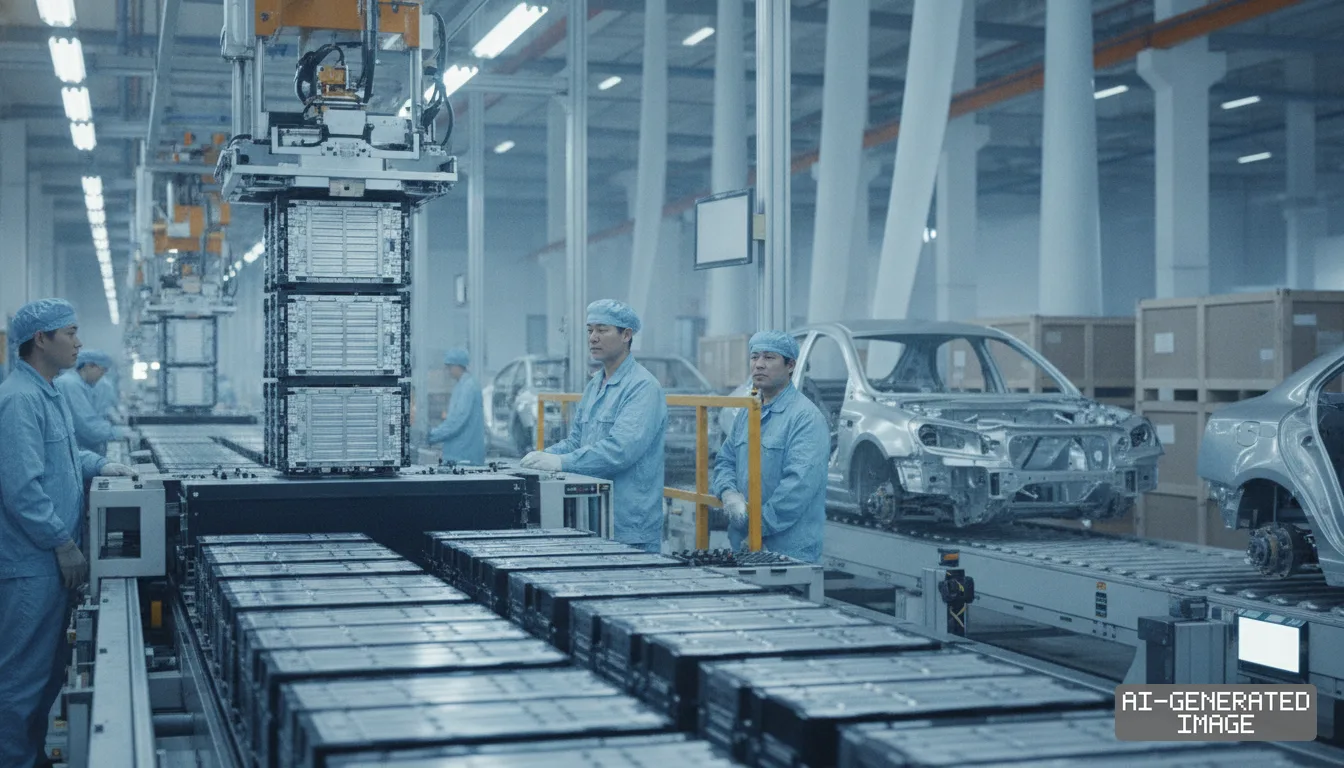
Times Changan operates 25 gigawatt-hours of cell capacity. The partners have committed 5 billion yuan ($750 million) to build an additional 50-gigawatt-hour facility spanning 700,000 square meters, bringing combined site capacity to 75 gigawatt-hours.
The joint site sits in an industrial corridor between Chongqing municipality and Sichuan province. Local authorities project the expanded base will yield 10 billion yuan ($1.5 billion) in annual output upon completion.
The factory supplies prismatic lithium iron phosphate and ternary cells to Changan brands, including Nevo, Deepal and Avatr. Solid-state cell fabrication will enter parallel engineering lines as technical verification advances, the automaker said.
Alongside joint factory expansion, Changan Automobile confirmed ongoing laboratory collaboration with CATL on all-solid-state electrolytes and sodium-ion cells. The automaker released the statement on the Shenzhen Stock Exchange investor platform following inquiries regarding next-generation powertrains.
Changan Automobile is pursuing a dual pathway for next-generation chemistries. The state-backed automaker maintains in-house proprietary battery development while procuring scale volume from CATL through their shared assembly hub.
The automaker's proprietary technology runs under its Golden Bell program, introduced to produce liquid, semi-solid and solid-state formats. The Golden Bell initiative won a national science and technology progress award earlier this year.
Changan Automobile has set a design target of 400 watt-hours per kilogram for its all-solid-state cell. The target aims for a driving range exceeding 1,500 kilometers under China light-duty vehicle test cycle standards.
Current commercial lithium-ion cells top out around 255 to 300 watt-hours per kilogram. Solid-state batteries replace flammable liquid electrolytes with solid conductive materials, allowing higher energy density and reduced thermal runaway risk.
The company claims its solid-state architecture improves battery safety by 70% over conventional liquid packs. The system uses artificial intelligence algorithms to run continuous remote diagnostics on cell degradation.
Validation schedules remain on track, the carmaker said. Changan Automobile has scheduled initial trial installations of solid-state modules in test vehicles and robotics platforms before moving to consumer fleets.
Commercial scale-up will follow in stages. Changan Automobile plans to complete pilot validation during late 2026 before launching series manufacturing in 2027.
The exchange filings do not state how much of the 75-gigawatt-hour footprint will be allocated exclusively to solid-state chemistry, and neither company has published a bill-of-materials cost breakdown.
CATL is deploying substantial research capital into sulfide-based solid electrolytes. The battery giant has targeted small-batch production of all-solid-state cells by 2027 while protecting its dominant market share in liquid chemistries.
The alliance also covers sodium-ion chemistries for lower-cost passenger cars. CATL supplies Naxtra sodium-ion packs delivering 175 watt-hours per kilogram to Changan compact electric models.
China's rapid testing cadence puts operational pressure on established battery developers in South Korea and Japan. Korean cell makers LG Energy Solution, Samsung SDI and SK On are developing competing solid-state technologies.
Samsung SDI is testing sulfide-based solid-state prototypes with an energy density of 900 watt-hours per liter. The Korean supplier plans commercial manufacturing in 2027, relying on premium European automakers for initial adoption.
LG Energy Solution plans to commercialize polymer-based solid-state batteries by 2028 before fielding sulfide systems in 2030. SK On has targeted commercial solid-state cell delivery by 2029.
In Japan, Toyota Motor holds the largest volume of solid-state battery patents. Toyota has established a development partnership with refiner Idemitsu Kosan to begin pilot solid-state vehicle production in 2027.
Chinese vehicle manufacturers move solid-state prototypes into road tests faster than foreign peers because domestic automakers run shorter vehicle development cycles. SAIC Motor, GAC Group and Dongfeng Motor have also demonstrated semi-solid and solid-state prototypes.
Changan Automobile operates three dedicated new-energy vehicle brands that absorb cell production directly. Deepal delivered over 150,000 electric vehicles last year, providing an immediate captive outlet for Times Changan cell output.
The captive integration insulates CATL from utilization drops while giving Changan discounted pack pricing. Joint venture structures allow Chinese automakers to hedge against battery price volatility while locking in next-generation chemistries.
Times Changan plans to commission the 50-gigawatt-hour expansion facility in phases starting in 2027. Changan Automobile will present audited trial data from prototype installations at an investor briefing scheduled for December.
Impact map
How this development propagates across the region and out to global buyers.
| Event | Korea | China | Japan | Global impact |
|---|---|---|---|---|
| Joint battery expansion and solid-state R&D | LG Energy Solution and Samsung SDI face accelerated 2027 Chinese series-production timelines | Changan and CATL scale Times Changan to 75 GWh while testing 400 Wh/kg solid-state cells | Toyota Motor faces direct commercial race against Chinese automakers targeting 2027 solid-state debuts | EV automakers face widening battery density divergence between Chinese domestic platforms and Western supply chains |
In this story
- Companies
- Changan AutomobileContemporary Amperex Technology
- Tickers
- 000625.SZ300750.SZ
- Exposed
- LG Energy SolutionSamsung SDIToyota Motor
- Policy
- Economic SecuritySubsidies
- Impact
- Supply ChainCapexOrder Book
Track every Economic Security development → Track every Subsidies development →
Related briefings
- CATL acquires Geely battery plant after antitrust clearance Also on Changan Automobile, Contemporary Amperex Technology
- CATL tops 15 Chinese automakers combined in first-half profits Also on Changan Automobile, Contemporary Amperex Technology
- CATL targets 2027 pilot output for all-solid-state batteries Also on Toyota Motor, Contemporary Amperex Technology, Samsung SDI
- BYD readies solid-state battery road trial as rivals advance Also on Toyota Motor, Contemporary Amperex Technology, Samsung SDI
Sources
Primary documents
Reporting
Confidence: high — how we grade this
The documents behind this briefing are linked above. East Asia Brief produces its English text with AI assistance under human editorial review, and does not translate or republish other outlets' articles. See our methodology and AI policy. Spotted an error? Tell us.
The Morning Brief
What changed in Korean, Chinese and Japanese industry overnight — and what it means for your supply chain. One email, weekday mornings, US time. Free.
The Morning Brief is in preparation. Leave your address and we will write to you once — when the first issue is ready. Nothing before that.