POSCO Future M Loses Anode Share as Chinese Graphite Surges in 2026
China captured 96% of global battery anode shipments in the second quarter while US tariff relief kept Chinese material at half the price of South Korean exports.
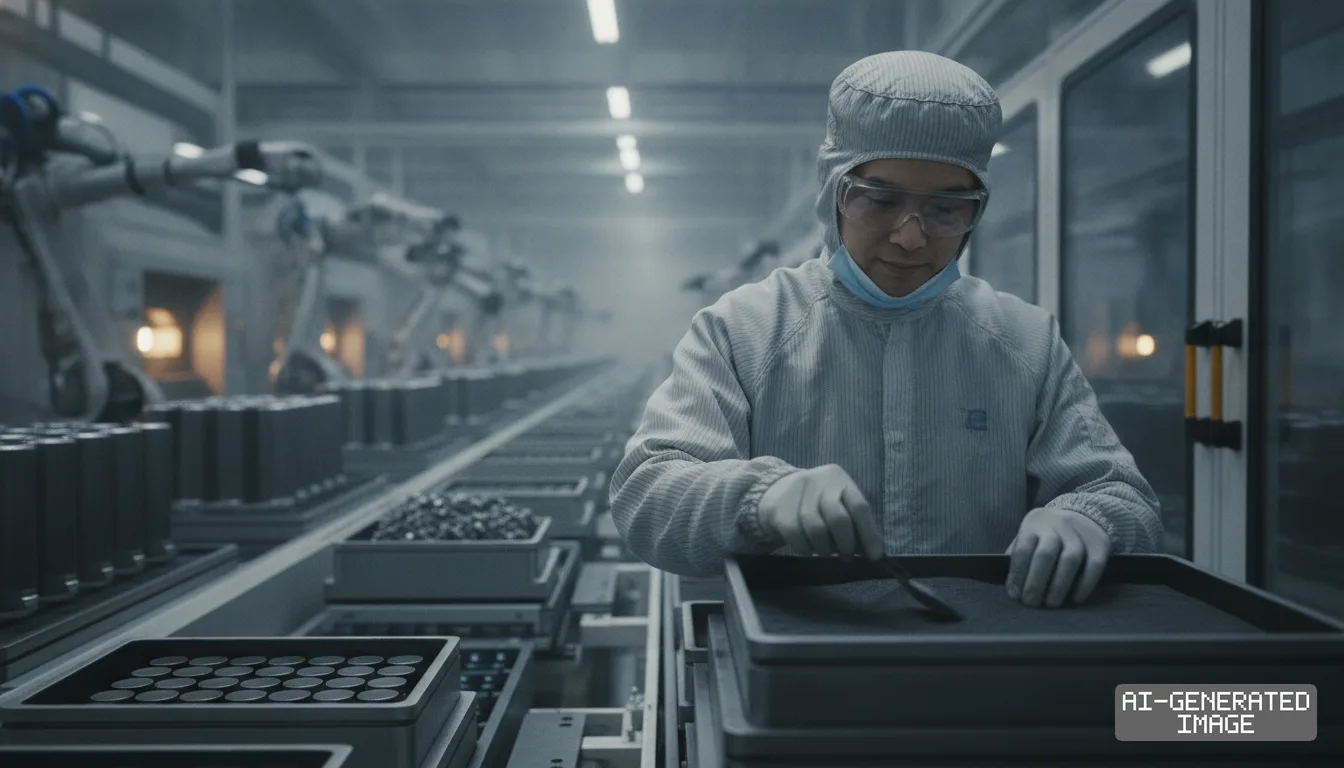
SNE Research said Oct. 13 that Chinese suppliers expanded their global electric-vehicle battery anode market share to 96.0% in the second quarter, cutting South Korea's share to 1.7%.
Global anode deployment for electric vehicles reached 1.02 million tons during the first eight months of the year, expanding 21.1% from 842,000 tons a year earlier, the research firm reported.
Demand outside China rose even faster, climbing 27.5% from 315,000 tons to 402,000 tons. The non-Chinese market accounted for 39.4% of total consumption, up two percentage points from 37.4%.
Yet rising demand in western markets did not translate into orders for non-Chinese producers. Cell manufacturers continued to favor lower-priced Chinese synthetic graphite over Korean and Japanese alternatives.
POSCO Future M, South Korea's sole commercial battery anode maker, saw deliveries drop 2.0% year-on-year to 14,000 tons between January and August, the data showed.
Japan's Hitachi Chemical recorded a parallel 1.3% decline, delivering 16,000 tons over the same period. The two established Asian suppliers steadily surrendered market share to Chinese rivals.
Market leader BTR New Material Group shipped 208,000 tons between January and August, up 22.0% from 171,000 tons a year earlier, according to the research firm.
Second-ranked Ningbo Shanshan delivered 200,000 tons, up 7.8% from 185,000 tons. Together, the two Chinese market leaders controlled 40.0% of worldwide anode deployment.
Mid-tier Chinese competitors expanded at an even faster pace. Shangtai Technology delivered 119,000 tons, up 27.6%, while Kaijin New Energy grew shipments 33.0% to 117,000 tons.
Hunan Shinzoom Technology recorded the highest expansion rate among major suppliers. The company increased deliveries by 51.1% to 90,000 tons, up from 60,000 tons a year earlier.
Shanghai Putailai's Jiangxi Zichen subsidiary shipped 70,000 tons, representing an increase of 29.2%. Smaller suppliers Kuntian and Xiangfenghua shipped 39,000 tons and 38,000 tons.
Chinese producers built their expansion on synthetic graphite — an artificial material made by heating petroleum coke past 2,800 degrees Celsius to align carbon atoms into crystal sheets.
This graphitization step consumes massive quantities of electricity. Chinese processors situated large-scale furnaces in provinces with heavily subsidized power, including Inner Mongolia and Sichuan, lowering processing costs.
South Korean manufacturers, by contrast, run facilities against standard industrial electricity tariffs. High domestic power rates left Korean graphitization costs uncompetitive against Chinese state-backed industrial parks.
Trade policy shifts in the United States deepened the cost disparity. The U.S. Department of Commerce had set antidumping duties of 93.5% and countervailing duties of 66.86% on Chinese active anode materials on Feb. 11.
Those protective tariffs never took effect. The U.S. International Trade Commission issued a final negative injury determination on March 12, deciding that Chinese imports did not harm American domestic industry.
The trade ruling allowed Chinese exporters to continue shipping anode materials without punitive border duties. Chinese synthetic graphite anode prices stabilized between $3.60 and $4.70 per kilogram.
South Korean synthetic graphite anode exports averaged roughly $8.50 per kilogram over the same period. That price gap left Korean material more than twice as expensive as Chinese alternatives.
The price difference places intense pressure on South Korean battery makers, including LG Energy Solution and Samsung SDI. Cell makers face higher input costs whenever contracts mandate non-Chinese anode supplies.
POSCO Future M has responded by relocating its processing footprint to lower-cost regions. The company committed 357.9 billion won ($265 million) to a synthetic graphite affiliate in Vietnam on Feb. 5.
The Vietnamese plant will run graphitization lines where industrial electricity rates remain substantially cheaper than in South Korea. POSCO Future M scheduled the equity acquisition date for Jan. 31, 2028.
South Korea's Ministry of Trade, Industry and Energy has not announced domestic price support or antidumping investigations against Chinese synthetic graphite imports.
The ministry has also not published tariff adjustment schedules or formal supply-chain monitoring criteria for battery anode materials entering South Korea.
Impact map
How this development propagates across the region and out to global buyers.
| Event | Korea | China | Japan | Global impact |
|---|---|---|---|---|
| Chinese synthetic graphite price drop | POSCO Future M shipments slip 2.0% to 14,000 tons as Korean export prices sit at $8.50 per kilogram | BTR and mid-tier makers expand shipments past 20% growth on $3.60 to $4.70 per kilogram pricing | Hitachi Chemical anode shipments fall 1.3% to 16,000 tons | Cell makers face a two-to-one cost premium for non-Chinese synthetic anode material |
In this story
- Companies
- POSCO Future MBTR New Material GroupShangtai TechnologyHunan Shinzoom TechnologyKaijin New Energy
- Tickers
- 003670.KS835185.BJ001301.SZ
- Exposed
- LG Energy SolutionSamsung SDIHitachi Chemical
- Policy
- TariffsSubsidies
- Impact
- PricingCost StructureSupply Chain
Track every Tariffs development → Track every Subsidies development →
Related briefings
- China Tightens Dual-Use Graphite Export Licensing for Anode Supply Chains Also on BTR New Material Group, POSCO Future M, Samsung SDI
- Gotion and Sunwoda ramp sodium-ion battery output for Chinese light electric vehicles Also on BTR New Material Group, Cost Structure
- CATL Surpasses Korean Battery Trio in Markets Outside China Also on POSCO Future M, Samsung SDI, LG Energy Solution
- POSCO Future M signs $776M LFP cathode supply deal with SK On Also on POSCO Future M, Samsung SDI, LG Energy Solution
Sources
Reporting
Confidence: medium — how we grade this
The documents behind this briefing are linked above. East Asia Brief produces its English text with AI assistance under human editorial review, and does not translate or republish other outlets' articles. See our methodology and AI policy. Spotted an error? Tell us.
The Morning Brief
What changed in Korean, Chinese and Japanese industry overnight — and what it means for your supply chain. One email, weekday mornings, US time. Free.
The Morning Brief is in preparation. Leave your address and we will write to you once — when the first issue is ready. Nothing before that.