Suzuki launches Japan's cheapest mini EV using BYD batteries
The 2.12 million yen e SKY undercuts domestic rivals and presses Japanese cell makers as lithium iron phosphate chemistry penetrates the kei car segment.
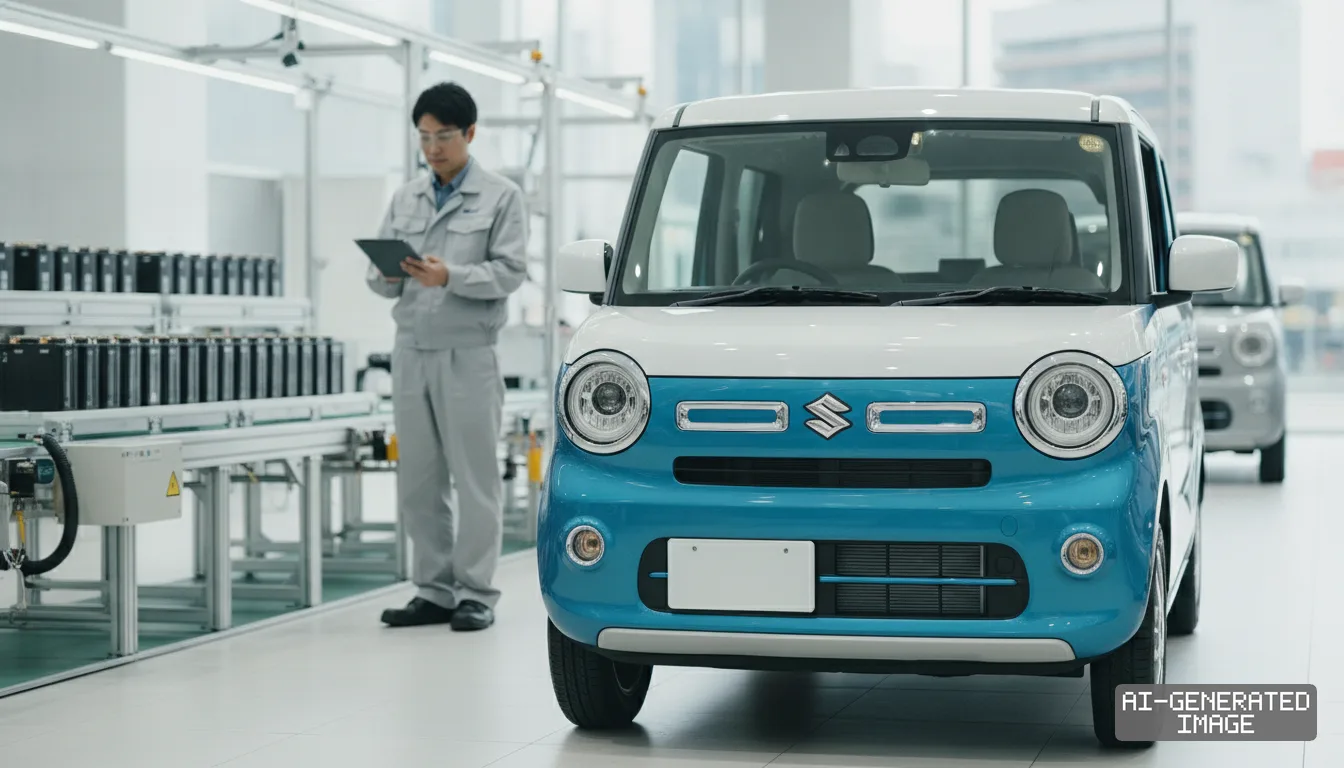
Suzuki Motor opened domestic orders on Oct. 7, 2026, for the e SKY, an electric minicar starting at 2.12 million yen ($13,400) that relies on BYD lithium iron phosphate cells.
The model undercuts the 2.145 million yen base price of BYD's Racco minicar. It establishes the lowest retail entry point for any passenger electric vehicle sold in Japan.
A Japanese government Clean Energy Vehicle subsidy of 568,000 yen lowers the starting outlay to 1.55 million yen ($9,800). That matches the 1.53 million yen sticker on Suzuki's gasoline Spacia.
Suzuki targets sales of 1,000 units per month across three trim grades. The base made-to-order grade lists at 2.12 million yen, while higher variants run 2.39 million and 2.79 million yen.
The car carries a 26 kilowatt-hour lithium iron phosphate battery — a chemistry prized for low raw material cost and high thermal stability. The pack yields 310 kilometers of driving range under Japan's test cycle.
Suzuki built the vehicle on a dedicated architecture called HEARTECT-e. The curb weight stands at 1,030 kilograms, enabling certified energy efficiency of 97 watt-hours per kilometer.
The powertrain uses an integrated electric axle combining the traction motor, inverter and reduction gears. The motor delivers 47 kilowatts of peak output to drive the front wheels.
Kei cars — lightweight passenger and cargo vehicles restricted to 3.4 meters in length — account for roughly 40% of Japanese light vehicle registrations. Electrification in the category has lagged due to high battery costs.
Suzuki selected battery cells from FinDreams, the manufacturing arm of Chinese automaker BYD. The move bypasses long-standing domestic keiretsu suppliers that have anchored Japanese assembly lines for decades.
The procurement decision delivers immediate cost advantages against incumbent models. Nissan Motor sells the Sakura kei EV from roughly 2.5 million yen using a 20 kilowatt-hour ternary lithium pack from Envision AESC.
Ternary cells using nickel, cobalt and manganese deliver higher energy density but cost roughly 20% to 30% more than iron-based alternatives. That premium proved difficult to absorb in entry-level minicars.
Japanese battery producers face heightened pricing discipline from Chinese cell makers. Panasonic Holdings and Prime Planet Energy & Solutions, a joint venture between Toyota Motor and Panasonic, have concentrated investment on ternary chemistries.
Panasonic supplies cylindrical cells to high-performance passenger fleets and commercial projects. The supplier operates limited commercial volume in lithium iron phosphate chemistries for domestic light-duty vehicles.
Suzuki engineers adapted the platform around Chinese cells to protect vehicle margins. The procurement model mirrors strategies deployed by Western automakers seeking entry-level cost parity.
Foreign battery content in subsidized models has attracted regulatory scrutiny in Tokyo. Japanese subsidy schedules link consumer rebates to recycling capabilities, charging infrastructure commitments and production emissions criteria.
The e SKY secured the standard 568,000 yen national purchase incentive after meeting efficiency standards. The certification ensures parity with domestic electrified kei vans currently sold in Tokyo and Osaka.
Autobacs Seven and Chery Automobile plan to introduce a competing electric minicar venture called EMT in 2027. BYD sold 648 units of its Racco model in Japan between July and September.
Suzuki president Toshihiro Suzuki said the vehicle was developed to provide practical features suited to daily commutes. The automaker aims to reduce its vehicle development timeline to 24 months to match Chinese product cycles.
Suzuki chief technology officer Katsuhiro Kato said the compact electric axle design will scale into larger vehicle segments. Unit volume will expand to B-segment and C-segment passenger cars with minor dimensional revisions.
The company also confirmed development of drive motors free of heavy rare-earth elements. Eliminating imported dysprosium and terbium addresses geopolitical supply risks and reduces production overhead.
Suzuki scheduled nationwide showroom arrivals and retail customer deliveries for Nov. 16, 2026. Dealership networks began registering customer deposit allocations across Japan this week.
Suzuki has not disclosed the total procurement contract value or the long-term cell delivery volume agreed with FinDreams.
Impact map
How this development propagates across the region and out to global buyers.
| Event | Korea | China | Japan | Global impact |
|---|---|---|---|---|
| Suzuki e SKY minicar launch | Battery cell suppliers face reduced demand for entry-level EV platforms in Japan | BYD and FinDreams expand tier-one commercial cell supply into Japanese minicars | Panasonic and Prime Planet face pricing pressure as domestic brands adopt LFP | Automotive OEMs accelerate low-cost LFP integration across urban electric fleets |
| Suzuki e SKY minicar launch | Battery cell suppliers face reduced demand for entry-level EV platforms in Japan | BYD and FinDreams expand tier-one commercial cell supply into Japanese minicars | Panasonic and Prime Planet face pricing pressure as domestic brands adopt LFP | Automotive OEMs accelerate low-cost LFP integration across urban electric fleets |
In this story
- Companies
- Suzuki MotorBYD
- Tickers
- 7269.T002594.SZ
- Exposed
- Panasonic HoldingsNissan Motor
- Policy
- Subsidies
- Impact
- Supply ChainPricingCost Structure
Track every Subsidies development →
Related briefings
- Japan leads India FDI with $5.7 billion as factories expand Also on Suzuki Motor, Cost Structure
- Japanese automakers standardize prismatic battery cold tests as EV timelines advance Also on Nissan Motor, Panasonic Holdings, Cost Structure
- Japan certifies $2.4 billion in battery subsidies to lock in solid-state cell capacity Also on Nissan Motor, Panasonic Holdings
- UK weighs tariffs on Chinese electric cars to protect EU supply ties Also on Nissan Motor, BYD, Pricing
Sources
Reporting
Confidence: medium — how we grade this
The documents behind this briefing are linked above. East Asia Brief produces its English text with AI assistance under human editorial review, and does not translate or republish other outlets' articles. See our methodology and AI policy. Spotted an error? Tell us.
The Morning Brief
What changed in Korean, Chinese and Japanese industry overnight — and what it means for your supply chain. One email, weekday mornings, US time. Free.
The Morning Brief is in preparation. Leave your address and we will write to you once — when the first issue is ready. Nothing before that.