BYD hits 10,000 Japan EV sales as mini car cuts registration time
The second 5,000 deliveries took 14 months compared to 31 for the initial tranche, driven by the sub-$15,000 Racco in a market held 94% by local brands.
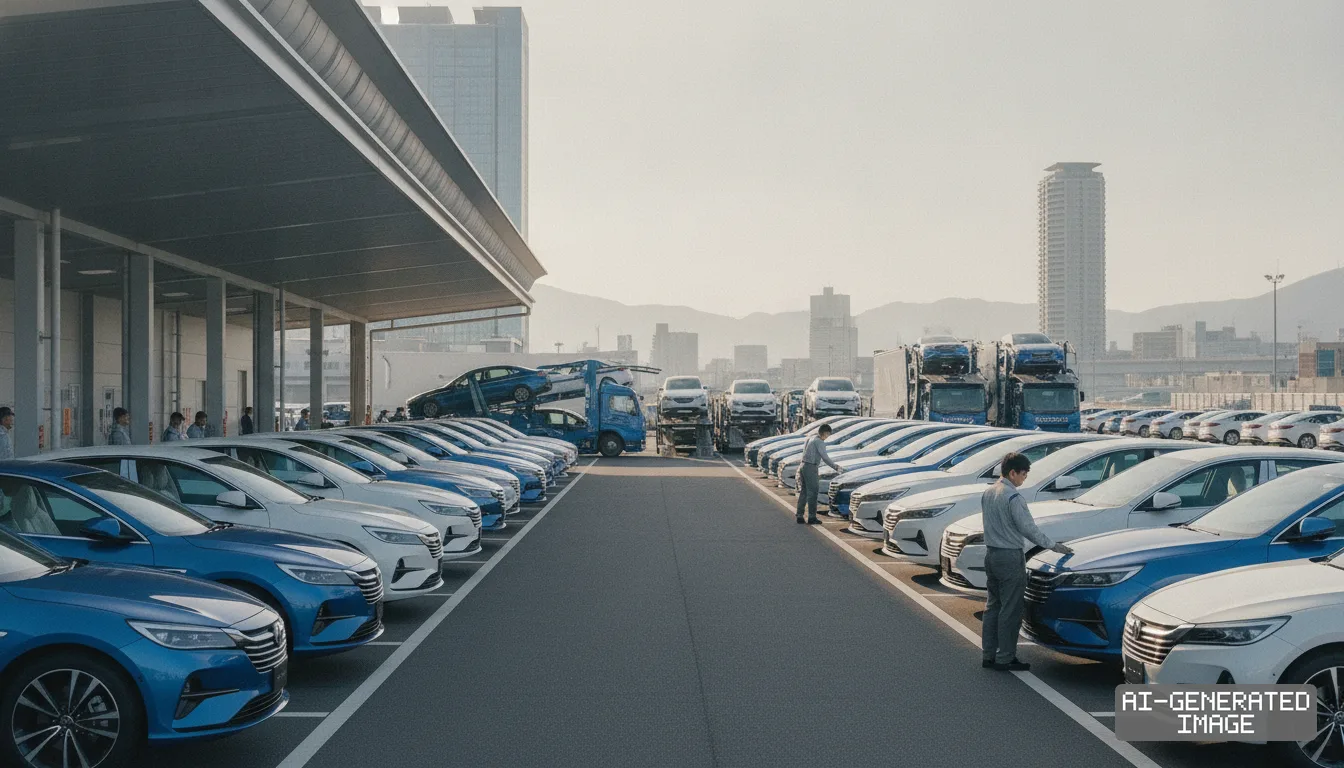
BYD Japan released official delivery records on Nov. 16, 2026, marking 10,000 cumulative passenger vehicle registrations across the country since entering the market in 2023.
The milestone arrived faster than the automaker's initial buildup, with the second 5,000 vehicles taking 14 months to register compared to 31 months for the first batch.
The volume represents less than 1% of total imported car registrations in Japan, where domestic vehicle manufacturers control roughly 94% of annual passenger automobile sales.
The official video released on Nov. 16 documents an in-person ceremony held earlier on Oct. 4, 2026, at the BYD Auto Shonan dealership in Hiratsuka, Kanagawa Prefecture.
BYD Senior Vice President and Japan President Liu Xueliang attended the handover alongside BYD Auto Japan President Atsuki Tofukuji.
The Shenzhen-based automaker began selling passenger cars in Japan in January 2023, introducing the Atto 3 compact sport utility vehicle through a dedicated brick-and-mortar dealer network.
Sales expanded gradually across 2023 and 2024 before the company recorded its 5,000th customer delivery on Aug. 4, 2025.
Momentum shifted on July 28, 2026, when BYD introduced the Racco, an urban compact electric vehicle engineered specifically to match Japanese domestic road dimensions.
The Racco entered showrooms at a base price of 2,145,000 yen ($14,300) before national and municipal zero-emission subsidies.
The model accumulated 1,000 customer contracts within two weeks of launch and crossed 2,000 contracted orders by mid-October, the company said.
The rollout takes aim at Nissan Motor, whose Sakura electric minicar previously accounted for more than 40% of all battery-electric vehicles sold domestically in Japan.
Nissan priced the Sakura around 2,540,000 yen ($16,900) before incentives, creating an opening for imported subcompacts priced under Japanese legacy benchmarks.
Toyota Motor, which holds a 32% share of Japan's passenger market, relies primarily on conventional hybrids and has limited its pure electric minicar output.
Lower pricing on BYD imports has prompted regional dealer groups to take on Chinese franchises to offset stagnant domestic showroom foot traffic.
BYD has built an authorized dealership network of roughly 60 operational stores, using franchise agreements with established Japanese auto retail groups to provide local maintenance.
The expansion marks a notable shift for imported vehicles in Japan, where foreign manufacturers have historically struggled to build sustainable sales outside luxury segments.
However, the published documents disclose total cumulative passenger vehicle deliveries without distinguishing pure battery electric models from plug-in hybrids.
The 10,000th vehicle handed over to a buyer in Hiratsuka was a Sealion 6 plug-in hybrid rather than a pure battery vehicle.
The company has not published registration figures showing how many of the 10,000 units rely solely on battery propulsion.
The automaker plans to open 30 additional sales points by Dec. 31, 2026, to reach its declared target of 100 retail locations nationwide.
Impact map
How this development propagates across the region and out to global buyers.
| Event | Korea | China | Japan | Global impact |
|---|---|---|---|---|
| Chinese EV penetration in Japan | Hyundai Motor faces tighter pricing ceilings for Kona Electric and Inster in Japanese subcompact segment | BYD secures beachhead in closed Japanese auto market using tailored compact EV platform | Nissan Motor loses margin cushion on Sakura minicar as foreign rivals undercut kei EV pricing | Asian urban EV pricing resets lower as domestic manufacturers lose protected home advantages |
| Chinese EV penetration in Japan | Hyundai Motor faces tighter pricing ceilings for Kona Electric and Inster in Japanese subcompact segment | BYD secures beachhead in closed Japanese auto market using tailored compact EV platform | Nissan Motor loses margin cushion on Sakura minicar as foreign rivals undercut kei EV pricing | Asian urban EV pricing resets lower as domestic manufacturers lose protected home advantages |
In this story
- Companies
- BYDNissan MotorToyota Motor
- Tickers
- 002594.SZ7201.T7203.T
- Policy
- Subsidies
- Impact
- PricingOrder BookSupply Chain
Track every Subsidies development →
Related briefings
- Japan funds $21 billion GlobalFoundries build in New York Also on Nissan Motor, Toyota Motor, Subsidies
- Japanese automakers standardize prismatic battery cold tests as EV timelines advance Also on Nissan Motor, Toyota Motor, Subsidies
- Japan certifies $2.4 billion in battery subsidies to lock in solid-state cell capacity Also on Nissan Motor, Toyota Motor, Subsidies
- KOTRA Flags Japan Auto Supply Shift as Keiretsu Ties Weaken Also on Nissan Motor, Toyota Motor, Order Book
Sources
Reporting
Confidence: medium — how we grade this
The documents behind this briefing are linked above. East Asia Brief produces its English text with AI assistance under human editorial review, and does not translate or republish other outlets' articles. See our methodology and AI policy. Spotted an error? Tell us.
The Morning Brief
What changed in Korean, Chinese and Japanese industry overnight — and what it means for your supply chain. One email, weekday mornings, US time. Free.
The Morning Brief is in preparation. Leave your address and we will write to you once — when the first issue is ready. Nothing before that.