BYD and Gentari Detail 1.5MW EV Flash Charging Push Across Malaysia
The Shenzhen carmaker and Petronas unit outlined intercity megawatt charging corridors backed by stationary storage to serve next-generation vehicles.
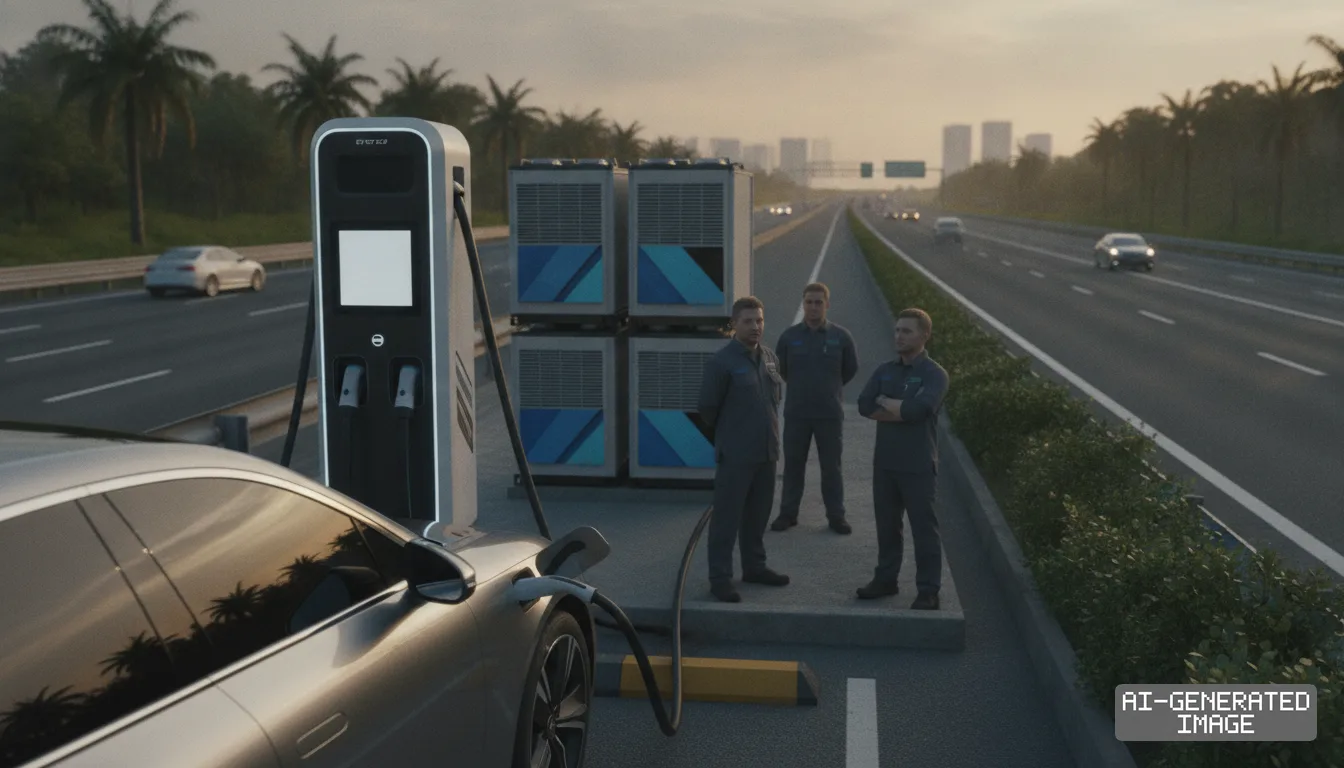
BYD Malaysia and clean-energy operator Gentari published plans on Oct. 23 to deploy 1,500-kilowatt ultra-fast flash chargers across Malaysian highways, pairing megawatt charging hardware with on-site battery storage systems.
The agreement targets intercity expressways linking urban centers, marking BYD's second charging infrastructure partnership in Southeast Asia. Gentari is the clean-energy unit of Malaysia's state-owned energy group Petroliam Nasional Bhd.
Each station will deliver up to 1,500 kW of direct-current output. The system is designed to replenish 10% to 70% of battery capacity in five minutes, providing roughly 400 kilometers of driving range.
To avoid overloading local distribution grids, each installation will integrate a 370-kilowatt-hour battery energy storage system. The storage unit will draw between 100 kW and 560 kW continuously from the utility network between vehicle arrivals.
The rollout follows surging electric vehicle adoption across Peninsular Malaysia. New electric vehicle registrations reached 53,537 units during the first nine months of 2026, expanding 98.8% from the same period last year.
Public charging availability has lagged vehicle sales. Malaysia missed its target of installing 10,000 public chargers by late 2025, operating 6,416 charging points nationwide by May before the government set a 30,000-charger goal for 2030.
Gentari currently operates more than 600 charging points across Malaysia. Its regional roaming platform links roughly 18,000 connectors across Malaysia, Singapore, Thailand and India, providing extensive site access for foreign hardware makers.
Vehicle compatibility remains limited at the top power rating. The Denza Z9GT luxury sedan is currently the only vehicle in Malaysia capable of taking the full 1,500 kW rate using second-generation Blade Battery chemistry.
Standard electric vehicles will remain able to plug into the chargers. Their charging speed will be capped at each vehicle's onboard power limits, restricting the full throughput advantage to BYD premium models.
The Malaysian venture mirrors BYD's aggressive domestic charging buildup. The company operated 10,000 flash charging stations across mainland China by September, adding more than 30 new hubs daily behind its proprietary hardware.
The arrangement represents BYD's second high-speed charging venture in the region within two weeks. BYD signed a parallel agreement with Singapore-based Charge+ on Oct. 14 to build flash charging hubs across Indonesia.
Corporate leaders held the formal signing ceremony in Shenzhen on Oct. 21. Gentari Group Chief Executive Sushil Purohit and BYD Malaysia Managing Director Jacob Ma signed the pact, witnessed by BYD Chairman Wang Chuanfu.
Corridor selection will focus on major intercity highway rest-and-service areas. Both parties are examining route spacing to eliminate range anxiety along trunk highways linking Kuala Lumpur with Penang and Johor Bahru.
High-power charging in emerging markets presents severe utility challenges. Local distribution grids cannot handle unbuffered 1.5 MW spikes, making integrated battery energy storage mandatory for highway charging operators.
By pairing vehicles with bespoke high-power charging networks, Chinese automakers seek to establish technical standards abroad. Bundling vehicles, chargers and battery storage allows manufacturers to secure captive charging revenue.
Gentari is expanding its renewable footprint to feed the charging hubs. The company manages commercial solar assets and intends to link future flash charging installations directly to certified green power supplies.
The companies will assess grid interconnection capacity and site viability before beginning construction. Commercial terms and revenue sharing for the prospective charging hubs remain under negotiation between the two operating units.
The announcement does not state the total capital expenditure, the targeted station count or the equipment procurement schedule. Neither company published an engineering construction timeline or specified charger supply contracts.
The partners will conduct preliminary feasibility assessments along highway rest stops through early 2027, aligning future deployments with Malaysia's 2030 public charging infrastructure timetable.
Impact map
How this development propagates across the region and out to global buyers.
| Event | Korea | China | Japan | Global impact |
|---|---|---|---|---|
| BYD 1.5MW charging rollout | Hyundai and Kia face standard lock-in as BYD couples megawatt chargers to Blade batteries | BYD opens export route for proprietary 1,500 kW charging hardware and BESS storage containers | Toyota and Honda EV sales in Malaysia face wider infrastructure gap against 5-minute charge networks | Southeast Asian grid operators turn to BESS-buffered chargers to bypass 1.5MW distribution spikes |
In this story
- Companies
- BYDGentariPetroliam Nasional Bhd
- Tickers
- 002594.SZ1211.HK
- Exposed
- Charge+
- Policy
- StandardsLocal Content Rules
- Impact
- Supply ChainCapexCost Structure
Track every Standards development → Track every Local Content Rules development →
Related briefings
- India Rebukes China on Trade Barriers as Deficit Hits $100B Also on Local Content Rules, Standards, Cost Structure
- SK hynix halts Solidigm US IPO as dual-listing rules tighten Also on Local Content Rules, Standards
- CATL Clears Battery Passport Trial Ahead of 2027 EU Mandate Also on Local Content Rules, Standards
- Stellantis pushes Leapmotor European parts past 40% in Spain Also on Local Content Rules, BYD, Cost Structure
Sources
Reporting
Confidence: medium — how we grade this
The documents behind this briefing are linked above. East Asia Brief produces its English text with AI assistance under human editorial review, and does not translate or republish other outlets' articles. See our methodology and AI policy. Spotted an error? Tell us.
The Morning Brief
What changed in Korean, Chinese and Japanese industry overnight — and what it means for your supply chain. One email, weekday mornings, US time. Free.
The Morning Brief is in preparation. Leave your address and we will write to you once — when the first issue is ready. Nothing before that.