Malaysian customs seizes $12M in AI servers over transshipment rules
Authorities at Kuala Lumpur International Airport impounded 30 high-performance computing units as Southeast Asian logistics hubs tighten export control scrutiny.
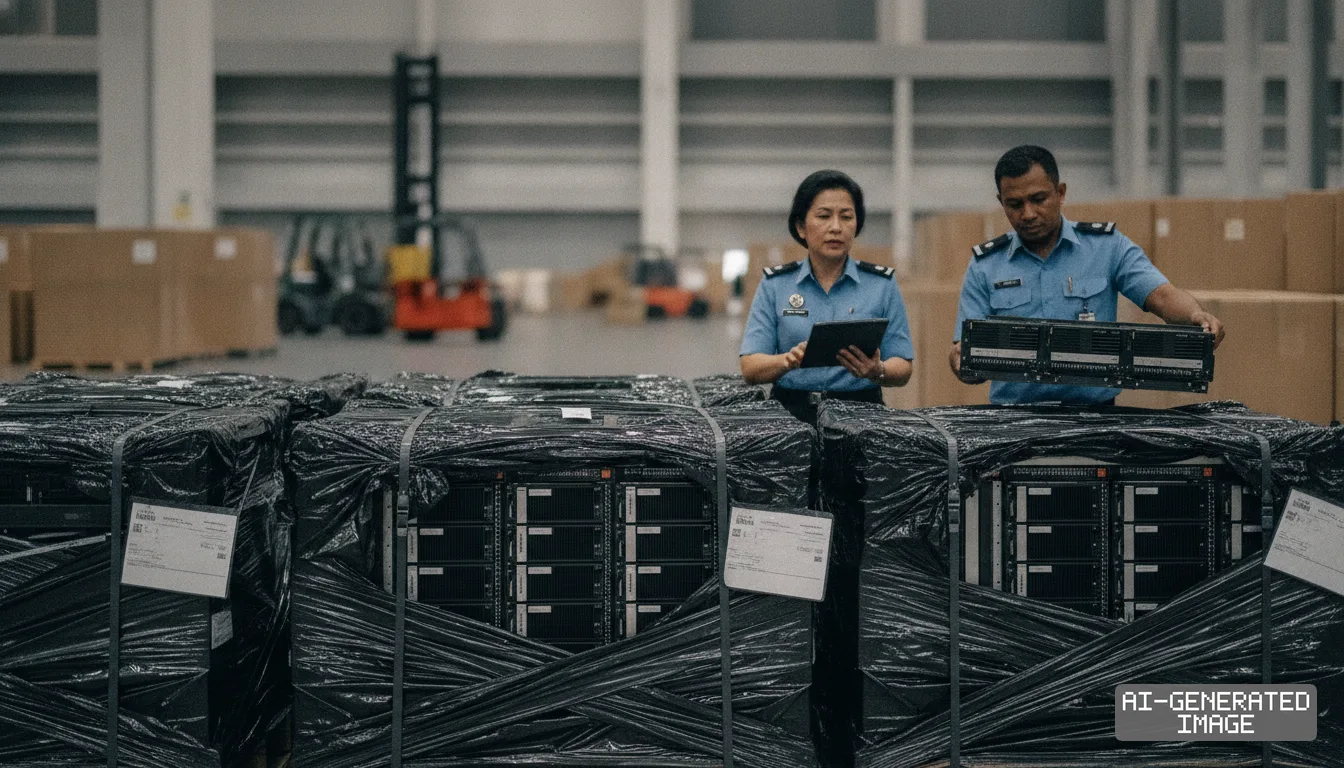
The Royal Malaysian Customs Department disclosed Oct. 28, 2026, the seizure of 30 servers housing high-performance artificial intelligence chips valued at 49.5 million ringgit ($12.2 million) at Kuala Lumpur International Airport.
Customs officers intercepted the cargo on Oct. 15 at a free trade zone warehouse within the airport complex. Air waybills had declared the hardware as standard electronic components, Aspalila Ag Tuah, the customs director for the airport, said.
The confiscated servers represent roughly half of the 100 million ringgit ($24.6 million) in restricted computing hardware intercepted across five operations tied to a single smuggling syndicate. That cumulative figure covers seizures conducted over the past five months.
The interception marks the second major interdiction of advanced accelerators at the airport this year. Customs agents seized 72 servers worth 52.9 million ringgit ($13 million) on June 5 after inspectors identified discrepancies in shipping paperwork.
Malaysia regulates the transit of advanced computing hardware under the Strategic Trade Act 2010. The law establishes dual-use export controls designed to prevent illicit transfers of military and commercial items through national sea and air gateways.
The Ministry of Investment, Trade and Industry enforces specific performance thresholds through Directive No. 1/2025. That rule requires shippers to secure permits for processors that exceed a total processing performance rating of 4,800.
Under the ministerial directive, freight handlers must submit permit notifications at least 30 days before moving restricted hardware through domestic ports. The permit obligation applies to transshipment cargo and air transit without domestic customs clearance.
Southeast Asian transit hubs have faced mounting compliance scrutiny as multilateral trade controls restrict shipments of advanced accelerators. Logistics operators in Singapore, Malaysia and Thailand have encountered stricter verification demands from overseas vendors.
Global server assemblers and cloud hosting providers face growing audit burdens across regional supply lines. Freight forwarders must verify end-use documentation before accepting cargo manifests that contain high-density computational clusters.
Customs officials summoned one domestic logistics provider for questioning regarding freight booking procedures. The forwarding agent handled the local transit documentation for the intercepted consignment, enforcement officials said.
Penalties under the Strategic Trade Act 2010 include corporate fines and potential prison sentences for corporate directors. Companies that transport controlled strategic items without ministerial approval risk forfeiture of goods and operational suspensions.
Cross-border logistics firms operating within Malaysian free trade zones handle tens of thousands of transit containers each month. Cargo documentation discrepancies have triggered expanded secondary inspections across air freight terminals in Selangor and Penang.
The enforcement operation highlights the regulatory liabilities confronting third-party logistics networks across the region. Multi-leg air freight routes face routine screening for semiconductor hardware meeting restricted performance specifications.
Shippers moving advanced electronics through regional hubs must maintain verifiable chain-of-custody logs. Trade compliance officers across Asian logistics hubs report longer clearance intervals for high-value enterprise servers and data center racks.
Mashitah Ismail, senior deputy director at the Strategic Trade Control Division of the trade ministry, said enforcement teams have increased cargo inspections. The ministry coordinates with customs units to monitor compliance with international trade restrictions.
The Malaysian government maintains export control oversight to protect national industrial ports from trade penalties. Ministry officials said compliance mechanisms ensure domestic logistics hubs remain accessible to international semiconductor manufacturers.
Authorities did not state the specific semiconductor manufacturer, the country of origin or the final destination country of the seized servers. Customs investigators said those details remain restricted while international intelligence inquiries continue.
The Ministry of Investment, Trade and Industry conducts its next scheduled strategic trade compliance review with regional port operators on Dec. 10.
Impact map
How this development propagates across the region and out to global buyers.
| Event | Korea | China | Japan | Global impact |
|---|---|---|---|---|
| Malaysian AI server transshipment seizure | Korean logistics branches in Southeast Asia face mandatory 30-day transit pre-clearance | Chinese buyers face tightening Southeast Asian transit routes for high-density compute nodes | Japanese freight forwarders expand end-use documentation checks at regional air hubs | Enterprise server consignments encounter higher audit overhead and extended transit times |
| Malaysian AI server transshipment seizure | Korean logistics branches in Southeast Asia face mandatory 30-day transit pre-clearance | Chinese buyers face tightening Southeast Asian transit routes for high-density compute nodes | Japanese freight forwarders expand end-use documentation checks at regional air hubs | Enterprise server consignments encounter higher audit overhead and extended transit times |
In this story
- Policy
- Export Controls
- Impact
- ComplianceSupply Chain
Track every Export Controls development →
Related briefings
- China MOFCOM tightens drone motor and autopilot export rules Also on Export Controls, Compliance
- ACM Research Expands Korea Plant to Bypass US Export Rules Also on Export Controls, Compliance
- China curbs tunnel boring machine exports ahead of Nov. 18 Also on Export Controls, Compliance
- TSMC tests rare-earth-free motors as China magnet curbs loom Also on Export Controls, Compliance
Sources
Reporting
Confidence: medium — how we grade this
The documents behind this briefing are linked above. East Asia Brief produces its English text with AI assistance under human editorial review, and does not translate or republish other outlets' articles. See our methodology and AI policy. Spotted an error? Tell us.
The Morning Brief
What changed in Korean, Chinese and Japanese industry overnight — and what it means for your supply chain. One email, weekday mornings, US time. Free.
The Morning Brief is in preparation. Leave your address and we will write to you once — when the first issue is ready. Nothing before that.