Japan and India launch five mineral ventures to blunt China risk
The bilateral framework targets rare earth permanent magnets, where Chinese refiners control roughly 90% of global output and Japan supplies 8%.
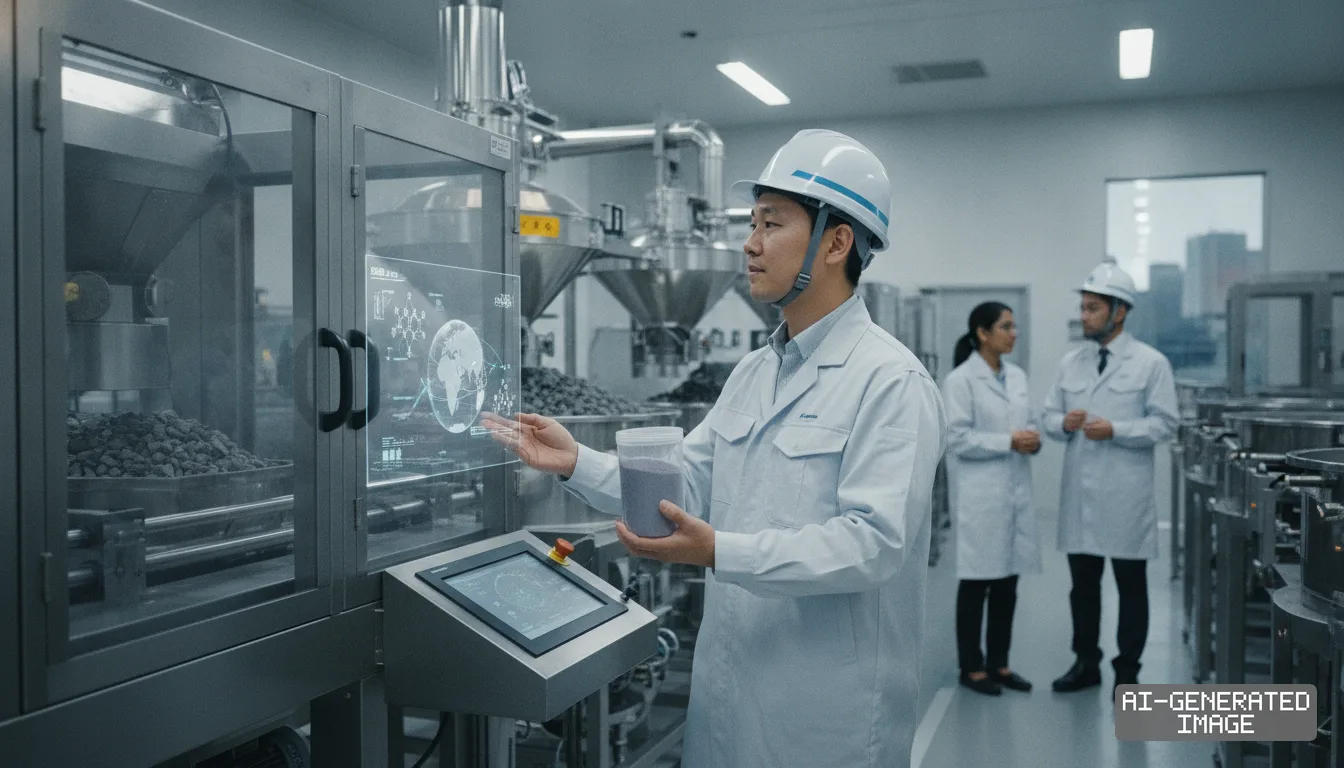
Japan's Ministry of Economy, Trade and Industry and India's Ministry of Mines agreed Nov. 24, 2026 to accelerate five joint critical mineral projects to counter arbitrary supply curbs.
The agreement implements commitments from the fourth bilateral security dialogue held earlier this month in Tokyo. Japanese officials seek to diversify mineral procurement following persistent supply disruptions across global trade corridors.
China currently refines roughly 90% of global rare earth permanent magnets, creating concentrated supply risks for advanced manufacturing. Japan produces about 8% of the world's permanent magnets, while India accounts for less than 1%.
India holds the world's third-largest deposits of rare earth minerals, representing roughly 6% of global reserves. The country produced just 2,900 metric tons of rare earth oxides in 2024, official mining statistics show.
State-owned miner IREL (India) Limited exported over 1,000 metric tons of mixed rare earths to Japan in 2024. That volume accounted for approximately 34% of India's total domestic extraction that year.
Indian authorities suspended raw material shipments under that long-standing channel last year. The Ministry of Mines halted unprocessed exports to force foreign industrial partners to invest in domestic downstream separation and magnet fabrication.
Toyota Tsusho Corporation maintains processing operations in Andhra Pradesh through its wholly owned subsidiary, Toyotsu Rare Earths India. The plant refines raw monazite beach sands into high-purity separated rare earth oxides.
Shin-Etsu Chemical purchases separated neodymium and dysprosium oxides from international refiners to produce traction motor magnets. The material group accounts for approximately 15% of the company's functional materials division sales.
Following Chinese export restrictions in 2010, Japan reduced its import dependence on China from over 90% to roughly 60% by backing suppliers in Australia. Tokyo views Indian refining capacity as the next anchor for regional procurement.
Indian beach sand deposits yield heavy concentrations of light rare earths, including cerium, lanthanum and neodymium. Modern electric vehicle motors require heavy rare earths to maintain magnetic strength at operating temperatures.
The updated bilateral roadmap links Indian mining concessions directly to Japanese solvent extraction technology. Both governments intend to develop an integrated supply chain extending from coastal mines to finished electronic components.
State-run Japan Organization for Metals and Energy Security agreed to expand technical exploration with the Geological Survey of India. Joint survey teams will map heavy mineral sand reserves in Odisha and Andhra Pradesh.
IREL operates a dedicated rare earth extraction complex at OSCOM in Odisha with an annual capacity of 11,200 metric tons of mixed rare earth chloride. The plant has operated below nameplate capacity due to domestic separation constraints.
Indian chemical facilities have struggled to separate heavy rare earth elements, including dysprosium and terbium, above 99.9% purity levels. Japanese chemical plant engineering firms will license proprietary solvent extraction circuits to Indian state plants.
The enhanced separation infrastructure will produce magnet-grade neodymium oxide and high-purity battery salts within India. Output will support domestic Indian electric vehicle assembly lines and Japanese precision industrial equipment factories.
India allocated 75 billion rupees ($890 million) under its National Critical Minerals Mission to subsidize domestic refining facilities. Japanese companies participating in these Indian projects will access capital grants from Tokyo's economic security promotion fund.
The bilateral initiative responds to recent export licensing controls imposed by China on heavy rare earths and processing equipment. Those regulatory restrictions delayed component delivery schedules for industrial robot makers and automotive motor suppliers.
The mineral framework also aligns with regional supply security initiatives under the Quad partnership. Japanese and Indian negotiators agreed to establish shared verification standards to guarantee mineral traceability and environmental compliance across the chain.
Automotive component manufacturers from both countries have formed an industrial working group to evaluate prototype materials. The technical panel will test Indian-refined neodymium alloys against Japanese automotive specifications throughout next year.
The ministry notice does not state whether Tokyo will extend sovereign loan guarantees through the Japan Bank for International Cooperation, and authorities have not published the facility-level capital allocation schedule.
The bilateral Economic Security Dialogue working group convenes in Tokyo in February 2027 to finalize formal procurement contracts and approve the engineering design for the initial separation plant.
Impact map
How this development propagates across the region and out to global buyers.
| Event | Korea | China | Japan | Global impact |
|---|---|---|---|---|
| India-Japan critical mineral partnership | South Korean magnet makers face tighter Indian feedstock as volumes shift to Japan | Chinese refiners lose leverage as Indo-Pacific processing corridor bypasses domestic supply | Toyota Tsusho and Shin-Etsu secure non-China oxide supply for automotive magnets | Electric vehicle motor supply chains gain secondary ex-China source for rare earth elements |
In this story
- Companies
- Toyota TsushoShin-Etsu Chemical
- Tickers
- 8015.T4063.T
- Policy
- SubsidiesStandards
- Impact
- Supply ChainCapex
Track every Subsidies development → Track every Standards development →
Related briefings
- Japan chemical makers expand LiFSI electrolyte salt synthesis for fast-charging EVs Also on Toyota Tsusho, Subsidies
- Japan seeks rare earth supply pact with India's Andhra Pradesh Also on Toyota Tsusho
- Namibia rare earth project faces water shortfall, clouding JOGMEC plans Also on Toyota Tsusho
- Japan's Sankyu takes TVS SCS stake to serve 1,400 Indian factories Also on Toyota Tsusho
Sources
Primary documents
Reporting
Confidence: high — how we grade this
The documents behind this briefing are linked above. East Asia Brief produces its English text with AI assistance under human editorial review, and does not translate or republish other outlets' articles. See our methodology and AI policy. Spotted an error? Tell us.
The Morning Brief
What changed in Korean, Chinese and Japanese industry overnight — and what it means for your supply chain. One email, weekday mornings, US time. Free.
The Morning Brief is in preparation. Leave your address and we will write to you once — when the first issue is ready. Nothing before that.