Dutch prime minister confronts Trump over US MATCH chip curbs
Rob Jetten warns against draft legislation forcing allies to mirror tool bans that threaten ASML sales, with China driving 20% of 2026 revenue.
Dutch Prime Minister Rob Jetten said Nov. 27, 2026 he will confront US President Donald Trump at the upcoming Group of 20 summit over proposed American legislation restricting semiconductor tool exports.
The dispute centers on the Multilateral Alignment of Technology Controls on Hardware Act, known as the MATCH Act. The draft bill forces foreign allies to mirror American export bans on China or face unilateral trade penalties.
Lithography system manufacturer ASML expects China to generate roughly 20% of its total revenue in 2026. The legislation gives allied governments 150 days to align export rules before the US Department of Commerce imposes extraterritorial licensing curbs.
Jetten described the congressional measure as disproportionate and unacceptable during a press conference in The Hague following a weekly cabinet meeting. The prime minister said he will address the restrictions directly with Trump in Miami in December.
The confrontation represents the sharpest public clash between The Hague and Washington over semiconductor manufacturing equipment since 2023. Dutch officials argue that unilateral American statutory mandates violate national sovereignty and international trade principles.
Dutch Foreign Trade Minister Sjoerd Sjoerdsma told lawmakers during a parliamentary budget debate that the Netherlands will not submit to foreign instructions. Sjoerdsma said the proposed statutory restrictions go far beyond justifiable national security considerations.
The trade minister said the Dutch government is preparing a formal diplomatic request for non-enforcement from the White House if Congress passes the bill. The Hague is also coordinating unified diplomatic pushback with the European Commission, Germany and France.
Lawmakers in the Tweede Kamer, the lower house of the Dutch parliament, submitted two separate motions opposing the American proposal. Conservative lawmaker Michiel Hoogeveen filed a motion Nov. 26 calling the draft bill unacceptable and demanding proactive cabinet intervention.
Parliamentarian Mpanzu Bamenga filed an amended resolution Nov. 27 urging the European Commission to issue a formal European Union rejection. Progressive lawmaker Laurens Dassen warned colleagues that the bill seeks to undermine Europe's sole global semiconductor equipment champion.
Nicole Maes, a lawmaker from the People's Party for Freedom and Democracy, said during the debate that the legislation would prove disastrous for ASML and the Dutch economy. European leaders have grown increasingly wary of extraterritorial controls that damage domestic manufacturing value.
The MATCH Act was introduced in Congress on April 2 under House bill H.R. 8170 and Senate bill S. 4281. Representative Michael Baumgartner introduced the House version, while Senator Pete Ricketts led the bipartisan Senate companion measure.
The House Foreign Affairs Committee approved an amended version of the bill on April 22 by a 36-8 vote. The committee substitute extended the compliance window from 150 days to 240 days while keeping extraterritorial enforcement mechanisms intact.
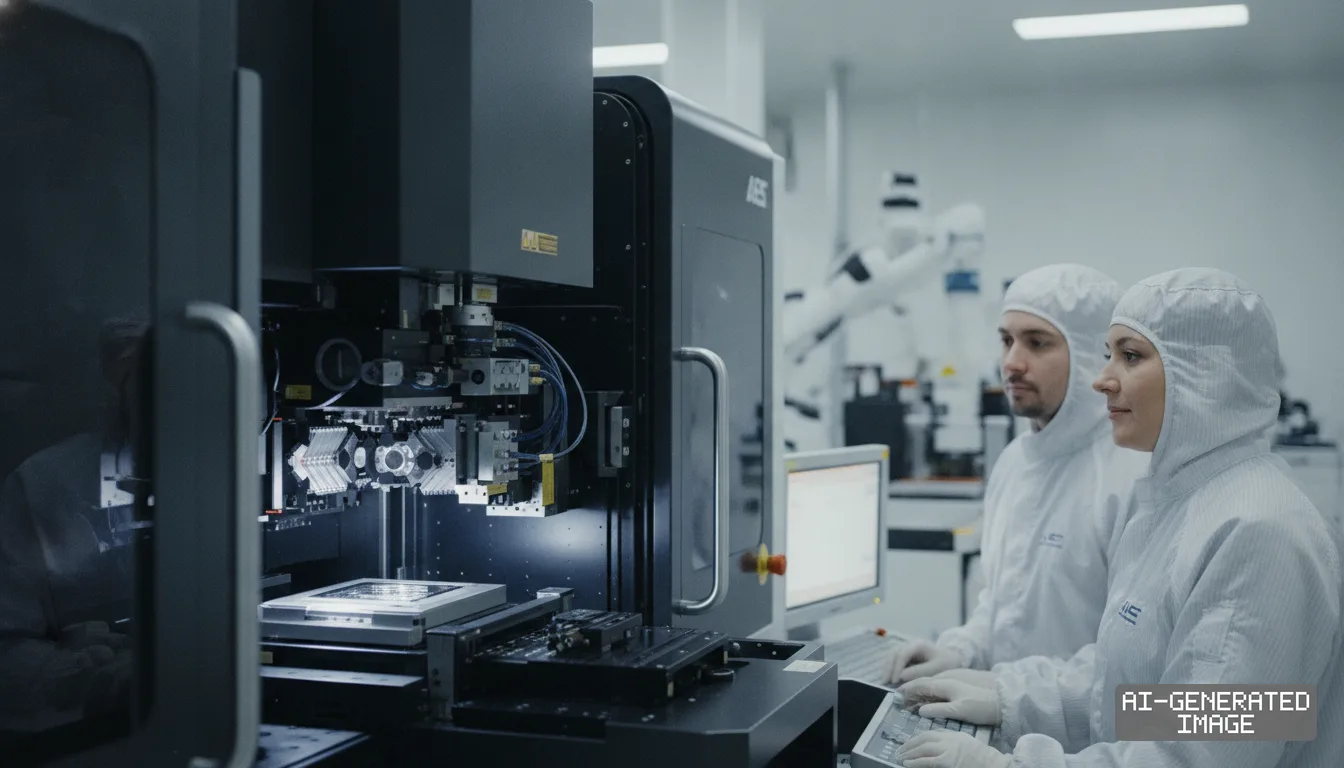
The bill directs the US Department of Commerce to prohibit exports of critical manufacturing tools to countries of concern. Immersion deep ultraviolet lithography systems and cryogenic etch equipment are designated as mandatory chokepoint categories under the statutory text.
The proposed restrictions reach beyond future equipment sales by banning servicing, calibration, software updates and replacement parts for installed machinery. ASML generates approximately 25% of its total net sales from recurring maintenance contracts and field service operations worldwide.
The legislative text designates specific fabrication facilities operated by Semiconductor Manufacturing International Corp. and Yangtze Memory Technologies Corp. as covered entities. Memory maker ChangXin Memory Technologies and telecommunications equipment provider Huawei Technologies are also targeted under the draft rules.
The extraterritorial mechanism relies on the Foreign Direct Product Rule to assert US regulatory jurisdiction over foreign-built equipment. If a foreign machine contains American origin software or components, Washington can block its sale without foreign government consent.
Tokyo Electron faces similar operational disruptions under the proposed congressional framework. The Japanese etching and deposition equipment maker generates over 40% of its quarterly revenue from Chinese chipmakers and spent $140,000 on federal lobbying in the third quarter.
Dutch policymakers argue that cutting off equipment maintenance will not stop Chinese semiconductor fabrication but will destroy European commercial trust. The Hague has already restricted shipments of advanced extreme ultraviolet systems and higher-end immersion deep ultraviolet models.
Chinese toolmakers are already expanding capacity to supply domestic foundries as Western supply chains face increasing regulatory uncertainty. Shanghai-based Advanced Micro-Fabrication Equipment and Beijing-based Naura Technology Group have captured more than 15% of the domestic etch market.
Congressional negotiators are working to attach the MATCH Act to the annual National Defense Authorization Act before Dec. 20, 2026. That legislative maneuver would bundle the semiconductor tool restrictions into mandatory national security funding legislation before the congressional session adjourns.
The prime minister's office has not published an official written communique outlining the specific negotiating terms Jetten will present to Trump, leaving the formal diplomatic memorandum unreleased outside spoken briefing transcripts.
Impact map
How this development propagates across the region and out to global buyers.
| Event | Korea | China | Japan | Global impact |
|---|---|---|---|---|
| MATCH Act equipment and servicing restrictions | Samsung Electronics and SK hynix face tighter tool maintenance rules at Wuxi and Xi'an fabs | SMIC and CXMT lose foreign equipment servicing, accelerating migration to domestic tools | Tokyo Electron risks losing Chinese tool revenue that accounts for over 40% of sales | Advanced chip packaging and trailing-node capacity expansion face higher maintenance costs |
In this story
- Companies
- ASMLTokyo Electron
- Tickers
- ASML8035.T
- Exposed
- Semiconductor Manufacturing International Corp.ChangXin Memory Technologies
- Policy
- Export Controls
- Impact
- Supply ChainComplianceOrder Book
Track every Export Controls development →
Related briefings
- ASML and tool makers see China sales share plunge in third quarter Also on Semiconductor Manufacturing International Corp, ASML, Tokyo Electron
- TSMC revenue rises 53% on AI demand to record NT$514 billion Also on Semiconductor Manufacturing International Corp., Tokyo Electron, Export Controls
- CXMT beats SK hynix and Micron in DRAM margin at 87.59% gross rate Also on ChangXin Memory Technologies, ASML, Export Controls
- Naura and SMEE Accelerate Domestic Tool Shipments to Chinese Fabs Also on ChangXin Memory Technologies, Tokyo Electron, Export Controls
Sources
Primary documents
Reporting
Confidence: high — how we grade this
The documents behind this briefing are linked above. East Asia Brief produces its English text with AI assistance under human editorial review, and does not translate or republish other outlets' articles. See our methodology and AI policy. Spotted an error? Tell us.
The Morning Brief
What changed in Korean, Chinese and Japanese industry overnight — and what it means for your supply chain. One email, weekday mornings, US time. Free.
The Morning Brief is in preparation. Leave your address and we will write to you once — when the first issue is ready. Nothing before that.