China curbs solar wafer tech exports to shield its industry lead
The Ministry of Commerce and science officials placed 12 key photovoltaic technologies under export bans and licensing controls to restrict equipment transfers abroad.
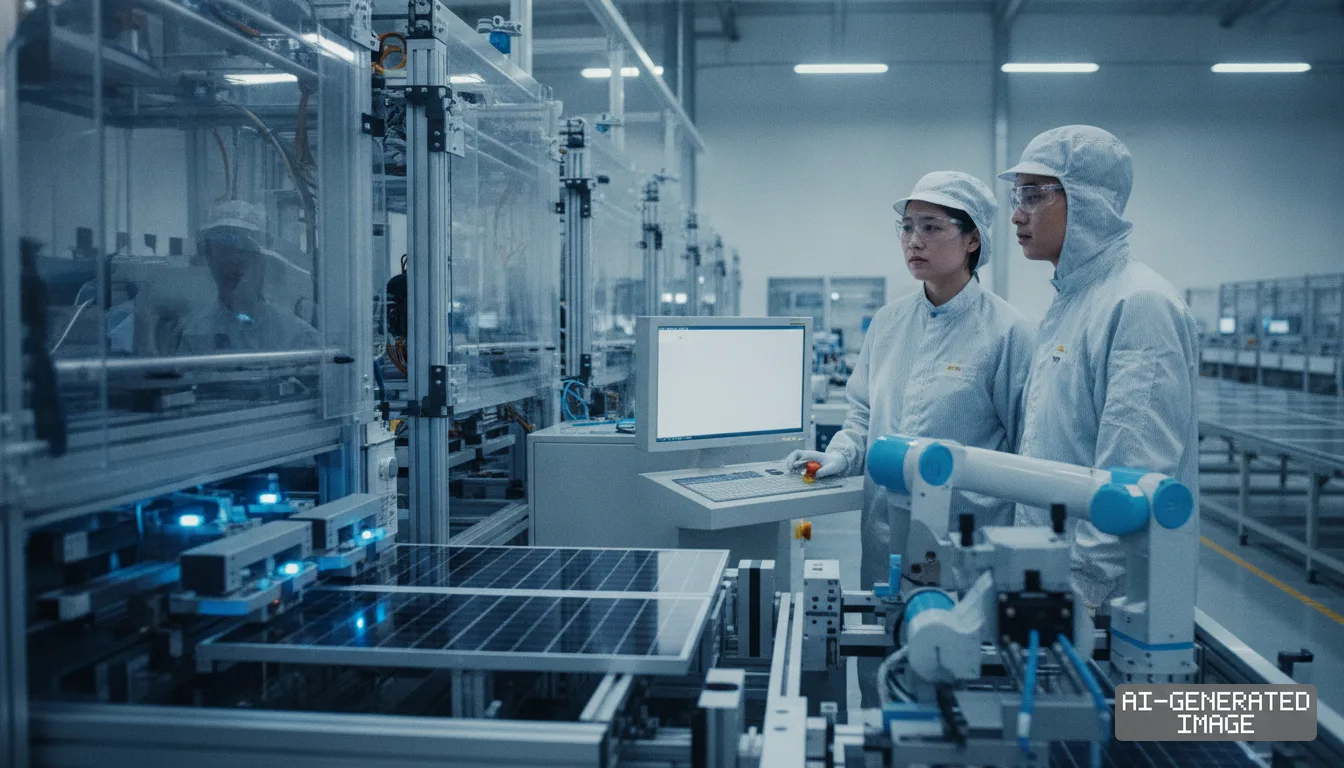
China's Ministry of Commerce moved Oct. 20, 2026 to restrict exports of 12 advanced photovoltaic manufacturing technologies, threatening overseas expansion plans for solar cell and wafer makers.
The joint proposal with the Ministry of Science and Technology seeks to amend China's export control catalog. Officials also instituted immediate pre-export registration requirements for covered manufacturing techniques.
Chinese manufacturers currently control roughly 97% of global solar wafer production capacity and more than 80% of polysilicon output. The measures target the intellectual property and specialized machinery behind that dominance.
The draft divides the 12 photovoltaic technologies into two regulatory categories. Authorities designated certain core processes for complete export bans, while placing advanced high-efficiency cell assembly methods under mandatory export licensing.
Export bans apply to manufacturing techniques for ultra-thin silicon wafers measuring 70 micrometers or less. Specialized equipment designed to slice those fragile wafers also falls under the absolute export prohibition.
The ministry also barred foreign transfers of large-scale fluidized bed reactor processes. The ban covers trichlorosilane systems producing 250,000 metric tons annually and silane units yielding at least 20,000 tons.
Next-generation tandem cells face outright export bans under the proposed catalog revisions. Beijing blocked overseas transfers of perovskite-silicon tandem cells delivering 30% or higher conversion efficiency on 182-millimeter or larger wafers.
The ban covers slot-die coating technology with a width of 1.1 meters or wider, according to the ministry notice. Single-junction perovskite modules larger than one square meter with 18% efficiency are also barred.
Other mainstream cell technologies will require discretionary export permits from commercial regulators. Those restricted lines include tunnel oxide passivated contact, heterojunction and back-contact manufacturing processes, widely known as TOPCon, HJT and XBC.
Regulators extended the export licensing requirements beyond hardware tools. Exporters must secure permits for algorithmic models, proprietary software code and detailed engineering drawings associated with controlled production lines.
Commercial shipments of finished solar panels and standard wafers remain unrestricted, the ministry said. The controls focus exclusively on upstream manufacturing equipment and factory-floor production secrets.
The measure threatens Western efforts to build autonomous solar supply chains outside Asia. The United States and the European Union have offered billions of dollars in manufacturing subsidies to reduce reliance on Chinese components.
Foreign project developers rely heavily on specialized Chinese machinery to furnish greenfield fabrication plants. Non-Chinese toolmakers cannot supply commercial ingot pullers or diamond-wire wafer saws in matching volumes.
Hanwha Solutions faces immediate operational friction at its North American solar expansion. The South Korean manufacturer is building a $2.5 billion fully integrated solar supply hub in Cartersville, Georgia, through its Qcells subsidiary.
The Cartersville facility includes 3.3 gigawatts of planned annual capacity for solar ingots, wafers, cells and modules. Qcells planned to source specialized ingot pullers and wafering tools from established suppliers in China.
Hanwha Solutions generated 68% of its clean energy division operating income from the United States last year. Delays in machinery import approvals could push back trial runs at the Georgia ingot and wafer plant.
Canadian Solar Inc., which delivers roughly 62% of its module volumes to buyers outside China, saw its shares drop 7% following the announcement. Investors reacted to rising compliance friction across its international manufacturing footprint.
The company operates cell and module facilities across Southeast Asia and is expanding manufacturing capacity in Mesquite, Texas. Restrictions on Chinese engineering support could complicate production ramp schedules at those foreign sites.
Tesla Inc. also faces scrutiny over its energy hardware manufacturing lines. Tesla generated $3.1 billion from energy storage and generation sales last quarter, relying on specialized automated assembly tools sourced from mainland Chinese vendors.
The export rules also curb Chinese photovoltaic majors seeking to circumvent trade tariffs. Leading manufacturers including LONGi Green Energy Technology and Tongwei have explored building wafer and cell facilities in the Middle East and North America.
LONGi Green Energy Technology books approximately 18% of its total revenue from overseas shipments. Chinese manufacturers must now seek formal government clearances before transferring production equipment to their own foreign joint ventures.
Southeast Asian solar cell hubs in Vietnam, Malaysia and Thailand face severe capital expenditure increases. Those facilities produce roughly 70% of solar modules imported into the United States and depend entirely on Chinese wafer machinery.
The notice does not state whether pending equipment export contracts signed before Oct. 16 will receive grandfathered export clearances, and the ministry has not published specific licensing approval criteria for restricted technologies.
The Ministry of Commerce set a public consultation deadline of Nov. 15, 2026, for the proposed catalog revisions. The interim technology export registration rules will remain in force until the State Council formally ratifies the final list.
Impact map
How this development propagates across the region and out to global buyers.
| Event | Korea | China | Japan | Global impact |
|---|---|---|---|---|
| Solar tech export controls | Hanwha Solutions faces tool procurement friction for US ingot and wafer lines | Domestic toolmakers lock in IP, restricting foreign fab buildouts | Sharp and equipment vendors see delays in cross-border tandem cell pilots | US and European cell makers see fab capex rise by an estimated 15-20% |
In this story
- Companies
- Hanwha SolutionsCanadian Solar
- Tickers
- 009830.KSCSIQ
- Exposed
- TeslaLONGi Green Energy TechnologyTongwei
- Policy
- Export Controls
- Impact
- Supply ChainCapexOrder Book
Track every Export Controls development →
Related briefings
- China restricts 12 solar technologies under new export rules Also on Hanwha Solutions, LONGi Green Energy Technology, Tongwei
- China curbs exports of 40 AI, solar and biotech technologies Also on LONGi Green Energy Technology, Export Controls
- China polysilicon cash costs diverge across regional power grids under new price rules Also on Tongwei
- China Tightens Connected Vehicle Data Rules With Mandatory Local Sensor Scrubbing Also on Tesla, Export Controls
Sources
Primary documents
Reporting
Confidence: high — how we grade this
The documents behind this briefing are linked above. East Asia Brief produces its English text with AI assistance under human editorial review, and does not translate or republish other outlets' articles. See our methodology and AI policy. Spotted an error? Tell us.
The Morning Brief
What changed in Korean, Chinese and Japanese industry overnight — and what it means for your supply chain. One email, weekday mornings, US time. Free.
The Morning Brief is in preparation. Leave your address and we will write to you once — when the first issue is ready. Nothing before that.