Jiangnan Shipyard puts twin 93,000-cbm ammonia tankers in service
The Panda 93A vessels Ivy Cove and Nurai provide 186,000 cubic meters of dedicated capacity for Eastern Pacific Shipping and AW Shipping.
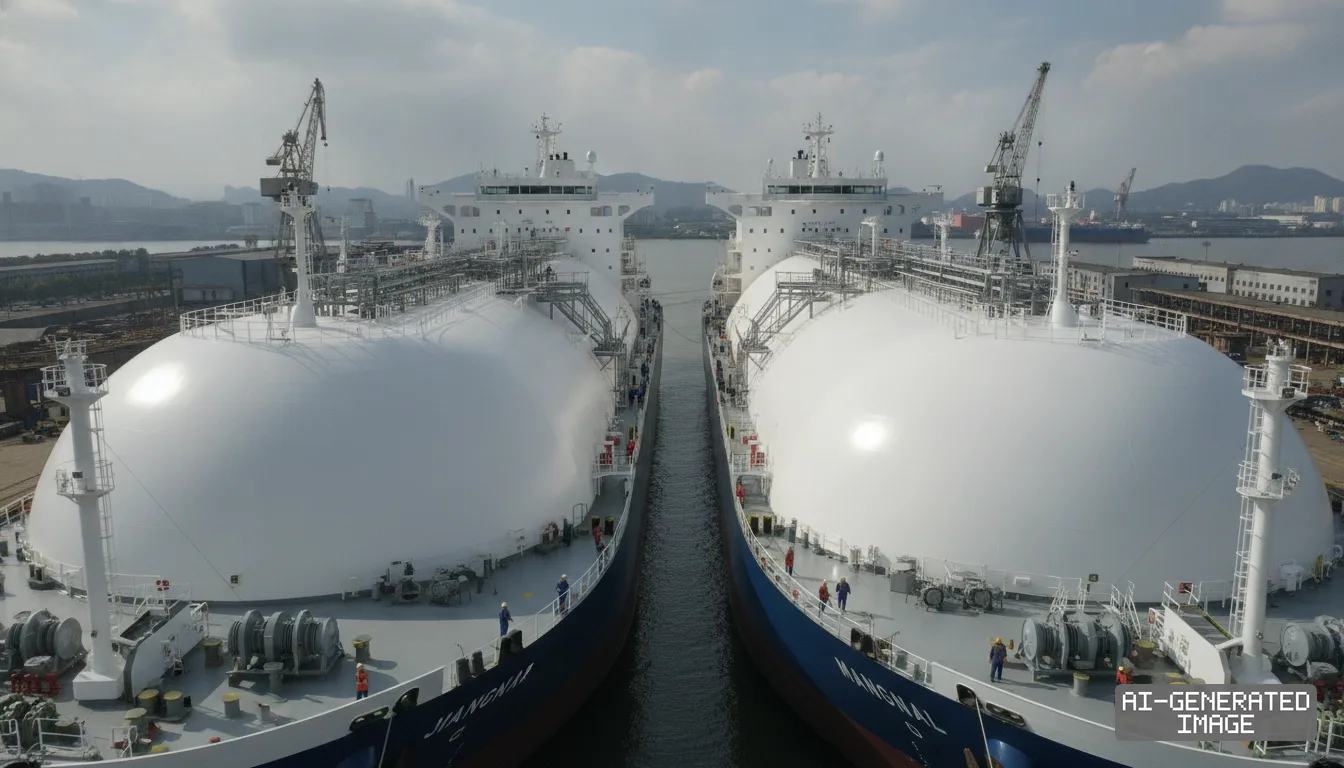
Jiangnan Shipyard confirmed Nov. 17 that twin 93,000-cubic-meter ammonia carriers have entered active commercial service, establishing the largest operating zero-carbon gas transport vessels in the global merchant fleet.
The sister ships represent an initial 186,000 cubic meters of dedicated waterborne capacity for clean hydrogen derivatives. That volume shifts long-haul chemical trading away from standard gas carriers into purpose-built hulls, shipping registries show.
Each tanker carries up to 66,615 deadweight tons of cargo across four independent Type A containment tanks. The layout accommodates anhydrous ammonia at minus 52 degrees Celsius, according to classification dockets published by Lloyd's Register.
The lead tanker, Ivy Cove, entered commercial employment following delivery to Singapore-based Eastern Pacific Shipping. The owner placed the vessel under a multi-year charter with commodity trader Trafigura to handle global industrial ammonia flows.
Eastern Pacific Shipping holds contracts for six 93,000-cubic-meter carriers at the Shanghai shipyard. The owner took delivery of the second vessel in that series, Lilac Cove, in September to expand its alternative-fuel gas portfolio.
The second newbuilding, Nurai, joined the active trading fleet under the ownership of AW Shipping. The joint-venture operator completed final vessel delivery on October 19 following formal christening ceremonies at the Changxing Island yard.
AW Shipping operates as a joint venture formed by Abu Dhabi National Oil Company Logistics and Services and China's Wanhua Chemical Group. The entity handles long-term gas transportation between Middle Eastern export terminals and Chinese chemical complexes.
The venture ordered four 93,000-cubic-meter ammonia vessels as part of a $1.9 billion fleet investment program. That package also contracted nine very large ethane carriers to support synthetic chemical manufacturing across the Asia-Pacific region.
Both vessels utilize Jiangnan Shipyard's proprietary Panda 93A design, an evolution of its fourth-generation gas carrier platform. The hull spans 230 meters in length, 36.6 meters in beam and 22.5 meters in molded depth.
Naval architects reinforced the cargo holds to handle the high density of anhydrous ammonia. The chemical carries a specific gravity of 0.69, which exerts greater hydrostatic stress than conventional propane or butane cargoes, the yard said.
Containment tanks utilize specialized low-temperature steel to prevent stress corrosion cracking. Jiangnan Shipyard assembled each tank as a single integrated block prior to hull installation to ensure structural integrity across the 13-meter operating draft.
The cargo piping layout allows the vessels to carry two distinct liquefied gas grades simultaneously. That dual-loading flexibility enables operators to transport split parcels of ammonia and liquefied petroleum gas to ports with constrained storage infrastructure.
Propulsion power comes from an LPG-fueled dual-fuel two-stroke main engine rated at 12,600 kilowatts. A shaft generator supplies auxiliary electrical power while underway, cutting fuel consumption across extended transoceanic voyages.
The mechanical configuration lowers carbon dioxide emissions by approximately 20% compared with conventional marine diesel. Sulfur oxide emissions fall by 99%, satisfying the International Maritime Organization's Phase III energy efficiency design requirements, the builder said.
The yard incorporated an ammonia-ready structural interface into the engine spaces. The design reserves equipment footprints and deck areas for piping retrofits once ammonia-burning main engines achieve commercial type approval, Jiangnan Shipyard said.
The vessel deliveries advance China State Shipbuilding Corporation's campaign to secure high-value gas tonnage. Chinese shipbuilders have captured early contracts for very large ammonia carriers, intensifying competition against South Korean shipbuilders HD Hyundai and Hanwha Ocean.
South Korean yards pioneered the large liquefied natural gas carrier segment over the past decade. Jiangnan Shipyard has used the ammonia carrier niche to establish scale in the next phase of zero-carbon energy transport, shipyard filings indicate.
The vessels support chemical producers adjusting procurement strategies for clean industrial feedstocks. Wanhua Chemical relies on imported ammonia and gas streams to produce polyurethanes and advanced materials at plants in Shandong and Fujian provinces.
Global trading houses have stepped into the sector to secure maritime transport corridors ahead of clean fuel mandates. Trafigura's charter of Ivy Cove guarantees vessel access along routes connecting clean ammonia production sites to industrial off-takers.
Shipyard schedules show the remaining two ammonia carriers ordered by AW Shipping will deliver by late 2027. Construction has also commenced on four expanded 95,000-cubic-meter carriers for Jaldhi Overseas, with handovers scheduled through late 2028.
Jiangnan Shipyard has not published the capital expenditure required to execute future engine conversions to full ammonia combustion. Operating documents do not settle which regional bunkering hubs will certify ammonia fueling facilities for commercial trading.
Impact map
How this development propagates across the region and out to global buyers.
| Event | Korea | China | Japan | Global impact |
|---|---|---|---|---|
| VLAC commercial fleet deployment | HD KSOE and Hanwha Ocean face Chinese yard competition for 2027 delivery slots | Jiangnan Shipyard establishes early lead in large zero-carbon ammonia carrier construction | Imabari and trading houses review ammonia-ready gas carrier designs | Fleet adds 186,000 cbm of capacity for long-haul hydrogen derivative shipping |
| VLAC commercial fleet deployment | HD KSOE and Hanwha Ocean face Chinese yard competition for 2027 delivery slots | Jiangnan Shipyard establishes early lead in large zero-carbon ammonia carrier construction | Imabari and trading houses review ammonia-ready gas carrier designs | Fleet adds 186,000 cbm of capacity for long-haul hydrogen derivative shipping |
In this story
- Companies
- Jiangnan ShipyardEastern Pacific ShippingAW Shipping
- Tickers
- 600150.SS
- Exposed
- TrafiguraWanhua Chemical GroupADNOC Logistics & ServicesHD Korea Shipbuilding & Offshore Engineering
- Policy
- Standards
- Impact
- Supply ChainOrder BookCapex
Track every Standards development →
Related briefings
- Chinese shipbuilders surpass South Korea in October LNG orders Also on ADNOC Logistics & Services, Eastern Pacific Shipping, Jiangnan Shipyard
- HD Hyundai develops 150,000 cbm ultra-large ethane carrier Also on Eastern Pacific Shipping, Jiangnan Shipyard, Order Book
- HD Hyundai reserves Mipo dock slots for eight gas carriers Also on Trafigura, HD Korea Shipbuilding & Offshore Engineering, Order Book
- Korea Zinc advances $7.4B US smelter for critical minerals Also on Trafigura
Sources
Reporting
Confidence: medium — how we grade this
The documents behind this briefing are linked above. East Asia Brief produces its English text with AI assistance under human editorial review, and does not translate or republish other outlets' articles. See our methodology and AI policy. Spotted an error? Tell us.
The Morning Brief
What changed in Korean, Chinese and Japanese industry overnight — and what it means for your supply chain. One email, weekday mornings, US time. Free.
The Morning Brief is in preparation. Leave your address and we will write to you once — when the first issue is ready. Nothing before that.