Hanwha Ocean takes legal action after Geoje crane sit-in
The shipbuilder rejected joint bargaining with catering subcontractors under Korea's amended labor law, escalating risks for delivery schedules across its packed commercial vessel order book.
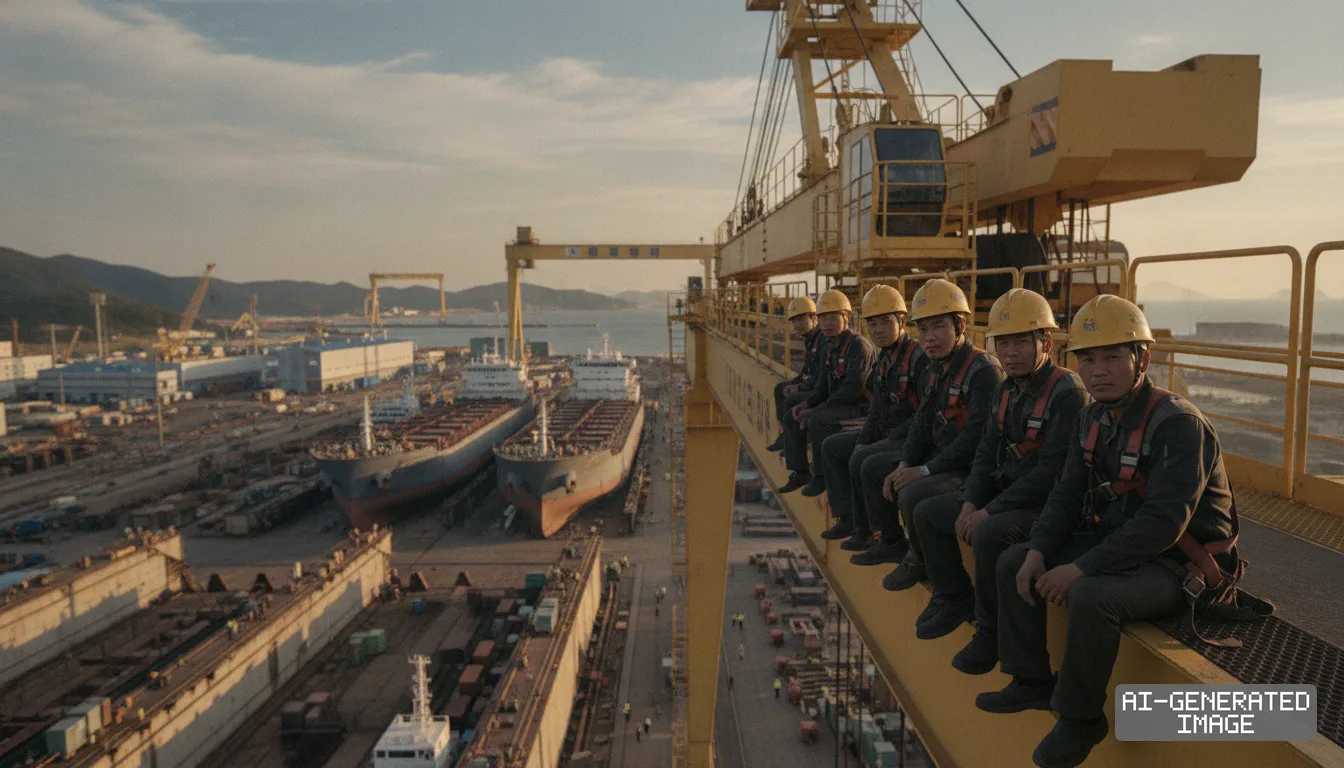
Hanwha Ocean pledged strict legal action on Oct. 1, 2026, after subcontracted shipyard workers mounted a crane at its Geoje shipyard to demand direct collective bargaining.
The high-altitude action by six union officials followed a 218-day continuous tent sit-in. It challenges assembly workflows at a yard where subcontracted labor provides more than four-fifths of outfitting and hull production hours.
The confrontation revives memory of a 51-day dock occupation in 2022 that prompted a 47 billion won ($35 million) civil lawsuit, which Hanwha Ocean withdrew only on Nov. 2, 2025.
Hanwha Ocean labeled the latest protest an illegal occupation that violates the Trade Union and Labor Relations Adjustment Act. The company stated that the action could constitute criminal obstruction of business.
The protest began at roughly 12:30 p.m. on Sept. 30. Six executives from the Geoje-Tongyeong-Goseong Shipbuilding Subcontract Workers’ Chapter of the Korean Metal Workers’ Union mounted a 30-meter crane and the roof of a pre-painting shop.
The scaffolding assembly yard where the crane stands supplies temporary access platforms for hull painting and outfitting blocks. Those structures are required before large sections can move into dry docks.
Union officials stated they climbed the structure because management refused direct collective negotiations. Subcontracted workers launched a tent protest outside the complex in February 2026 to demand direct contract talks.
The labor dispute stems from an amended Trade Union and Labor Relations Adjustment Act that took effect on March 10, 2026. Commonly termed the Yellow Envelope Law, the legislation widened employer definitions.
Under the revised statute, prime contractors must bargain with subcontracted workers whenever the lead firm exercises substantive and specific control over daily working conditions. South Korea's shipyards rely heavily on tiered staffing vendors.
Hanwha Ocean agreed in principle to bargain directly with the subcontracted shipbuilding union branch alone. It refused, however, to hold joint bargaining sessions that include workers from Welliv.
Welliv is an on-site service partner that operates employee cafeterias, commuter buses and dormitory facilities across the Geoje complex. Its employees organized an affiliated branch under the same regional metalworkers' union.
Quasi-judicial labor boards have sided with the union. The Gyeongnam Regional Labor Relations Commission ruled on May 15, 2026, that Hanwha Ocean must include Welliv in its public notice of bargaining demands.
The National Labor Relations Commission affirmed that decision in July 2026. The tribunal concluded that Hanwha Ocean exercises structural authority over kitchen, laundry and facility conditions because the shipbuilder owns the physical plant.
Hanwha Ocean rejected the administrative finding. The shipbuilder filed an administrative lawsuit and a request for a stay of execution with the Seoul Administrative Court on July 20, 2026, seeking to annul the order.
Management argued that catering and commuter bus operations have no bearing on shipbuilding manufacturing. Forcing prime contractors into wage talks with service vendors threatens industrial subcontracting structures, the shipbuilder said.
The subcontractor protest coincides with wage disputes among Hanwha Ocean's direct workforce. Regular union members halted all four 900-ton Goliath cranes at Geoje for 24 hours on Sept. 18 during an eight-hour walkout.
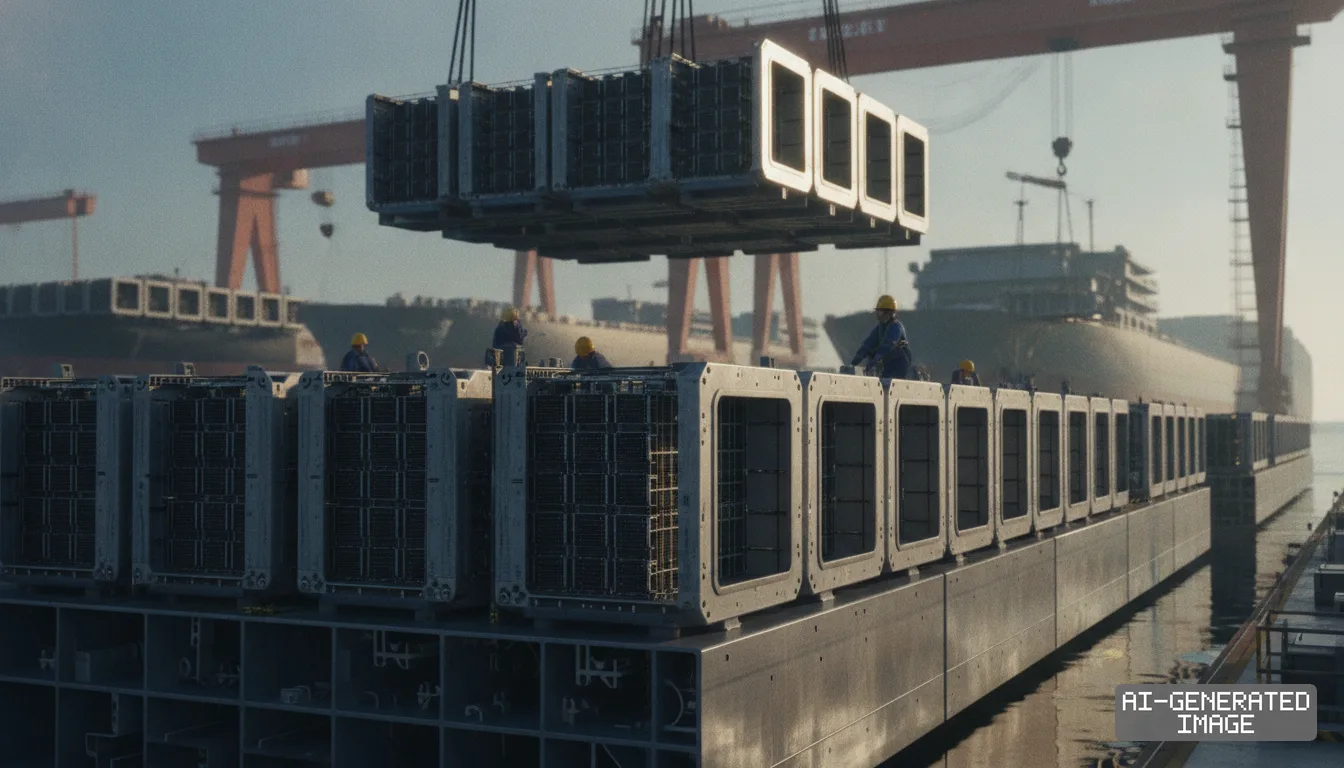
That stoppage involved 140 crane operators across two shifts. Goliath cranes hoist massive pre-outfitted hull blocks into the dry docks where commercial vessels take final shape.
Regular union negotiators completed a 24th round of wage talks on Sept. 22 without reaching an agreement. The union demands a 149,600 won monthly base wage increase and an annual bonus equal to 900% of base salary.
Management countered with a 123,689 won base wage increase and a lump-sum payment of 6.5 million won. The shipbuilder cited the risk of cumulative cost escalation across multi-year contracts.
Jeong In-seop, president of Hanwha Ocean, told employees in a company memo that crane stoppages cause immediate production bottlenecks. Delayed block erection creates rolling delivery risks for subsequent hull welding and equipment installation.
Korean shipbuilders hold full order books stretching past 2028, dominated by high-margin liquefied natural gas carriers and containerships. Tight shipyard capacity leaves little buffer to absorb serial labor interruptions.
Global shipowners face penalty clauses and postponed charter revenues if dock turnover slows. Berth space at Geoje is committed to international energy majors and container liners under fixed milestone timetables.
For industrial shipyards, the dual front with regular and subcontract unions complicates cost projections. Concessions granted to prime workers typically trigger matching wage claims from subcontracted trades that assemble scaffolding and paint hulls.
The Seoul Administrative Court is scheduled to open hearings on Hanwha Ocean’s stay-of-execution filing in October 2026. That legal ruling will determine whether prime contractors can exclude peripheral service vendors from statutory bargaining.
Hanwha Ocean has not disclosed the exact monetary damages or quantified delivery delays resulting from the scaffolding crane stoppage. The shipbuilder maintained on Oct. 1 that site operations continue under contingency plans.
Impact map
How this development propagates across the region and out to global buyers.
| Event | Korea | China | Japan | Global impact |
|---|---|---|---|---|
| Shipyard subcontractor crane sit-in | Hanwha Ocean faces concurrent subcontractor and regular union disputes over Yellow Envelope Law compliance | Chinese shipbuilders market slot reliability to global shipowners facing Korean yard delivery risk | Japanese yards face no prime-contractor statutory bargaining expansion for vendor personnel | Shipowners face delivery milestone slippage on high-margin LNG carriers as Geoje outfitting slows |
In this story
- Companies
- Hanwha Ocean
- Tickers
- 042660.KS
- Policy
- Economic Security
- Impact
- Supply ChainCost StructureCompliance
Track every Economic Security development →
Related briefings
- Shipyard labor policies diverge as Korea, Japan, and China tackle yard manning gaps Also on Hanwha Ocean, Compliance, Cost Structure
- South Korea court cuts Hanwha Ocean antitrust fine to $560,000 Also on Hanwha Ocean, Compliance, Cost Structure
- Hanwha Ocean faces $1.0 billion arbitration over Arctic LNG Also on Hanwha Ocean, Compliance, Cost Structure
- Korean shipbuilders validate quiet electric propulsion on naval unmanned surface vessels Also on Hanwha Ocean, Compliance
Sources
Reporting
Confidence: medium — how we grade this
The documents behind this briefing are linked above. East Asia Brief produces its English text with AI assistance under human editorial review, and does not translate or republish other outlets' articles. See our methodology and AI policy. Spotted an error? Tell us.
The Morning Brief
What changed in Korean, Chinese and Japanese industry overnight — and what it means for your supply chain. One email, weekday mornings, US time. Free.
The Morning Brief is in preparation. Leave your address and we will write to you once — when the first issue is ready. Nothing before that.