UK and Japan ink offshore wind compact for £9 billion pipeline
The bilateral framework underpins 5.9 gigawatts of floating capacity across the British coast to replace Chinese subsea cables and platforms.
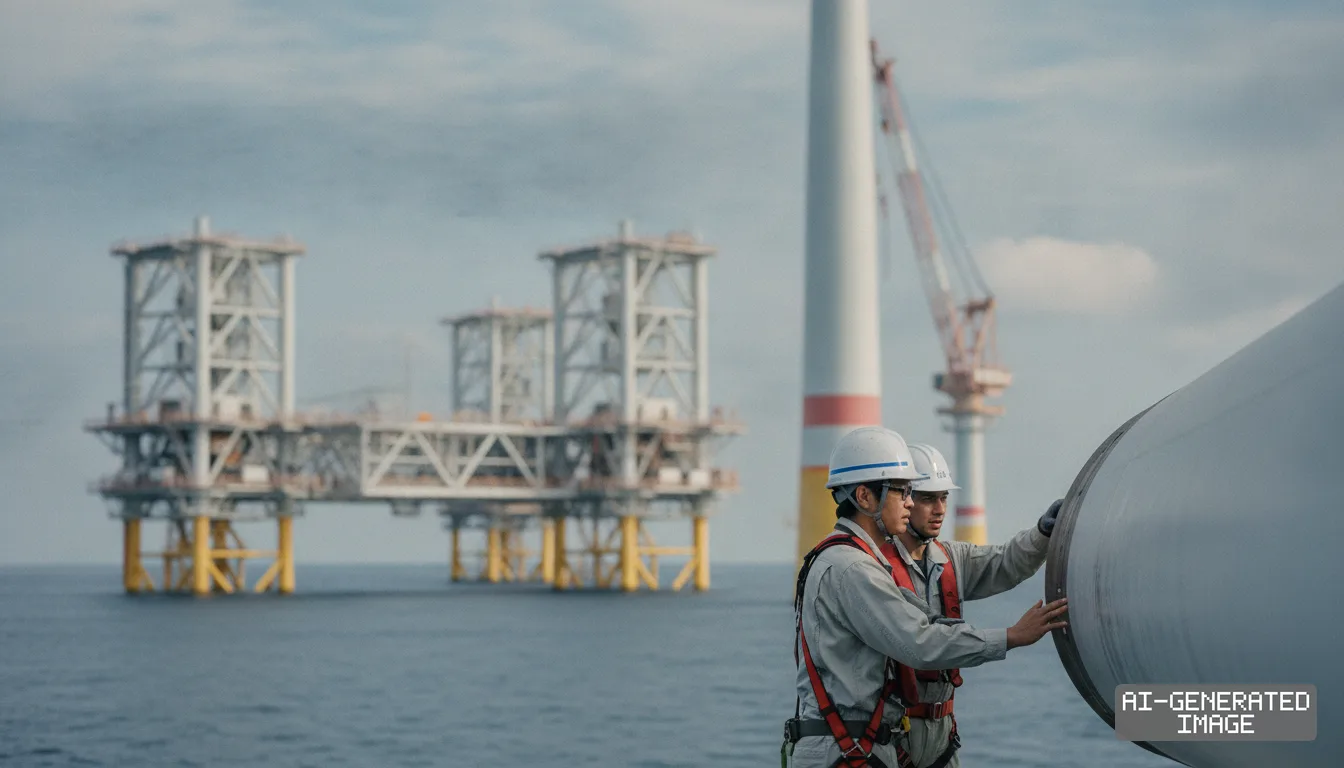
British and Japanese energy officials formalized the UK-Japan Offshore Wind Industrial Compact on Nov. 11, 2026, establishing a government-backed framework to align supply chains and industrial standards across floating wind projects.
The compact connects the UK Department for Energy Security and Net Zero with Japan's Ministry of Economy, Trade and Industry. It supports a private investment pipeline of up to £9 billion ($12 billion).
The capital will underpin 5.9 gigawatts of proposed floating offshore wind capacity off the British coastline. Both ministries seek to secure alternative hardware sources for offshore platforms, subsea transmission links and deep-water foundations.
UK Parliamentary Under-Secretary of State for Energy Michael Shanks and Japan's State Minister of Economy, Trade and Industry Kei Takagi authorized the agreement. The signing formalizes pledges drafted during bilateral trade summits earlier this year.
Western grid operators have grown concerned over high market concentration in key offshore electrical gear. Chinese turbine makers and cable fabricators have expanded international bidding, prompting European utilities to seek politically aligned supply arrangements.
The pact establishes three formal pillars of cooperation. The governments agreed to coordinate project financing, standardize component testing for floating foundations, and build resilient manufacturing corridors between European waters and Japanese yards.
Floating wind installations operate in water depths exceeding 60 meters, where fixed-bottom towers become impractical. Turbines are anchored to the seabed using tethered hulls, requiring specialized marine engineering and dynamic high-voltage cables.
Sumitomo Electric Industries stands as the most exposed Japanese equipment manufacturer under the initiative. The company invested £350 million ($440 million) to construct the UK's first high-voltage direct current subsea cable factory at the Port of Nigg in Scotland.
The Nigg plant covers 58,000 square meters on a 15-hectare coastal site. The facility directly employs more than 200 workers and produces 525-kilovolt cross-linked polyethylene subsea cables designed to carry electricity across long marine distances.
Sumitomo Electric secured a capacity reservation framework with SSEN Transmission to supply cables for the planned Shetland 2 link. That marine transmission project connects Shetland renewable generation to the Scottish mainland grid.
Commercial cable manufacturing at the Scottish factory is scheduled to begin in the second quarter of 2027, the company said. The contract provides Sumitomo Electric with a protected manufacturing pipeline insulated from low-cost overseas rivals.
Japanese trading houses and power developers also hold sizable stakes in British marine acreage. Marubeni Corporation is partnering with SSE Renewables and Copenhagen Infrastructure Partners on the Ossian floating wind project off the east coast of Scotland.
Ossian holds a planned capacity of up to 3.6 gigawatts, positioning the site to become one of the largest floating offshore wind developments worldwide. Marubeni has earmarked £1 billion in direct capital alongside broader consortium pledges.
Power utility JERA has expanded its North Sea exposure through its dedicated renewables arm, JERA Nex bp. The venture is co-developing the 2.9-gigawatt Morven offshore project with German utility EnBW under the ScotWind leasing program.
Japan's power sector faces tight domestic seabed space, driving its biggest utilities to deploy early capital into mature British leasing rounds. The companies intend to export operational know-how back to Japanese waters as Asian offshore auctions expand.
State-backed research bodies will manage technical validation under the compact. Japan's Floating Offshore Wind Technology Research Association will coordinate with Britain's Offshore Renewable Energy Catapult and the European Marine Energy Centre.
The research cohort focuses on stress-testing floating hulls, mooring tethers and substations against North Sea wave environments. Shared test data is intended to drive down fabrication costs across commercial deployments.
The UK government has mobilized newly established state corporation Great British Energy to steer strategic project co-investments. The agency works alongside private developers to accelerate grid connection timelines and de-risk port infrastructure.
High capital costs and turbine warranty inflation have delayed several European offshore developments. Developers have struggled with higher interest rates and bottlenecks in specialized installation vessels and high-voltage converter stations.
By institutionalizing technical specifications between Tokyo and London, both governments aim to give engineering suppliers predictable order volumes. The coordination helps fabricators justify plant capital expenditures without relying on Chinese sub-tier components.
Bilateral technical working groups will convene in the first quarter of 2027 to align testing criteria between OREC and FLOWRA ahead of the UK's Allocation Round 7 clean-power auctions.
The agreement text does not specify an expiration date, and neither ministry has published binding domestic content quotas or direct subsidy guarantees.
Impact map
How this development propagates across the region and out to global buyers.
| Event | Korea | China | Japan | Global impact |
|---|---|---|---|---|
| UK-Japan offshore wind compact | LS Cable & System faces stiffer competition in European export-cable tenders | Chinese wind turbine and HVDC cable makers face tighter procurement barriers in UK waters | Sumitomo Electric and Marubeni secure project access across 5.9 GW of UK floating wind | Offshore wind supply chains diversify away from Chinese components in North Sea grid buildouts |
| UK-Japan offshore wind compact | LS Cable & System faces stiffer competition in European export-cable tenders | Chinese wind turbine and HVDC cable makers face tighter procurement barriers in UK waters | Sumitomo Electric and Marubeni secure project access across 5.9 GW of UK floating wind | Offshore wind supply chains diversify away from Chinese components in North Sea grid buildouts |
In this story
- Companies
- Sumitomo Electric IndustriesMarubeniJERA
- Tickers
- 5802.T8002.T
- Policy
- StandardsSubsidies
- Impact
- Supply ChainCapexOrder Book
Track every Standards development → Track every Subsidies development →
Related briefings
- Japan optical suppliers scale laser diodes and engines for AI co-packaged optics Also on Sumitomo Electric Industries, Subsidies, Order Book
- Japan, Uzbekistan agree to refine critical minerals locally for export Also on Marubeni, Subsidies
- Seven Japanese firms order ammonia car carriers for 2030 fleet Also on JERA, Standards, Order Book
- Japan nuclear restarts widen regional power cost gap for manufacturers Also on JERA, Subsidies
Sources
Primary documents
Reporting
Confidence: high — how we grade this
The documents behind this briefing are linked above. East Asia Brief produces its English text with AI assistance under human editorial review, and does not translate or republish other outlets' articles. See our methodology and AI policy. Spotted an error? Tell us.
The Morning Brief
What changed in Korean, Chinese and Japanese industry overnight — and what it means for your supply chain. One email, weekday mornings, US time. Free.
The Morning Brief is in preparation. Leave your address and we will write to you once — when the first issue is ready. Nothing before that.