TSMC maps $22.6B Texas fab campus as Taiwanese suppliers follow
A 3,232-acre parcel in Brazos County anchors the proposed campus, accounting for 8.5% of the foundry giant's $265 billion long-term US outlay.
Taiwan Semiconductor Manufacturing Co. advanced plans on Nov. 25, 2026, to evaluate a $22.6 billion manufacturing campus in Texas, pulling its network of Taiwanese chemical, cleanroom and packaging contractors deeper into the United States.
The project, outlined in property tax limitation filings in Brazos County, designates a 3,232-acre site near College Station for leading-edge wafer fabrication. The planned capital outlay accounts for roughly 8.5% of TSMC's broader $265 billion long-term US expenditure roadmap.
The Texas filing follows formal regulatory clearance from Taiwan's Ministry of Economic Affairs on July 2, 2026, which approved a $20 billion capital injection into TSMC Arizona. That decision brought cumulative approved equity transfers for American operations to $44 billion.
Cleanroom engineering contractor United Integrated Services is expanding its American operational footprint in response. The firm constructed the 650,000-square-foot cleanroom enclosure at TSMC's Fab 21 in Phoenix, generating part of its NT$86 billion ($2.65 billion) trailing revenue.
To support future installation schedules, United Integrated Services purchased 29 acres in north Phoenix for $41 million in June 2026. The engineering firm shifted its site logistics in-house, reducing monthly project warehousing expenditures from $10 million to below $3 million.
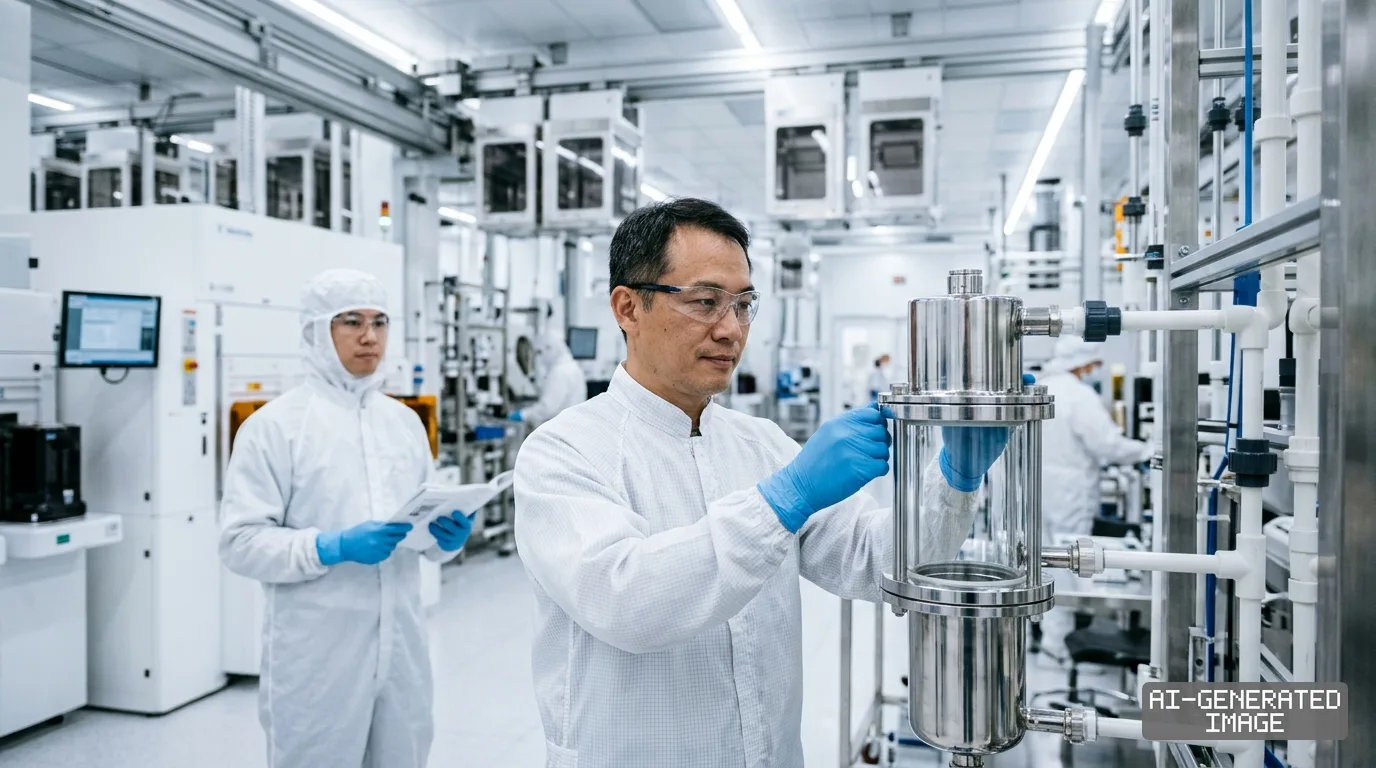
Engineering contractors Marketech International and Yankey Engineering have also established specialized American units. Both firms supply mechanical piping and chemical delivery equipment that carry ultra-pure fluids from storage tanks directly into wafer processing chambers.
Advanced packaging providers are aligning their capacity plans with the foundry's expansion. TSMC signed a 10-year commercial agreement with Amkor Technology on June 16, 2026, contracting turnkey wafer packaging and testing services in Peoria, Arizona.
Surging customer demand prompted Amkor to announce a $12 billion phase two expansion on Sept. 8, 2026. The project will expand cleanroom capacity to 93,000 square meters to handle Chip-on-Wafer-on-Substrate (CoWoS) and integrated fan-out assembly.
The packaging pact addresses a persistent bottleneck in domestic chip manufacturing. While American wafer fabs produce advanced logic, packaging capacity has remained in East Asia, requiring domestic fabricators to airfreight finished silicon overseas for multi-chip integration.
Upstream chemical suppliers are establishing local manufacturing to provide raw materials. Chang Chun Petrochemical committed $300 million to build a 109,346-square-foot electronic chemicals facility on an 80-acre site in Casa Grande, Arizona.
The chemical facility produces electronic-grade hydrogen peroxide and tetramethylammonium hydroxide developer. These wet process chemicals require impurity ceilings below parts per trillion to avoid contaminating microscopic transistor patterns during etching and cleaning steps.
Specialized solvent maker LCY Chemical deployed capital in Arizona to produce electronic-grade isopropyl alcohol. Nearby, joint venture Kanto-PPC broke ground on a $120 million chemical purification complex to blend hydrochloric acid and ammonium hydroxide.
Building specialized materials operations in the United States has introduced structural friction for Taiwanese suppliers. Subcontractors face multi-year environmental reviews, local zoning reviews and construction labor costs running 30% higher than equivalent projects in Taiwan.
Local municipal decisions have complicated material logistics schedules. The Casa Grande Planning and Zoning Commission rejected a conditional use permit for a major chemical blending site over concerns regarding hazardous freight corridors passing through residential neighborhoods.
Operating expense premiums remain elevated across the supplier base. Ultrapure chemical production requires continuous clean analytical laboratories and certified chemical technicians whose prevailing wage rates exceed Asian benchmarks by more than 40%.
Suppliers are pushing higher overhead charges directly into baseline contract terms. TSMC and its equipment vendors pass utility and facility expenses downstream to American fabless chip designers purchasing localized leading-edge wafers.
Property tax abatements serve as the primary mechanism to mitigate elevated domestic operational overhead. TSMC submitted its Brazos County application under Texas's Jobs, Energy, Technology and Innovation program to secure 10-year school district tax limitations.
Local school boards and county commissioners are scheduled to vote on the incentive application in mid-December 2026. Site preparation across the 3,232-acre parcel would commence in 2027 if regional authorities approve the tax cap.
The application does not confirm whether the TSMC board of directors has granted final capital expenditure approval, and supplier firms have not published binding facility commitments for the Texas site.
TSMC continues commercial wafer production at its initial Phoenix fabrication plant while screening alternative expansion parcels across Arizona and Texas.
Impact map
How this development propagates across the region and out to global buyers.
| Event | Korea | China | Japan | Global impact |
|---|---|---|---|---|
| TSMC US supplier localization | Samsung and SK hynix face rising US construction and packaging labor costs in Texas and Indiana | Domestic foundries SMIC and CXMT remain insulated from US supply chain relocation rules | Tokyo Electron and Shin-Etsu expand US field engineering to support Phoenix and Texas fabs | Leading-edge foundry and advanced packaging costs rise 25% to 30% under dual-shore US operations |
| TSMC US supplier localization | Samsung and SK hynix face rising US construction and packaging labor costs in Texas and Indiana | Domestic foundries SMIC and CXMT remain insulated from US supply chain relocation rules | Tokyo Electron and Shin-Etsu expand US field engineering to support Phoenix and Texas fabs | Leading-edge foundry and advanced packaging costs rise 25% to 30% under dual-shore US operations |
In this story
- Companies
- Taiwan Semiconductor Manufacturing Co.Amkor TechnologyUnited Integrated Services
- Tickers
- TSMAMKR2404.TW
- Exposed
- Chang Chun PetrochemicalLCY Chemical
- Policy
- Tax CreditsSubsidies
- Impact
- CapexSupply ChainCost Structure
Track every Tax Credits development → Track every Subsidies development →
Related briefings
- High-purity hydrogen peroxide supply chains face regional bottlenecks across East Asian fabs [90 characters] Also on Chang Chun Petrochemical, Cost Structure
- South Korean substrate makers develop embedded silicon bridges for AI chips Also on Amkor Technology, Tax Credits, Subsidies
- Silicon interposer scaling drives foundry and OSAT shifts in 3.5D chiplets Also on Amkor Technology, Taiwan Semiconductor Manufacturing Co, Subsidies
- Intel pits EMIB-T packaging against TSMC to win AI chip orders Also on Amkor Technology, Taiwan Semiconductor Manufacturing Co., Cost Structure
Sources
Reporting
Confidence: medium — how we grade this
The documents behind this briefing are linked above. East Asia Brief produces its English text with AI assistance under human editorial review, and does not translate or republish other outlets' articles. See our methodology and AI policy. Spotted an error? Tell us.
The Morning Brief
What changed in Korean, Chinese and Japanese industry overnight — and what it means for your supply chain. One email, weekday mornings, US time. Free.
The Morning Brief is in preparation. Leave your address and we will write to you once — when the first issue is ready. Nothing before that.