Tesla files $3.1 billion Texas plan for solar polysilicon plant
An incentive filing with the Texas Comptroller details a refinery designed to process trichlorosilane and reduce dependence on Chinese solar feedstock.
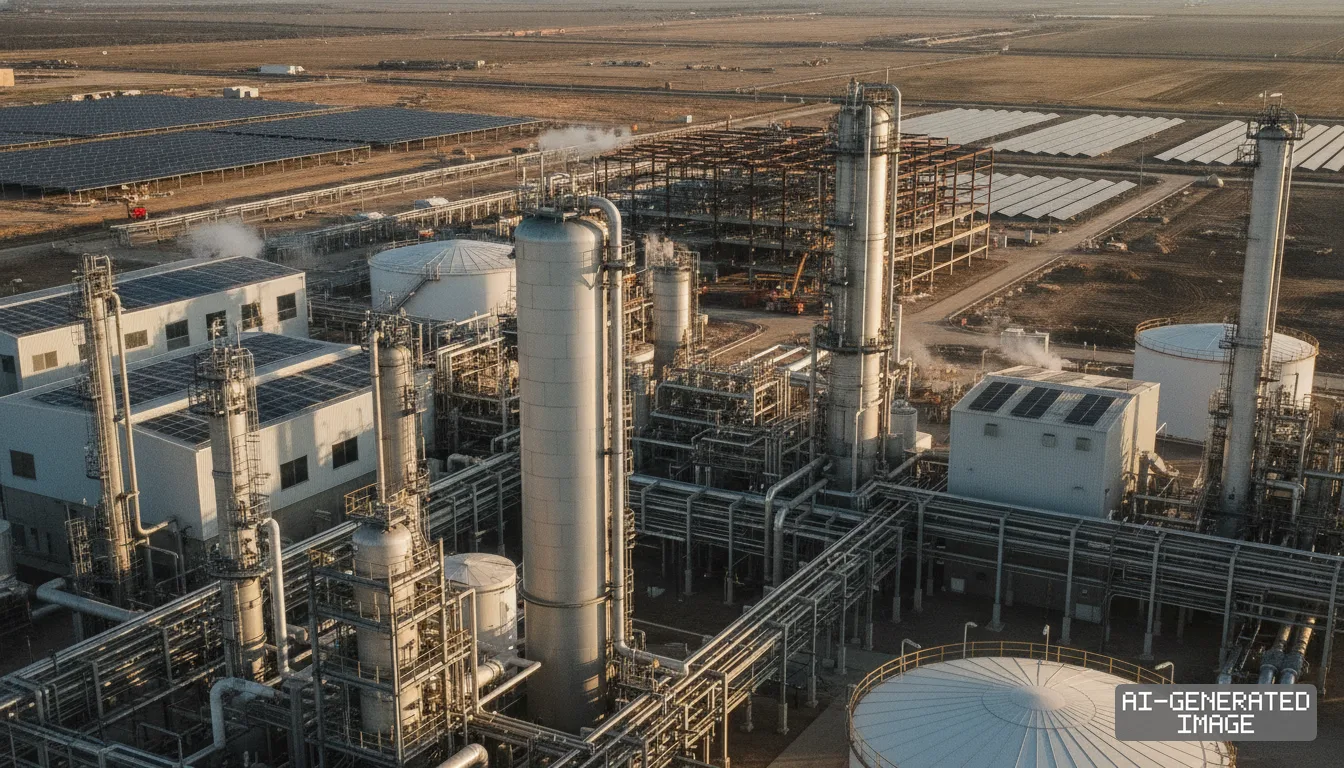
Tesla proposed building a $3.1 billion solar-grade polysilicon refinery in southern Texas on Nov. 23, 2026, seeking local tax relief to develop an onshore supply chain free from Chinese material dependencies.
The planned capital outlay includes $1.5 billion for engineering and construction, $1.425 billion for manufacturing machinery and $183 million for utility infrastructure, according to an application published by the Texas Comptroller of Public Accounts.
The facility would process ultra-pure trichlorosilane into high-purity polysilicon for single-crystal ingots and N-type solar cells. Chinese chemical refiners currently produce more than 90% of global solar-grade polysilicon feedstock.
The electric vehicle maker selected a site in Nueces County near Robstown, within the Tuloso-Midway Independent School District. The project serves as the upstream foundation for Tesla's clean energy division.
Output from the refinery would feed Project Crystal Sun, a planned $10.1 billion solar cell and module factory in Fort Bend County, Texas. Tesla is designing both sites as an integrated domestic platform.
Tesla applied for property tax relief under Texas's Jobs, Energy, Technology, and Innovation Act, known as the JETI program. The incentive would cap taxable property values for school operations across a 10-year period.
The requested abatement would run from 2031 through 2040. Tesla said in the filing that it will not build the plant in Texas without an executed tax agreement, citing active site evaluations in competing jurisdictions.
Tesla plans to create 515 full-time operational jobs at the refinery by 2032. The filing projects average annual employee compensation of $130,000, including benefits, alongside 1,770 temporary construction positions across the state.
Capital spending would concentrate between 2028 and 2029, absorbing roughly 80% of the total budget. Construction would begin in 2027, with initial commercial operations starting in 2030 and full capacity by 2032.
The investment targets an acute vulnerability in Western renewable energy manufacturing. Chinese industrial producers Tongwei Co. and GCL Technology Holdings anchor China's 90% global market dominance, with Tongwei operating more than 650,000 metric tons of annual polysilicon capacity.
Western solar module assemblers face mounting import duties and enforcement actions under the Uyghur Forced Labor Prevention Act. Federal trade policies have imposed steep tariffs and minimum import prices on imported Chinese photovoltaic inputs.
Refining metallurgical silicon into electronic-grade polysilicon requires immense continuous electric power. Tesla pointed to the Texas electric grid and local industrial infrastructure as primary operational assets for running high-heat chemical vapor deposition reactors.
Existing non-Chinese polysilicon suppliers maintain limited capacity in North America. Hemlock Semiconductor in Michigan and Wacker Chemie in Tennessee supply solar and semiconductor markets, but domestic wafer manufacturing capacity remains negligible across the continent.
South Korean solar module maker Hanwha Qcells has also expanded module and cell capacity in Georgia, while relying on international supply lines for foundational ingots and wafers. Japanese silicon chemical specialists such as Tokuyama Corporation have largely concentrated on electronic-grade semiconductor silicon rather than high-volume solar materials.
By internalizing polysilicon production, Tesla aims to protect its stationary energy storage and solar roof businesses from maritime freight shocks and trade sanctions. The company deployed 6.9 gigawatt-hours of battery storage products during the third quarter of 2026.
The Tuloso-Midway school board must evaluate whether project-generated economic activity offsets the proposed tax limitation before executing the contract. The Texas Comptroller already issued preliminary statutory eligibility findings for the manufacturing classification.
The application does not disclose the total dollar value of the requested school property tax limitation, and Tesla has not filed a Form 8-K with the U.S. Securities and Exchange Commission to formally commit capital to the project.
Records filed with the state contain no direct request for federal funding grants, countering industry speculation that the facility relies on immediate Department of Energy loan guarantees.
Tuloso-Midway school district trustees and state economic development officials plan to complete their formal review of the application in early 2027 before deciding whether to execute the final incentive agreement.
Impact map
How this development propagates across the region and out to global buyers.
| Event | Korea | China | Japan | Global impact |
|---|---|---|---|---|
| Tesla Texas polysilicon investment | Hanwha Qcells gains a potential domestic upstream partner for U.S. cell manufacturing | Tongwei and GCL Technology face long-term market erosion in U.S.-bound solar feedstocks | Tokuyama Corporation sees stable pricing in semiconductor-grade silicon as solar supply bifurcates | Solar manufacturers accelerate geographic diversification away from China's 90% refining concentration |
In this story
- Companies
- Tesla
- Tickers
- TSLA
- Exposed
- TongweiGCL TechnologyHemlock SemiconductorWacker ChemieHanwha QcellsTokuyama Corporation
- Policy
- Tax CreditsTariffs
- Impact
- Supply ChainCapex
Track every Tax Credits development → Track every Tariffs development →
Related briefings
- China polysilicon cash costs diverge across regional power grids under new price rules Also on GCL Technology, Tongwei
- Wacker Chemie keeps Tennessee plant open despite US tariffs Also on Wacker Chemie, Tariffs
- USTR extends Section 301 tariff relief on 178 Chinese product lines Also on Hanwha Qcells, Tariffs
- Trump 100% China tariff threats hit Asian intermediate hubs Also on Hanwha Qcells, Tariffs
Sources
Primary documents
Reporting
Confidence: high — how we grade this
The documents behind this briefing are linked above. East Asia Brief produces its English text with AI assistance under human editorial review, and does not translate or republish other outlets' articles. See our methodology and AI policy. Spotted an error? Tell us.
The Morning Brief
What changed in Korean, Chinese and Japanese industry overnight — and what it means for your supply chain. One email, weekday mornings, US time. Free.
The Morning Brief is in preparation. Leave your address and we will write to you once — when the first issue is ready. Nothing before that.