Yaskawa Electric releases CIP Safety card for factory drives
The JOHB-NSC3-MA option card integrates Ethernet-based CIP Safety protocols across four inverter lines to reduce hardwiring in robotics and factory lines.
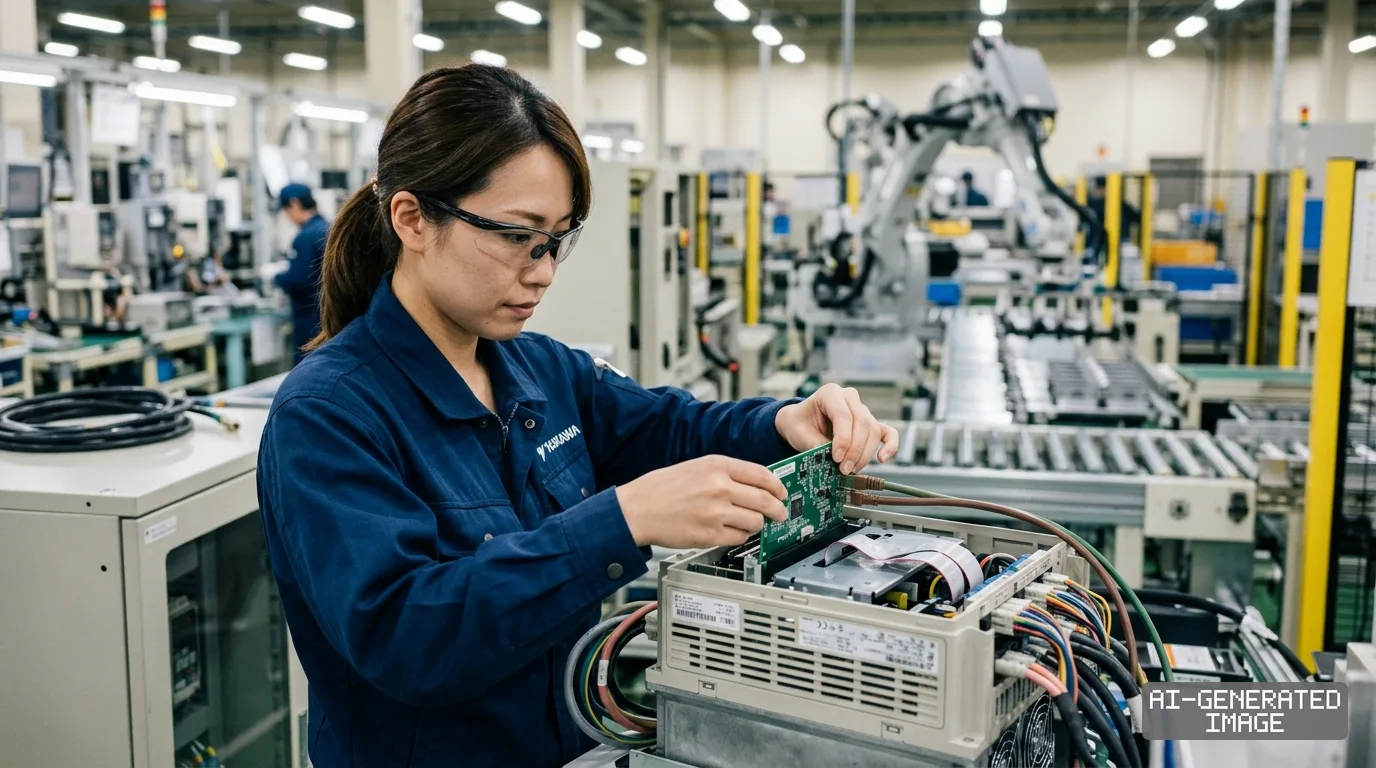
Yaskawa Electric launched an industrial network safety option card for AC drives on Oct. 8, 2026, aiming to cut wiring complexity across automated robotic production lines.
The release expands the company's drive business, which anchors its factory automation hardware. Yaskawa Electric generated consolidated revenue of 542.1 billion yen ($3.6 billion) in the fiscal year ended February 2026 across 28 global production facilities.
The option card, model JOHB-NSC3-MA, links industrial inverters directly to EtherNet/IP networks via Common Industrial Protocol Safety, or CIP Safety. The protocol transmits emergency halt and interlock signals over digital communication lines, the company said.
CIP Safety operates as an international networking standard that routes critical safety data through standard network architecture. The new card complies with the IEC 61800-5-2 international functional safety standard for adjustable speed electrical power drive systems.
The hardware installs directly into four Yaskawa inverter lines. Compatible models include the GA700, the CR700, the GA500 and the North American market GA800 series. These drive units govern electric motor speeds across automated manufacturing machinery.
The card introduces two primary functional safety mechanisms defined under IEC rules. The first is Safe Torque Off, known as STO, which cuts power to motor windings to prevent unexpected rotation during maintenance.
The second function is Safe Stop 1-time controlled, designated as SS1-t. When an operator triggers an emergency stop, the inverter decelerates the motor along a controlled trajectory before initiating the torque cutoff, the company said.
Under the SS1-t routine, factory operators adjust deceleration parameters directly through inverter drive settings. Once the timer elapses, the drive switches automatically into STO mode to guarantee mechanical immobility.
Conventional factory safety installations rely on physical relay modules and hardwired loops. Every safety door switch, light curtain and emergency stop button requires discrete copper wiring connected back to a central control cabinet.
That hardwiring increases electrical engineering time and consumes scarce panel space. In complex automation layouts, hundreds of individual safety cables add potential electrical failure points that complicate ongoing line diagnostics.
Replacing individual safety loops with digital fieldbus communication reduces control cabinet footprints. The design eliminates external safety relays, shortening installation lead times during plant commissioning, the company said.
Yaskawa designated five primary machine sectors for the card. The target categories include robot systems, material handling conveyors, packaging machines, industrial machine tools and automated assembly lines.
Industrial robot workcells require synchronized safety zones between robotic arms and peripheral equipment. Networked drives enable transfer conveyors and turntable positioners to execute synchronized stops whenever personnel enter an active hazard envelope.
Japanese automation manufacturers face increasingly strict safety regulations in overseas markets. Machine builders exporting equipment to European Union member states must comply with harmonized machinery directives and functional safety benchmarks, driving demand for certified network components.
The option card allows factory operators to retrofit existing equipment. Plant managers can insert the card into deployed GA700 or GA500 drives without overhauling existing motor hardware or physical cabinet enclosures.
Motion control hardware represents a foundational pillar of Japanese factory automation exports. Integrating network safety into core drive units protects supplier margins as global automakers and electronics assemblers standardize plant communications on Ethernet backbones.
The transition to unified network protocols also aids automated data collection. Safety controllers can poll inverter operating health over CIP Safety, recording trip causes and operational timestamps into plant management software.
Factory builders frequently run safety and standard motion control over parallel networks. The CIP Safety protocol routes safety packets across standard EtherNet/IP hardware, eliminating redundant cabling runs across machine frames.
The product rollout aligns with broader industrial modernization programs. Automakers and battery manufacturers have accelerated production cell modularity, where machine stations disconnect and reconfigure without extensive electrical rewiring.
The announcement does not state the retail price of the JOHB-NSC3-MA card or Yaskawa's initial sales volume target.
The company notice also does not state whether a dedicated hardware safety card will be released separately for robot controllers.
Yaskawa Electric will report its second-quarter financial results later in October 2026, when executives will review global capital expenditure trends in automation hardware.
Impact map
How this development propagates across the region and out to global buyers.
| Event | Korea | China | Japan | Global impact |
|---|---|---|---|---|
| CIP Safety inverter option launch | domestic automation builders face higher functional safety benchmarks in export tooling | machine tool integrators maintain hardwired lines amid slower industrial Ethernet upgrades | Yaskawa Electric unifies inverter safety bus across four product families | factory builders reduce panel footprint and installation labor across automated lines |
In this story
- Companies
- Yaskawa Electric
- Tickers
- 6506.T
- Policy
- Economic Security
- Impact
- Cost StructureSupply Chain
Track every Economic Security development →
Related briefings
- IndexBox reports 12% annual growth for dual-arm chip cobots Also on Yaskawa Electric, Cost Structure
- Inbolt raises $12.5 million for robot vision in auto plants Also on Yaskawa Electric, Cost Structure
- FANUC America taps Palladyne AI for factory robot autonomy Also on Yaskawa Electric, Cost Structure
- ABB targets end-of-line palletizing with heavy-payload PoWa cobots Also on Yaskawa Electric, Cost Structure
Sources
Reporting
Confidence: medium — how we grade this
The documents behind this briefing are linked above. East Asia Brief produces its English text with AI assistance under human editorial review, and does not translate or republish other outlets' articles. See our methodology and AI policy. Spotted an error? Tell us.
The Morning Brief
What changed in Korean, Chinese and Japanese industry overnight — and what it means for your supply chain. One email, weekday mornings, US time. Free.
The Morning Brief is in preparation. Leave your address and we will write to you once — when the first issue is ready. Nothing before that.