Path Robotics raises $300M at $2.45B valuation for welding robots
The autonomous welding specialist quadruples its valuation following a $600 million supply deal with American military shipbuilder HII.
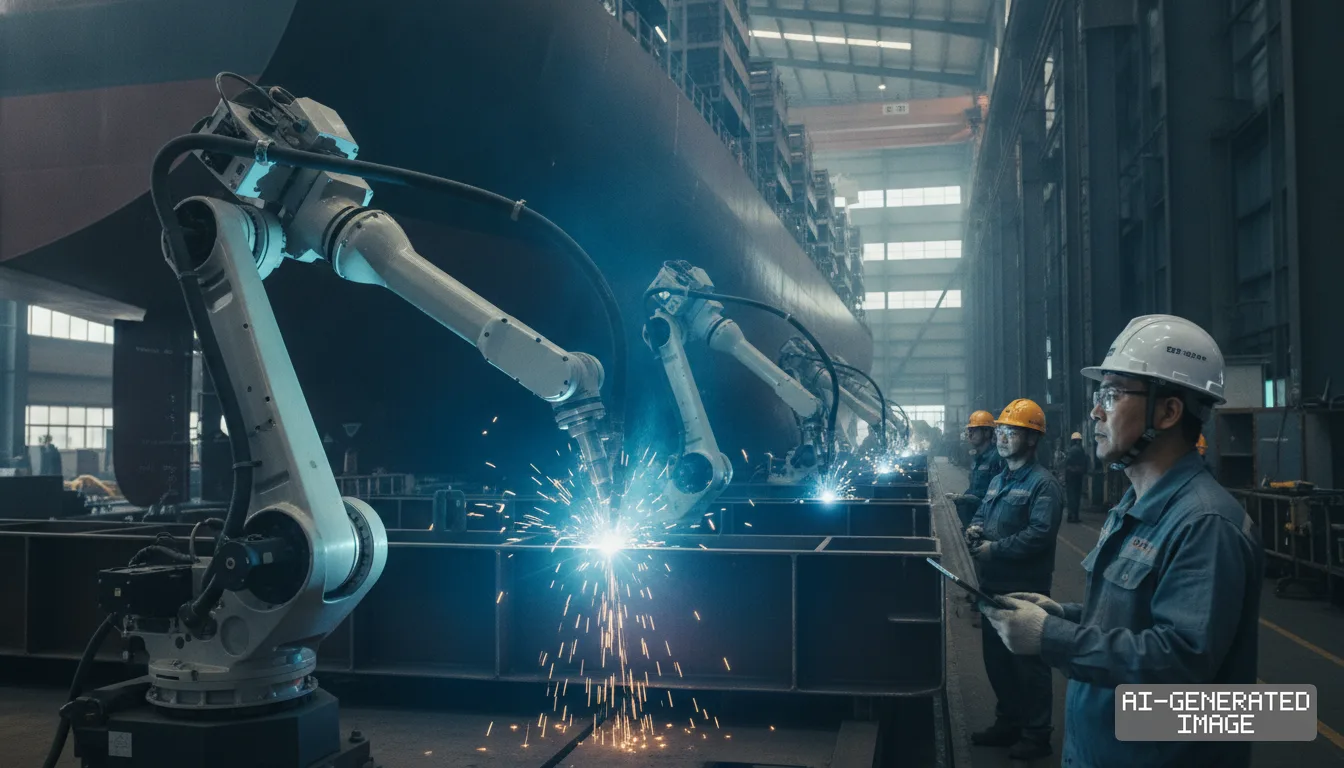
Path Robotics finalized a $300 million Series E funding round on Nov. 14, 2026, valuing the autonomous welding system manufacturer at $2.45 billion as shipyards seek automated alternatives to scarce manual labor.
The round nearly quadruples the company's prior valuation and raises its cumulative equity funding past $610 million, the Columbus, Ohio-based company said.
Growth equity firm Georgian led the transaction, with partner Emily Walsh taking a seat on the Path Robotics board of directors. New participants included NAVER Ventures and D. E. Shaw Ventures alongside existing investors Addition, Drive Capital, IronArc Ventures, Tiger Global and Yamaha Motor Ventures.
Heavy equipment fabricators and commercial shipyards face an acute deficit of skilled welders. The American Welding Society estimates the sector must fill roughly 80,000 open welding roles annually through 2029 as older tradespeople retire.
Conventional factory automation fails to resolve the bottleneck in heavy structural manufacturing. Standard industrial robot arms require pre-programmed trajectory scripts and rigid jigs, leaving them unable to handle slight deviations in large, heat-distorted steel plates.
Path Robotics builds autonomous welding cells that eliminate manual robotic teaching — the time-consuming process where technicians program specific coordinates into a controller. The machines use computer vision, combining lasers and cameras to scan incoming parts and generate weld paths independently.
The technology relies on two machine learning frameworks developed by Path Robotics. Its foundational neural simulator, named the Weld World Model, trains on tens of millions of inches of physical weld seam data to predict how molten metal behaves.
An onboard operational model named Obsidian processes live sensor data at the torch tip. Obsidian adjusts voltage, travel speed and torch angle in real time to compensate for gaps and part misalignments during the active weld.
Internal test data show the adaptive system delivers a first-pass yield above 97% on complex joints. Human welders tackling comparable high-mix assemblies average first-pass success rates between 70% and 85%, Georgian said.
Customers report that automated adaptive cells cut the direct labor cost per weld by approximately 40%, the investment firm said. Those gains helped Path Robotics expand its annual recurring revenue 17-fold over the preceding 18 months.
The demand is concentrated across defense manufacturing and heavy maritime construction. Huntington Ingalls Industries (HII), the largest military shipbuilder in the United States, signed a $600 million performance-based manufacturing agreement with Path Robotics earlier this year.
Under that agreement, HII is deploying vision-directed welding units across naval fabrication facilities to increase assembly throughput on nuclear submarine and aircraft carrier components. Maritime defense manufacturer Saronic and aerospace contractor Lockheed Martin have also integrated the automated cells.
Deploying static welding booths presents logistics challenges in shipyards, where workers must join prefabricated hull blocks weighing dozens of tons. Moving bulky steel assemblies into a fixed robotic enclosure consumes crane capacity and creates shop floor queues.
To address field assembly, Path Robotics introduced Rove, a mobile welding unit mounted on a quadruped robot chassis. The walking platform brings the welding torch and vision sensors directly to static workpieces across dry docks and yard staging bays.
The company has secured 50 advance commercial orders for the quadruped welding system. Factory personnel grew 97% over the past 12 months, and Path Robotics said it plans to expand total staff to 400 employees by Dec. 31, 2026.
Path Robotics has not published its total annual revenue or the specific dollar figure underlying its 17-fold recurring revenue expansion. The private firm keeps its baseline balance sheet figures confidential.
Field deployments of the 50 Rove walking systems will begin across shipyard floors and industrial structural sites in early 2027. Production volumes under the $600 million HII contract will scale in parallel as verification benchmarks clear next year.
Impact map
How this development propagates across the region and out to global buyers.
| Event | Korea | China | Japan | Global impact |
|---|---|---|---|---|
| Path Robotics $300M Series E | NAVER Ventures takes minority stake as Korean shipyards evaluate autonomous welding cells | Domestic shipyards accelerate gantry robot automation to counter rising North American yard productivity | Yamaha Motor Ventures participates in the round to back physical AI expansion into heavy fabrication | Defense and shipbuilding sectors shorten fabrication lead times by replacing manual welding with vision AI |
In this story
- Companies
- Path RoboticsHII
- Tickers
- HII
- Exposed
- Lockheed MartinSaronicYamaha Motor
- Impact
- Supply ChainOrder BookCapex
Related briefings
- China detains US rare earth shipments, hitting magnet plants Also on Lockheed Martin, Order Book
- US redirects mineral funds to back Korea Zinc's $7.4B smelter Also on Lockheed Martin
- Evolution Metals scales Korea magnet capacity to 10,000 tons Also on Lockheed Martin
- Pentagon awards Elmet $2.45B to cut China tungsten reliance by 2027 Also on Lockheed Martin
Sources
Reporting
Confidence: medium — how we grade this
The documents behind this briefing are linked above. East Asia Brief produces its English text with AI assistance under human editorial review, and does not translate or republish other outlets' articles. See our methodology and AI policy. Spotted an error? Tell us.
The Morning Brief
What changed in Korean, Chinese and Japanese industry overnight — and what it means for your supply chain. One email, weekday mornings, US time. Free.
The Morning Brief is in preparation. Leave your address and we will write to you once — when the first issue is ready. Nothing before that.