Japanese makers deploy thermal-shielded automated forklifts for cold storage
Toyota Industries and Mitsubishi Logisnext engineer heated sensors and sealed powertrains to eliminate condensation and battery drag across deep-freeze hubs.
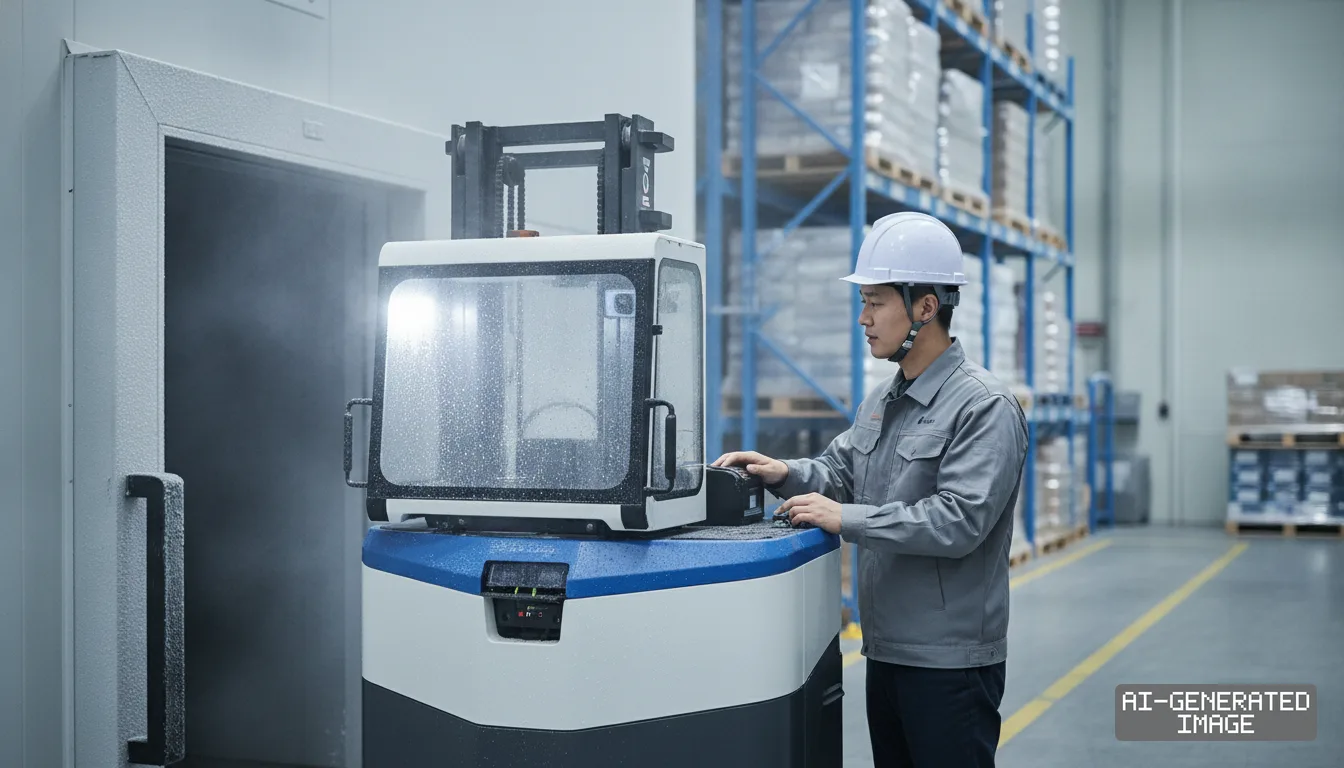
Japanese material handling manufacturers are accelerating the commercial deployment of automated guided forklifts engineered to withstand extreme thermal cycling between sub-zero freezer vaults and refrigerated staging docks. Toyota Industries Corporation and Mitsubishi Logisnext Company have commercialized specialized unmanned reach trucks capable of continuous transit between minus 25 degrees Celsius deep-freeze chambers and plus 10 degrees Celsius chilled loading docks. The engineering push addresses the physical failure modes that previously prevented automated guided vehicles from operating in low-temperature logistics: rapid lens condensation, electrical shorting from dew formation, and severe battery discharge degradation.
Cold-chain logistics hubs have historically relied on human operators in thermal suits driving insulated manual forklifts because autonomous optical and electronic systems fail when exposed to drastic temperature swings. When a vehicle moves from a minus 25 degrees Celsius freezer into a plus 10 degrees Celsius dock, ambient moisture instantly condenses across cold metal frames, circuit boards, and optical sensors. The resulting mist and water droplets refract laser guidance beams, blinding navigation systems, while repeated freezing cycles crack unheated electronic seals and degrade lithium and lead-acid battery voltage outputs.
Toyota Industries, through its Toyota L&F division, addressed these environmental stresses by releasing its Rinova AGF cold-storage lineup across 40 domestic sales channels. The product family spans six reach-type unmanned models with rated load capacities ranging from 1.0 to 3.0 metric tons. The engineering architecture integrates dedicated heating elements directly into the chassis and sensor housings to keep critical optical surfaces above the dew point during zone transitions. Toyota Industries verified the hardware durability, zone-transition stability, and mixed-traffic safety alongside manual forklifts during a 12-month field validation program conducted with Nichirei Logistics Group between October 2020 and September 2021.
Mitsubishi Logisnext entered the specialized segment with its PLATTER Auto cold-storage specification, developed in direct collaboration with Nichirei Logistics Group. The vehicle platform offers load ratings between 1.5 and 3.0 metric tons and operates natively in minus 25 degrees Celsius ambient environments. Unlike legacy low-temperature automated guided forklifts that required embedding magnetic rods or induction wires into concrete floors a costly and structurally disruptive modification in heavily insulated freezer facilities the PLATTER Auto uses laser reflector guidance. Mitsubishi Logisnext packaged electronic components and sensors certified for minus 30 degrees Celsius operation, supplemented by multi-layer anti-rust treatments across all structural assemblies and wiring harnesses.
The shift to laser-guided navigation in frozen environments required resolving optical scattering caused by micro-droplets and thermal fogging. Mitsubishi Logisnext adapted navigation hardware previously restricted to minus 10 degrees Celsius zones by enclosing laser scanners in heated, hermetically sealed housings with internal thermal regulation. The vehicle controls its position by measuring laser return times against high-reflectivity targets mounted on warehouse racking and facility walls, avoiding optical blind spots created when warm dock air enters freezer airlocks.
Thermal management of onboard power systems represents the second core design requirement for cold-storage automated guided forklifts. Electrochemical reactions inside industrial battery packs slow substantially below zero degrees Celsius, causing internal resistance to rise and usable battery capacity to drop by as much as 30 to 50 percent under continuous sub-zero loads. Both manufacturers counter this parasitic drain through insulated battery compartments, managed heating circuits, and opportunity charging schedules managed by central fleet dispatch software. By keeping cells within nominal operating temperature windows, the automated units maintain consistent lift speeds and mast acceleration without experiencing premature low-voltage cutoffs.
Operational pressures across Japanese food distribution are driving warehouse operators to fund cold-chain automation retrofits. Low-temperature facilities face acute structural labor shortages, compounded by statutory safety rules that restrict human work intervals in minus 25 degrees Celsius freezers to roughly 30 to 45 minutes before mandatory warm-up breaks. These mandated rotations disrupt handling continuity and force logistics operators to maintain oversized labor rosters to keep dock doors moving.
Fleet coordination software allows cold-storage operators to maintain continuous multi-vehicle throughput without human intervention. Mitsubishi Logisnext couples its automated reach trucks with its proprietary Route Optimizer fleet control software, which continuously schedules transit orders, dynamically allocates travel corridors, and balances battery replenishment cycles across multiple unmanned units. Nichirei Logistics Kansai validated this dispatch system during field trials at its Osaka Port Logistics Center, deploying two cold-storage PLATTER Auto units to handle pallet intake and racking transfers across separate temperature zones.
For cold-chain facility designers and third-party logistics operators, the availability of standard-production low-temperature automated forklifts changes capital expenditure allocation for warehouse automation. Automated storage and retrieval systems (ASRS) require permanent high-bay steel structures and fixed crane corridors, whereas laser-guided automated forklifts operate inside existing racking layouts with standard aisle clearances. This allows operators to automate pallet movements in leased facilities or older refrigerated hubs without structural alterations to freezer floor insulation.
Nichirei Logistics Group and major regional freight carriers, including Nippon Express, are integrating these cold-storage automated guided units into newly built and retrofitted distribution hubs across the Kanto, Kansai, and Hokkaido regions. Deployment monitoring across these facilities focuses on tracking component corrosion rates, laser reflector degradation from frost accumulation, and automated battery replenishment cycle times during peak summer throughput periods when dock-to-freezer temperature differentials reach their widest margins.
Impact map
How this development propagates across the region and out to global buyers.
| Event | Korea | China | Japan | Global impact |
|---|---|---|---|---|
| cold storage automation | cold chain hubs | frozen logistics capex | automated reach trucks | warehouse automation ROI |
In this story
- Companies
- Toyota IndustriesMitsubishi Logisnext
- Tickers
- 6201.T7105.T
- Exposed
- Nichirei CorporationNippon Express
- Policy
- Economic Security
- Impact
- Supply ChainCapexCost Structure
Track every Economic Security development →
Related briefings
- Nabtesco adapts cycloidal gearboxes for heavy logistics robots Also on Toyota Industries, Cost Structure
- SK hynix unveils MARS rack architecture to break HBM limits Also on Cost Structure
- South Korea pours $1B into AI smart shipyards to fight Chinese yards Also on Cost Structure
- GlobalFoundries signs $2B TSMC packaging deal for AI chips Also on Cost Structure
Sources
Reporting
Confidence: medium — how we grade this
The documents behind this briefing are linked above. East Asia Brief produces its English text with AI assistance under human editorial review, and does not translate or republish other outlets' articles. See our methodology and AI policy. Spotted an error? Tell us.
The Morning Brief
What changed in Korean, Chinese and Japanese industry overnight — and what it means for your supply chain. One email, weekday mornings, US time. Free.
The Morning Brief is in preparation. Leave your address and we will write to you once — when the first issue is ready. Nothing before that.