HD Hyundai Offers Welding Robots to U.S. Naval Shipbuilders
The South Korean shipbuilder expanded its American robotics push on Oct. 14, targeting naval maintenance bottlenecks with mobile collaborative welders.
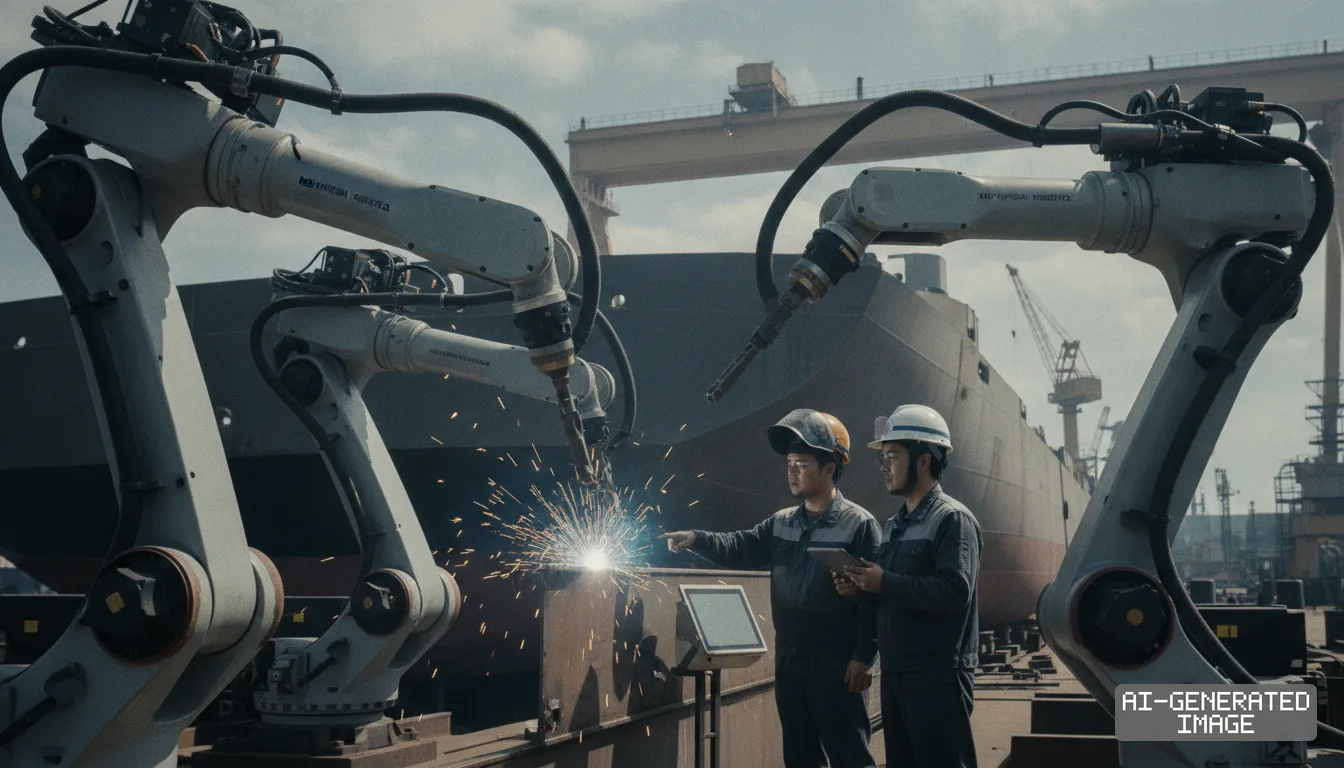
HD Hyundai accelerated its commercial campaign on Oct. 14, 2026, offering proprietary shipyard welding robots to U.S. shipbuilders to resolve labor bottlenecks across American naval and commercial construction yards.
The initiative channels automated tooling from Daegu-based HD Hyundai Robotics, which generated 263.0 billion won ($195 million) in revenue in 2025. The company is now marketing that field-tested machinery directly to North American shipyards.
U.S. shipbuilders face severe deficits of certified welding technicians, delaying surface combatant delivery schedules and submarine overhauls. Structural welding represents over 30% of total labor hours required to assemble complex military hull blocks.
The commercial rollout centers on two portable collaborative systems named ArcLift GO and ArcLift SLIDE. Both systems operate inside narrow double-hull compartments and panel blocks where conventional gantry welding machines cannot fit.
Shipyard personnel can reposition each mobile unit manually without overhead cranes. The design allows a single operator to manage several robotic arms at the same time, maintaining consistent weld beads across extended multi-pass joints.
Built-in arc sensors and touch-sensing software track joint geometry in real time. The software compensates for physical gaps between steel plates automatically, eliminating the need for manual torch adjustment on uneven structural members.
HD Hyundai is pairing the mobile units with ArcPak, an automated system for small structural sub-assemblies. The platform reads computer-aided design models to recognize structural parts before feeding precise torch coordinates to six-axis robotic manipulators.
ArcPak uses three-dimensional structured-light optical scanners to inspect cut steel members on assembly tables. The scanner detects physical thermal warpage and plate misalignments, regenerating torch motion paths to avoid defective joins before welding begins.
The South Korean manufacturer also developed ArcAdapt IQ, an artificial intelligence quality-control system. The software monitors weld pools through high-speed specialized cameras to evaluate molten metal penetration and seam consistency during active deposition.
When the system senses thermal fluctuations, ArcAdapt IQ adjusts electric current, voltage and torch speed within milliseconds. The automated adjustments prevent internal porosity while creating a verified digital record for military quality audits.
Huntington Ingalls Industries, America's largest military shipbuilder, is already testing HD Hyundai welding technology. HII launched a formal pilot program at its Ingalls Shipbuilding yard in Pascagoula, Mississippi, on Aug. 4, 2026.
Ingalls Shipbuilding builds Arleigh Burke-class destroyers and San Antonio-class amphibious transport docks for the U.S. Navy. The Mississippi facility employs roughly 11,000 workers and accounts for over half of HII's naval surface construction.
The Pascagoula pilot deploys mechanized welding cells across unit-fabrication halls that previously depended on manual stick and flux-cored welders. Ingalls verified that the robotic equipment satisfies baseline structural codes set by Naval Sea Systems Command.
Commercial offshore yards are adopting the robotic hardware alongside defense contractors. Edison Chouest Offshore signed a purchase contract on May 7, 2026, ordering ArcLift GO systems through U.S. subsidiary HD Hyundai Robotics USA.
The Chouest agreement deploys welding units across three North American shipyards, including fabrication sites in Louisiana, and one offshore yard in Brazil. The order represents HD Hyundai's first direct commercial robotics delivery to American shipyards.
Federal restrictions under the Merchant Marine Act of 1920, known as the Jones Act, restrict foreign-built hulls in coastal trade. Exporting automated machinery allows HD Hyundai to capture American market share without violating domestic construction statutes.
Four public naval shipyards in Norfolk, Portsmouth, Puget Sound and Pearl Harbor face multi-year submarine maintenance delays. U.S. defense officials estimate naval shipyards face a collective shortfall of several thousand skilled structural metalworkers.
HD Hyundai Heavy Industries and HD Hyundai Samho proved the machinery across commercial merchant vessel construction in South Korea. The shipbuilders assemble container vessels, oil tankers and liquefied natural gas carriers using identical automated welding platforms.
HD Hyundai Robotics manufactures the six-axis robot arms and electronic motion controllers at its headquarters in Daegu, South Korea. The unit designs its own servo software, enabling direct communication with third-party computer-aided manufacturing systems.
The company will conduct live welding demonstrations of ArcLift GO, ArcPak and ArcAdapt IQ at the FABTECH 2026 trade show running Oct. 21 to 23 in Las Vegas. Technical staff will present the hardware to American defense contractors.
Corporate releases and government filings do not confirm any direct supply contract signed Oct. 14 with U.S. Navy-owned public shipyards, nor has the naval service issued procurement purchase orders for state-run maintenance depots.
HD Hyundai continues to run robotic welding trials with private U.S. shipbuilders while pursuing formal qualification for naval overhaul contracts.
Impact map
How this development propagates across the region and out to global buyers.
| Event | Korea | China | Japan | Global impact |
|---|---|---|---|---|
| Shipyard welding automation | HD Hyundai monetizes yard robotics in the U.S. without Jones Act constraints | CSSC expands domestic automated yards, shut out of U.S. naval supply chains | Mitsubishi Heavy Industries runs domestic robotic lines with no U.S. yard deployment | U.S. naval builders cut multi-pass welding hours to clear surface vessel delivery backlogs |
In this story
- Companies
- HD HyundaiHD Hyundai Robotics
- Tickers
- 267250.KS
- Exposed
- Huntington Ingalls IndustriesEdison Chouest Offshore
- Policy
- Economic Security
- Impact
- Order BookSupply ChainCapex
Track every Economic Security development →
Related briefings
- HD Hyundai Robotics backs sensor maker AIDIN in $12M round Also on HD Hyundai Robotics, Order Book
- HD Hyundai deploys physical AI in Ulsan shipyard automation Also on HD Hyundai Robotics, Order Book
- HD Hyundai names Lee Sang-kyun head of group shipbuilding units Also on HD Hyundai, Order Book
- HD Hyundai Heavy launches 8,200-ton Aegis destroyer in Ulsan Also on HD Hyundai, Order Book
Sources
Reporting
Confidence: medium — how we grade this
The documents behind this briefing are linked above. East Asia Brief produces its English text with AI assistance under human editorial review, and does not translate or republish other outlets' articles. See our methodology and AI policy. Spotted an error? Tell us.
The Morning Brief
What changed in Korean, Chinese and Japanese industry overnight — and what it means for your supply chain. One email, weekday mornings, US time. Free.
The Morning Brief is in preparation. Leave your address and we will write to you once — when the first issue is ready. Nothing before that.